The big idea
A limit asks what value f(x) gets close to as x gets close to a number, not what happens exactly at that number. If plugging in gives a normal number, that is the limit. If it gives 0/0, the expression is hiding the answer, and algebra will uncover it.
Key ideas
- Try direct substitution first. A normal number is the answer.
- 0/0 means "do more work": factor and cancel, multiply by a conjugate, or combine fractions.
- A two-sided limit exists only if the left-hand and right-hand limits agree.
- As x → ∞ for a ratio of polynomials, compare the highest powers: same degree gives the ratio of leading coefficients, a bigger bottom gives 0.
- Two limits to know by heart: sin x / x → 1 and (1 − cos x)/x → 0 as x → 0 (x in radians).
Equations
| lim [f(x) ± g(x)] = lim f ± lim g | limits add, subtract, multiply and divide (if the bottom limit is not 0) |
| limx→0 (sin x)/x = 1 | key trig limit |
| limx→0 (1 − cos x)/x = 0 | second trig limit |
| limx→∞ 1/xn = 0 | for any n > 0 |
Worked questions: easy, medium, hard
Three questions that climb in difficulty, each solved one step at a time. Try each one before you read the steps.
Find limx→3 (x2 − 9)/(x − 3).
- Substituting x = 3 gives 0/0, so factor the top: x2 − 9 = (x − 3)(x + 3).
- Cancel the common factor (allowed because x ≠ 3 in a limit): the expression becomes x + 3.
- Now substitute: 3 + 3 = 6.
Find limx→0 (√(x + 4) − 2)/x.
- Substituting gives 0/0. There is a square root, so multiply top and bottom by the conjugate √(x + 4) + 2.
- Top: (√(x + 4))2 − 22 = x + 4 − 4 = x.
- The expression is x / [x(√(x + 4) + 2)] = 1/(√(x + 4) + 2).
- Substitute x = 0: 1/(2 + 2) = 1/4.
Find limx→∞ (√(4x2 + 3x) − 2x).
- This is ∞ − ∞, which tells us nothing yet. Multiply and divide by the conjugate √(4x2 + 3x) + 2x.
- Top: (4x2 + 3x) − 4x2 = 3x.
- So the expression is 3x / (√(4x2 + 3x) + 2x). Divide top and bottom by x (for x > 0, x = √(x2)): 3 / (√(4 + 3/x) + 2).
- As x → ∞, 3/x → 0, giving 3/(2 + 2) = 3/4.
Common mistakes
- Stopping at 0/0 and writing "does not exist". 0/0 means keep going.
- Cancelling a factor and then forgetting to substitute.
- Using sin x / x → 1 with x in degrees. It only works in radians.
Now you try: easy to hard
Six more questions, two at each level. These are the questions on the worksheet; each solution opens when you are ready.
Easy 1. Find limx→2 (3x2 − 4x + 1).
Show the step-by-step solution
A polynomial is continuous, so substitute: 3(4) − 4(2) + 1 = 12 − 8 + 1 = 5.
Easy 2. Find limx→−1 (x2 + 3x + 2)/(x + 1).
Show the step-by-step solution
Substituting gives 0/0. Factor: (x + 1)(x + 2)/(x + 1) = x + 2. Substitute x = −1: 1.
Medium 3. Find limx→0 sin(3x)/(4x).
Show the step-by-step solution
Rewrite as (3/4) · sin(3x)/(3x). As x → 0, sin(3x)/(3x) → 1, so the limit is 3/4.
Medium 4. Find limx→∞ (5x3 − 2x)/(2x3 + 7).
Show the step-by-step solution
Divide top and bottom by x3: (5 − 2/x2)/(2 + 7/x3). The small terms go to 0, leaving 5/2.
Hard 5. Find limx→1 (1/x − 1)/(x − 1).
Show the step-by-step solution
Combine the top: 1/x − 1 = (1 − x)/x. Then (1 − x)/[x(x − 1)] = −1/x. Substitute x = 1: −1.
Hard 6. Find limx→0 (1 − cos x)/x2.
Show the step-by-step solution
Multiply top and bottom by (1 + cos x): the top becomes 1 − cos2 x = sin2 x. So the expression is (sin x / x)2 · 1/(1 + cos x). As x → 0 this is 12 · 1/2 = 1/2.
6 questions to print or save, with full step-by-step answers at the end.
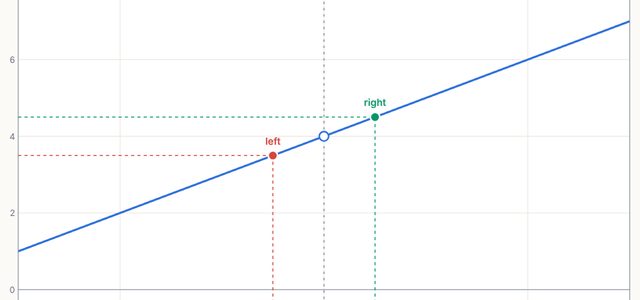
Open the Limits Explorer simulation and test every idea on this page yourself.
Open the simulation →