The big idea
A rational function is a fraction with polynomials on the top and bottom. Its graph is shaped by the places where the bottom is zero and by what happens far from the origin. Lines that the graph approaches but never reaches are called asymptotes.
Key ideas
- Factorise the top and bottom first.
- A factor that cancels gives a hole. A factor left in the bottom gives a vertical asymptote.
- Horizontal asymptote: compare degrees. Bottom higher gives y = 0; equal gives the ratio of leading coefficients.
- If the top is exactly one degree higher, divide to find a slant asymptote.
- To solve a rational equation, multiply through by the denominators, then check for values that make a denominator zero.
Equations
| denominator = 0 (not cancelled) ⇒ vertical asymptote | vertical |
| equal degrees ⇒ y = a/b (leading coefficients) | horizontal |
| top = (bottom)(quotient) + remainder ⇒ y = quotient | slant asymptote |
| a/b = c/d ⇒ ad = bc | cross-multiplying |
Worked questions: easy, medium, hard
Three questions that climb in difficulty, each solved one step at a time. Try each one before you read the steps.
Find the asymptotes and y-intercept of y = 1/(x − 2).
- The bottom is zero at x = 2: vertical asymptote x = 2.
- The bottom has the higher degree: horizontal asymptote y = 0.
- At x = 0, y = −1/2.
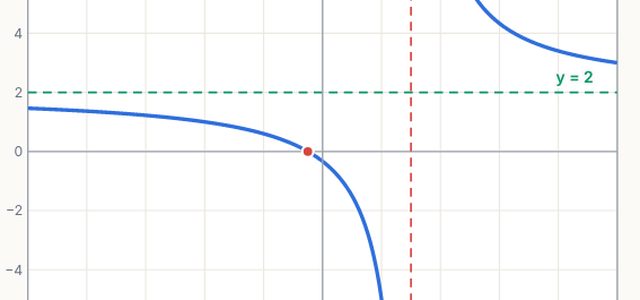
Find the asymptotes and intercepts of y = (2x + 1)/(x − 3).
- Vertical asymptote where x − 3 = 0: x = 3.
- Equal degrees: horizontal asymptote y = 2/1 = 2.
- x-intercept where the top is zero: x = −1/2.
- y-intercept at x = 0: y = −1/3.
Describe the graph of y = (x2 − 4)/(x2 − x − 2).
- Factorise: (x − 2)(x + 2)/[(x − 2)(x + 1)].
- (x − 2) cancels, so there is a hole at x = 2. The simplified function (x + 2)/(x + 1) gives y = 4/3 there.
- (x + 1) stays in the bottom: vertical asymptote x = −1.
- Equal degrees: horizontal asymptote y = 1.
Common mistakes
- Calling every zero of the denominator a vertical asymptote.
- Keeping a solution of a rational equation that makes a denominator zero.
- Saying a graph can never cross a horizontal asymptote. It can, away from the far ends.
Now you try: easy to hard
Six more questions, two at each level. These are the questions on the worksheet; each solution opens when you are ready.
Easy 1. State the domain of f(x) = 3/(x + 5).
Show the step-by-step solution
The bottom cannot be zero: all real x except x = −5.
Easy 2. Find the asymptotes of y = (3x2 + 1)/(x2 − 4).
Show the step-by-step solution
Vertical: x = 2 and x = −2. Horizontal: y = 3.
Medium 3. Simplify (x2 − 9)/(x − 3) and describe its graph.
Show the step-by-step solution
(x − 3)(x + 3)/(x − 3) = x + 3. The graph is the line y = x + 3 with a hole at (3, 6).
Medium 4. Solve 2/(x − 1) = 3/(x + 2).
Show the step-by-step solution
Cross-multiply: 2(x + 2) = 3(x − 1), so 2x + 4 = 3x − 3 and x = 7.
Hard 5. Solve (x + 1)/(x − 2) > 0.
Show the step-by-step solution
The sign changes at x = −1 and x = 2. Test: both factors have the same sign when x < −1 or x > 2.
Hard 6. Find the slant asymptote of y = (x2 + 1)/(x − 1).
Show the step-by-step solution
Divide: x2 + 1 = (x − 1)(x + 1) + 2, so y = x + 1 + 2/(x − 1). The slant asymptote is y = x + 1.
6 questions to print or save, with full step-by-step answers at the end.
Open the Pre-Calculus Lab simulation and test every idea on this page yourself.
Open the simulation →