The big idea
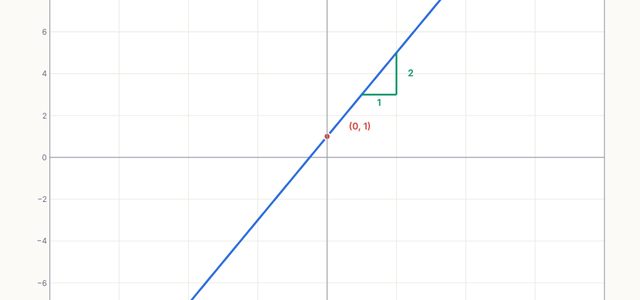
Every straight line can be written as y = mx + c. The number m is the gradient (how steep the line is) and c is where it crosses the y-axis. Parallel lines share a gradient, and perpendicular gradients multiply to −1.
Key ideas
- Gradient = change in y ÷ change in x.
- To find the equation through two points, find m first, then substitute one point to get c.
- Parallel lines have equal gradients. Perpendicular lines have gradients that multiply to −1.
- Midpoint: average the coordinates. Length: Pythagoras on the differences.
Equations
| y = mx + c | gradient m, y-intercept c |
| m = (y2 − y1)/(x2 − x1) | gradient |
| m1 × m2 = −1 | perpendicular lines |
| d = √((x2 − x1)2 + (y2 − y1)2) | distance |
Worked questions: easy, medium, hard
Three questions that climb in difficulty, each solved one step at a time. Try each one before you read the steps.
Write down the gradient and y-intercept of y = 3x − 2.
- Compare with y = mx + c.
- m = 3, so the gradient is 3.
- c = −2, so the line crosses the y-axis at (0, −2).
Find the equation of the line through (1, 2) and (4, 11).
- Gradient: (11 − 2)/(4 − 1) = 3.
- y = 3x + c. Substitute (1, 2): 2 = 3 + c, so c = −1.
- y = 3x − 1. Check with (4, 11): 12 − 1 = 11.
Find the line perpendicular to y = 2x + 1 that passes through (4, 3), and the point where the two lines meet.
- The perpendicular gradient is −1/2.
- y = −x/2 + c. Substitute (4, 3): 3 = −2 + c, so c = 5: y = −x/2 + 5.
- Meet where 2x + 1 = −x/2 + 5, so 2.5x = 4 and x = 1.6.
- y = 2(1.6) + 1 = 4.2. They meet at (1.6, 4.2).
Common mistakes
- Working out gradient as change in x over change in y.
- Reading the gradient of 2x + 3y = 12 as 2. Rearrange to y = … first.
- Using the same gradient for a perpendicular line.
Now you try: easy to hard
Six more questions, two at each level. These are the questions on the worksheet; each solution opens when you are ready.
Easy 1. Find the gradient of the line through (0, 1) and (2, 7).
Show the step-by-step solution
(7 − 1)/(2 − 0) = 3.
Easy 2. Does the point (3, 5) lie on y = 2x − 1?
Show the step-by-step solution
2(3) − 1 = 5. Yes.
Medium 3. Find the gradient and y-intercept of 2x + 3y = 12.
Show the step-by-step solution
Rearrange: 3y = −2x + 12, y = −(2/3)x + 4. Gradient −2/3, intercept 4.
Medium 4. Find the line parallel to y = 4x − 3 through (2, 1).
Show the step-by-step solution
Same gradient 4: 1 = 8 + c, so c = −7. y = 4x − 7.
Hard 5. Find the midpoint and length of the line joining (1, 2) and (7, 10).
Show the step-by-step solution
Midpoint: (4, 6). Length: √(62 + 82) = √100 = 10.
Hard 6. Find the perpendicular bisector of the line joining (0, 0) and (4, 2).
Show the step-by-step solution
Midpoint (2, 1). Gradient of the line is 1/2, so the perpendicular gradient is −2. 1 = −4 + c gives c = 5. y = −2x + 5.
6 questions to print or save, with full step-by-step answers at the end.
Open the Function Graphs simulation and test every idea on this page yourself.
Open the simulation →