The big idea
Solving an equation means finding the value that makes it true. Keep it balanced: whatever you do to one side, do to the other. Inequalities are solved the same way, with one extra rule: multiplying or dividing by a negative number reverses the sign.
Key ideas
- Expand brackets first, then collect the unknown on one side.
- Clear fractions by multiplying every term by the common denominator.
- Check by substituting your answer into the original equation.
- When you multiply or divide an inequality by a negative number, reverse the inequality sign.
Equations
| ax + b = c ⇒ x = (c − b)/a | linear equation |
| a < x ≤ b | x is between a and b, including b |
| −x < a ⇒ x > −a | reversing the sign |
| perimeter, angle or cost facts ⇒ equation | forming equations |
Worked questions: easy, medium, hard
Three questions that climb in difficulty, each solved one step at a time. Try each one before you read the steps.
Solve 3x + 7 = 22.
- Subtract 7 from both sides: 3x = 15.
- Divide by 3: x = 5.
- Check: 3(5) + 7 = 22.
Solve 5(x − 2) = 2x + 11.
- Expand: 5x − 10 = 2x + 11.
- Subtract 2x: 3x − 10 = 11.
- Add 10: 3x = 21, so x = 7.
Solve (x + 2)/3 + (x − 1)/2 = 6.
- Multiply every term by 6: 2(x + 2) + 3(x − 1) = 36.
- Expand: 2x + 4 + 3x − 3 = 36.
- Simplify: 5x + 1 = 36.
- 5x = 35, so x = 7. Check: 9/3 + 6/2 = 3 + 3 = 6.
Common mistakes
- Multiplying only some terms when clearing fractions.
- Forgetting to reverse the inequality when dividing by a negative.
- Sign errors when expanding a bracket with a minus in front.
Now you try: easy to hard
Six more questions, two at each level. These are the questions on the worksheet; each solution opens when you are ready.
Easy 1. Solve x/4 − 3 = 2.
Show the step-by-step solution
Add 3: x/4 = 5. Multiply by 4: x = 20.
Easy 2. Solve 7 − 2x = 15.
Show the step-by-step solution
Subtract 7: −2x = 8. Divide by −2: x = −4.
Medium 3. Solve 4x + 3 > 19.
Show the step-by-step solution
4x > 16, so x > 4.
Medium 4. A rectangle is 3 cm longer than it is wide and has perimeter 38 cm. Find its dimensions.
Show the step-by-step solution
Width w, length w + 3. 2(w + w + 3) = 38, so 4w + 6 = 38 and w = 8. 8 cm by 11 cm.
Hard 5. List the integers that satisfy −3 < 2x + 1 ≤ 9.
Show the step-by-step solution
Subtract 1: −4 < 2x ≤ 8. Divide by 2: −2 < x ≤ 4. Integers: −1, 0, 1, 2, 3, 4.
Hard 6. Solve 5 − 3x ≤ 2(x + 10).
Show the step-by-step solution
5 − 3x ≤ 2x + 20. Subtract 2x and 5: −5x ≤ 15. Divide by −5 and reverse the sign: x ≥ −3.
6 questions to print or save, with full step-by-step answers at the end.
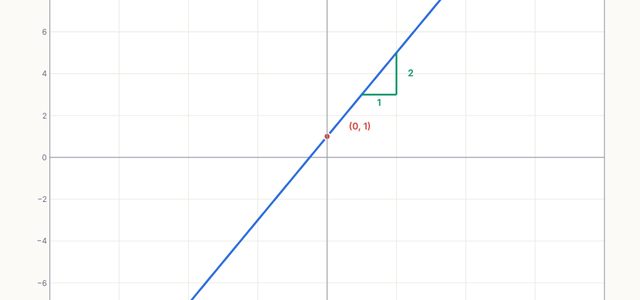
Open the Function Graphs simulation and test every idea on this page yourself.
Open the simulation →