The big idea
A probability is a number from 0 (impossible) to 1 (certain). For combined events, multiply along the branches of a tree diagram ("and") and add between branches ("or"). Without replacement, the second set of probabilities changes.
Key ideas
- P(event) = favourable outcomes ÷ total outcomes, when outcomes are equally likely.
- P(not A) = 1 − P(A).
- Independent events: P(A and B) = P(A) × P(B). Mutually exclusive events: P(A or B) = P(A) + P(B).
- "At least one" is usually easiest as 1 − P(none).
- Conditional probability changes the total you divide by.
Equations
| P(A′) = 1 − P(A) | complement |
| P(A and B) = P(A) × P(B) | independent events |
| P(A or B) = P(A) + P(B) − P(A and B) | addition rule |
| P(B given A) = P(A and B)/P(A) | conditional probability |
Worked questions: easy, medium, hard
Three questions that climb in difficulty, each solved one step at a time. Try each one before you read the steps.
A bag holds 3 red and 5 blue counters. One is picked at random. Find P(red) and P(not red).
- There are 8 counters, 3 of them red.
- P(red) = 3/8.
- P(not red) = 1 − 3/8 = 5/8.
A spinner lands on red with probability 0.3. It is spun twice. Find the probability of two reds and of at least one red.
- The spins are independent: P(red, red) = 0.3 × 0.3 = 0.09.
- P(no red) = 0.7 × 0.7 = 0.49.
- P(at least one red) = 1 − 0.49 = 0.51.
A bag holds 4 red and 6 blue counters. Two are taken without replacement. Find the probability that they are the same colour.
- Both red: 4/10 × 3/9 = 12/90.
- Both blue: 6/10 × 5/9 = 30/90.
- Add the two branches: 42/90.
- Simplify: 7/15.
Common mistakes
- Adding probabilities along a branch instead of multiplying.
- Keeping the same denominator when items are not replaced.
- Giving a probability greater than 1.
Now you try: easy to hard
Six more questions, two at each level. These are the questions on the worksheet; each solution opens when you are ready.
Easy 1. A fair die is rolled. Find the probability of a prime number.
Show the step-by-step solution
Primes: 2, 3, 5. 3/6 = 1/2.
Easy 2. The probability of rain on any day is 0.35. How many rainy days would you expect in 20 days?
Show the step-by-step solution
0.35 × 20 = 7.
Medium 3. Two fair dice are rolled. Find the probability that the total is 7.
Show the step-by-step solution
6 of the 36 outcomes total 7: 6/36 = 1/6.
Medium 4. Of 30 students, 18 study French, 15 study Spanish and 8 study both. Find the probability that a student chosen at random studies neither, and that they study French only.
Show the step-by-step solution
French or Spanish: 18 + 15 − 8 = 25. Neither: 5, so 5/30 = 1/6. French only: 10, so 10/30 = 1/3.
Hard 5. For the same students, a French student is chosen at random. Find the probability that they also study Spanish.
Show the step-by-step solution
Out of 18 French students, 8 also study Spanish: 8/18 = 4/9.
Hard 6. A bag holds 5 red and 3 green sweets. Three are taken without replacement. Find the probability that all are red, and that at least one is green.
Show the step-by-step solution
All red: 5/8 × 4/7 × 3/6 = 60/336 = 5/28. At least one green: 1 − 5/28 = 23/28.
6 questions to print or save, with full step-by-step answers at the end.
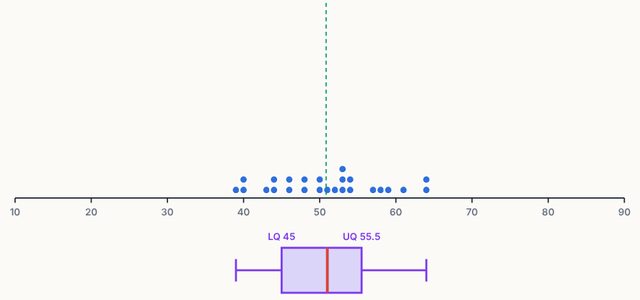
Open the Statistics & Probability Lab simulation and test every idea on this page yourself.
Open the simulation →