The big idea
A parametric curve gives x and y separately as functions of a third variable t, often time. This describes motion in a plane naturally: the position is a vector (x(t), y(t)), its derivative is the velocity vector, and the length of that vector is the speed.
Key ideas
- Slope: dy/dx = (dy/dt)/(dx/dt).
- Horizontal tangent where dy/dt = 0 (and dx/dt ≠ 0); vertical tangent where dx/dt = 0 (and dy/dt ≠ 0).
- Second derivative: differentiate dy/dx with respect to t, then divide by dx/dt again.
- Velocity vector (x′, y′), acceleration vector (x″, y″), speed √(x′2 + y′2).
- Distance travelled (arc length) is the integral of the speed.
Equations
| dy/dx = (dy/dt)/(dx/dt) | slope |
| d2y/dx2 = [d/dt (dy/dx)]/(dx/dt) | second derivative |
| speed = √((dx/dt)2 + (dy/dt)2) | magnitude of velocity |
| L = ∫ab √((dx/dt)2 + (dy/dt)2) dt | distance travelled |
Worked questions: easy, medium, hard
Three questions that climb in difficulty, each solved one step at a time. Try each one before you read the steps.
For x = 2t, y = t2, find the slope at t = 3 and the Cartesian equation.
- dx/dt = 2 and dy/dt = 2t, so dy/dx = 2t/2 = t.
- At t = 3 the slope is 3.
- Eliminate t: t = x/2, so y = x2/4.
For x = t2, y = t3 − 3t, find the points where the tangent is horizontal or vertical.
- dx/dt = 2t and dy/dt = 3t2 − 3.
- Horizontal: dy/dt = 0 at t = ±1 (dx/dt ≠ 0). Points: t = 1 gives (1, −2); t = −1 gives (1, 2).
- Vertical: dx/dt = 0 at t = 0 (dy/dt = −3 ≠ 0). Point: (0, 0).
A particle has position (t2, t3) for t ≥ 0. Find its speed at t = 1 and the distance it travels from t = 0 to t = 1.
- Velocity: (2t, 3t2). At t = 1: (2, 3), so speed = √(4 + 9) = √13 ≈ 3.61.
- Distance = ∫01 √(4t2 + 9t4) dt = ∫01 t√(4 + 9t2) dt.
- Let u = 4 + 9t2, du = 18t dt: (1/18)(2/3)[u3/2] from 4 to 13 = (1/27)(133/2 − 8).
- Distance ≈ (46.87 − 8)/27 = 1.44.
Common mistakes
- Writing dy/dx as (dx/dt)/(dy/dt), upside down.
- Finding the second derivative by differentiating dy/dx with respect to t and stopping. You must divide by dx/dt.
- Confusing speed (a number) with velocity (a vector).
Now you try: easy to hard
Six more questions, two at each level. These are the questions on the worksheet; each solution opens when you are ready.
Easy 1. Describe the curve x = 3 cos t, y = 3 sin t and find the point at t = π/2.
Show the step-by-step solution
x2 + y2 = 9: a circle of radius 3, traced anticlockwise. At t = π/2 the point is (0, 3).
Easy 2. For x = t + 1, y = t2 − 1, find dy/dx at t = 2.
Show the step-by-step solution
dy/dt = 2t, dx/dt = 1, so dy/dx = 2t = 4.
Medium 3. For x = t2, y = t3, find d2y/dx2.
Show the step-by-step solution
dy/dx = 3t2/(2t) = 3t/2. Differentiate with respect to t: 3/2. Divide by dx/dt = 2t: 3/(4t).
Medium 4. A particle has position (t3, t2). Find its speed and acceleration vector at t = 2.
Show the step-by-step solution
Velocity (3t2, 2t) = (12, 4), so speed = √(144 + 16) = √160 ≈ 12.65. Acceleration (6t, 2) = (12, 2).
Hard 5. Find the length of the spiral x = et cos t, y = et sin t from t = 0 to t = 1.
Show the step-by-step solution
x′ = et(cos t − sin t), y′ = et(sin t + cos t). x′2 + y′2 = 2e2t, so speed = √2 et. L = √2(e − 1) ≈ 2.43.
Hard 6. A particle starts at (1, 0) with velocity (2t − 4, 3t2). Find its position at t = 2 and describe its motion at that instant.
Show the step-by-step solution
x = 1 + ∫02 (2t − 4) dt = 1 + (4 − 8) = −3. y = 0 + ∫02 3t2 dt = 8. Position (−3, 8). At t = 2 the velocity is (0, 12): it is moving straight up, so the path has a vertical tangent.
6 questions to print or save, with full step-by-step answers at the end.
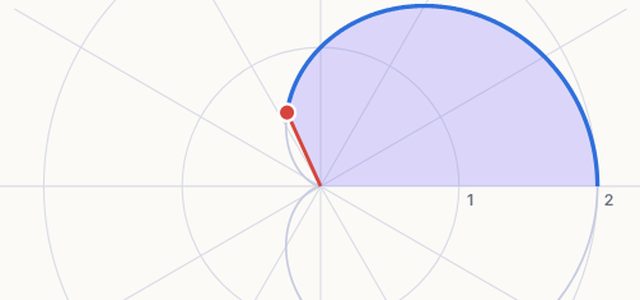
Open the Polar & Parametric Curves simulation and test every idea on this page yourself.
Open the simulation →