The big idea
A small set of angle facts solves almost every angle problem: angles on a line, round a point, in a triangle, and the pairs made when a line crosses parallel lines. For polygons, the exterior angles always add up to 360°.
Key ideas
- Angles on a straight line add to 180°, round a point to 360°, and in a triangle to 180°.
- With parallel lines: alternate angles are equal, corresponding angles are equal, and co-interior angles add to 180°.
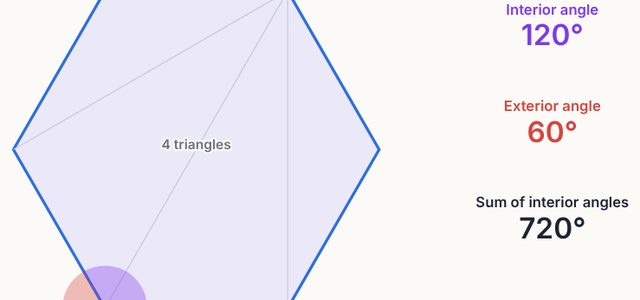
- The interior angles of an n-sided polygon add to (n − 2) × 180°.
- The exterior angles of any polygon add to 360°, so each exterior angle of a regular polygon is 360°/n.
- Always give a reason for each step.
Equations
| sum of interior angles = (n − 2) × 180° | n-sided polygon |
| exterior angle = 360°/n | regular polygon |
| interior + exterior = 180° | at each vertex |
| co-interior angles add to 180° | parallel lines |
Worked questions: easy, medium, hard
Three questions that climb in difficulty, each solved one step at a time. Try each one before you read the steps.
Two angles of a triangle are 50° and 60°. Find the third.
- Angles in a triangle add to 180°.
- 180 − 50 − 60 = 70°.
- Check: 50 + 60 + 70 = 180.
Find the sum of the interior angles of an octagon and the size of each interior angle of a regular octagon.
- Sum = (8 − 2) × 180 = 1080°.
- Regular means all angles equal: 1080 ÷ 8 = 135°.
- Check with exterior angles: 360 ÷ 8 = 45, and 180 − 45 = 135.
Each interior angle of a regular polygon is 156°. How many sides does it have?
- Exterior angle = 180 − 156 = 24°.
- Exterior angles add to 360°, so n = 360 ÷ 24.
- n = 15 sides.
- Check: (15 − 2) × 180 ÷ 15 = 156.
Common mistakes
- Using 360° for the angle sum of every polygon.
- Mixing up alternate and co-interior angles.
- Dividing the interior sum by n for a polygon that is not regular.
Now you try: easy to hard
Six more questions, two at each level. These are the questions on the worksheet; each solution opens when you are ready.
Easy 1. Two angles on a straight line are x and 115°. Find x.
Show the step-by-step solution
180 − 115 = 65°.
Easy 2. An isosceles triangle has an angle of 40° between its equal sides. Find the other angles.
Show the step-by-step solution
(180 − 40) ÷ 2 = 70° each.
Medium 3. Find the sum of the interior angles of a hexagon.
Show the step-by-step solution
(6 − 2) × 180 = 720°.
Medium 4. Co-interior angles between parallel lines are (3x + 10)° and (2x + 20)°. Find x and both angles.
Show the step-by-step solution
3x + 10 + 2x + 20 = 180, so 5x = 150 and x = 30. Angles 100° and 80°.
Hard 5. The exterior angle of a regular polygon is 20°. How many sides?
Show the step-by-step solution
360 ÷ 20 = 18 sides.
Hard 6. The angles of a pentagon are x, x + 20, 2x, 2x − 10 and 110 (in degrees). Find the largest angle.
Show the step-by-step solution
Sum = 540: 6x + 120 = 540, so x = 70. Angles 70, 90, 140, 130, 110. Largest: 140°.
6 questions to print or save, with full step-by-step answers at the end.
Open the Geometry Lab simulation and test every idea on this page yourself.
Open the simulation →