The big idea
When a limit of a fraction gives 0/0 or ∞/∞, L'Hôpital's rule says you may differentiate the top and the bottom separately and try the limit again. It is not the quotient rule, and it only applies to those two forms.
Key ideas
- Check the form first. The rule needs 0/0 or ∞/∞.
- Differentiate the top and the bottom separately, then take the limit again. Repeat if it is still indeterminate.
- For 0 · ∞, rewrite the product as a fraction.
- For 1∞, 00 or ∞0, take the natural log, find that limit, then exponentiate.
Equations
| lim f/g = lim f′/g′ | when the form is 0/0 or ∞/∞ |
| 0 · ∞ → rewrite as f/(1/g) | product form |
| y = fg ⇒ ln y = g ln f | power forms |
| limx→∞ (1 + a/x)x = ea | a result worth knowing |
Worked questions: easy, medium, hard
Three questions that climb in difficulty, each solved one step at a time. Try each one before you read the steps.
Find limx→0 (ex − 1)/x.
- Check: e0 − 1 = 0 and the bottom is 0, so the form is 0/0.
- Differentiate top and bottom separately: ex / 1.
- Substitute x = 0: e0 = 1.
Find limx→∞ x2/ex.
- The form is ∞/∞. Apply the rule: 2x/ex, which is still ∞/∞.
- Apply it again: 2/ex.
- As x → ∞, ex → ∞, so the limit is 0.
Find limx→∞ (1 + 2/x)x.
- The form is 1∞. Let y = (1 + 2/x)x, so ln y = x ln(1 + 2/x) = ln(1 + 2/x)/(1/x), which is 0/0.
- L'Hôpital: top derivative is (−2/x2)/(1 + 2/x), bottom derivative is −1/x2.
- The ratio simplifies to 2/(1 + 2/x) → 2.
- So ln y → 2 and y → e2 ≈ 7.39.
Common mistakes
- Using the rule when the form is not 0/0 or ∞/∞. For example limx→0 (x + 1)/(x + 2) is simply 1/2.
- Using the quotient rule instead of differentiating top and bottom separately.
- Forgetting to exponentiate at the end of a 1∞ problem.
Now you try: easy to hard
Six more questions, two at each level. These are the questions on the worksheet; each solution opens when you are ready.
Easy 1. Use L'Hôpital's rule to find limx→2 (x2 − 4)/(x − 2).
Show the step-by-step solution
0/0. Differentiate: 2x/1 → 4 (the same answer as factoring).
Easy 2. Find limx→0 sin(4x)/sin(3x).
Show the step-by-step solution
0/0. Differentiate: 4 cos 4x/(3 cos 3x) → 4/3.
Medium 3. Find limx→0 (1 − cos x)/x2.
Show the step-by-step solution
0/0. First pass: sin x/(2x), still 0/0. Second pass: cos x/2 → 1/2.
Medium 4. Find limx→∞ (ln x)/√x.
Show the step-by-step solution
∞/∞. Differentiate: (1/x)/(1/(2√x)) = 2/√x → 0. Logs grow more slowly than any root.
Hard 5. Find limx→0⁺ x ln x.
Show the step-by-step solution
Form 0 · (−∞). Rewrite as ln x/(1/x), which is ∞/∞. Differentiate: (1/x)/(−1/x2) = −x → 0.
Hard 6. Find limx→0 (ex − 1 − x)/x2.
Show the step-by-step solution
0/0. First pass: (ex − 1)/(2x), still 0/0. Second pass: ex/2 → 1/2.
6 questions to print or save, with full step-by-step answers at the end.
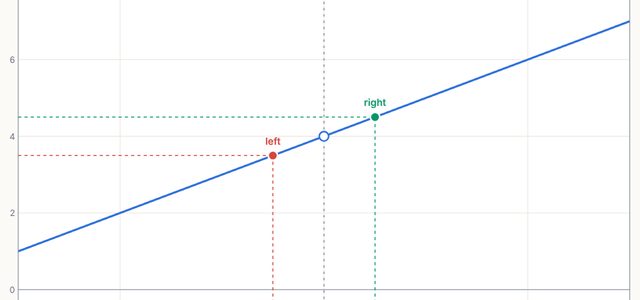
Open the Limits Explorer simulation and test every idea on this page yourself.
Open the simulation →