The big idea
A balloon inflates, a ladder slides, water fills a cone. In each case quantities are connected by a geometric equation. Differentiate that equation with respect to time and you get a connection between the rates.
Key ideas
- Draw the picture and name the changing quantities with letters.
- Write one equation linking them (Pythagoras, an area or volume formula, similar triangles, trigonometry).
- Differentiate both sides with respect to t. Every variable gets a d/dt factor.
- Substitute the numbers only after differentiating.
- A shrinking quantity has a negative rate.
Equations
| A = πr2 ⇒ dA/dt = 2πr · dr/dt | circle |
| V = (4/3)πr3 ⇒ dV/dt = 4πr2 · dr/dt | sphere |
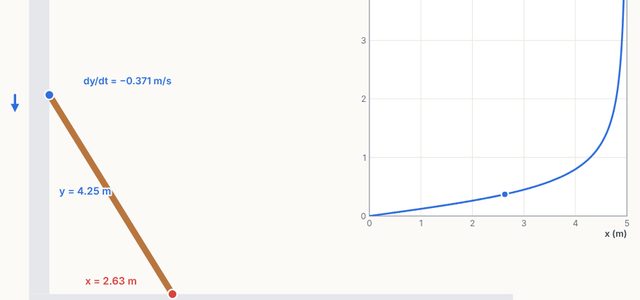
| x2 + y2 = L2 ⇒ x · dx/dt + y · dy/dt = 0 | ladder (L constant) |
| V = (1/3)πr2h | cone: use similar triangles to remove r |
Worked questions: easy, medium, hard
Three questions that climb in difficulty, each solved one step at a time. Try each one before you read the steps.
The radius of a circular ripple grows at 2 cm/s. How fast is its area growing when the radius is 5 cm?
- Link: A = πr2.
- Differentiate with respect to t: dA/dt = 2πr · dr/dt.
- Substitute r = 5 and dr/dt = 2: dA/dt = 2π(5)(2) = 20π ≈ 62.8 cm²/s.
A 5 m ladder leans against a wall. Its foot slides away from the wall at 0.6 m/s. How fast is the top moving when the foot is 3 m from the wall?
- Let x be the foot's distance from the wall and y the height of the top: x2 + y2 = 25.
- Differentiate: 2x · dx/dt + 2y · dy/dt = 0.
- When x = 3, y = √(25 − 9) = 4.
- Substitute: 3(0.6) + 4 · dy/dt = 0, so dy/dt = −0.45 m/s.
A conical tank (point down) has radius 2 m at the top and height 4 m. Water flows in at 3 m³/min. How fast is the water level rising when the water is 2 m deep?
- Similar triangles: r/h = 2/4, so r = h/2.
- Volume of water: V = (1/3)πr2h = (1/3)π(h/2)2h = πh3/12.
- Differentiate: dV/dt = (πh2/4) · dh/dt.
- Substitute dV/dt = 3 and h = 2: 3 = (π · 4/4) · dh/dt, so dh/dt = 3/π ≈ 0.955 m/min.
Common mistakes
- Substituting the "snapshot" numbers before differentiating, which turns variables into constants.
- Leaving two variables in a cone problem. Use similar triangles to remove one first.
- Dropping the minus sign for a quantity that is decreasing.
Now you try: easy to hard
Six more questions, two at each level. These are the questions on the worksheet; each solution opens when you are ready.
Easy 1. The side of a cube grows at 0.5 cm/s. How fast is its volume growing when the side is 4 cm?
Show the step-by-step solution
V = s3, so dV/dt = 3s2 · ds/dt = 3(16)(0.5) = 24 cm³/s.
Easy 2. A spherical balloon is inflated at 100 cm³/s. How fast is the radius growing when r = 5 cm?
Show the step-by-step solution
dV/dt = 4πr2 · dr/dt. So 100 = 4π(25) · dr/dt and dr/dt = 1/π ≈ 0.318 cm/s.
Medium 3. Car A is 30 km east of a junction driving east at 60 km/h. Car B is 40 km north of it driving north at 80 km/h. How fast is the distance between them growing?
Show the step-by-step solution
D2 = x2 + y2, so D · dD/dt = x · dx/dt + y · dy/dt. D = 50. dD/dt = (30 · 60 + 40 · 80)/50 = 5000/50 = 100 km/h.
Medium 4. A 1.8 m tall person walks away from a 6 m lamp post at 1.2 m/s. How fast is their shadow lengthening?
Show the step-by-step solution
Let x = distance from the post and s = shadow length. Similar triangles: s/1.8 = (x + s)/6, so 6s = 1.8x + 1.8s and s = (3/7)x. Then ds/dt = (3/7)(1.2) ≈ 0.514 m/s.
Hard 5. A balloon rises vertically at 3 m/s from a point 40 m from an observer. How fast is the angle of elevation increasing when the balloon is 30 m high?
Show the step-by-step solution
tan θ = h/40. Differentiate: sec2 θ · dθ/dt = (1/40) · dh/dt. At h = 30, tan θ = 0.75, so sec2 θ = 1 + 0.5625 = 1.5625. dθ/dt = (3/40)/1.5625 = 0.048 rad/s.
Hard 6. A point moves along y = x2 with dx/dt = 3 units/s. How fast is its distance from the origin changing when x = 1?
Show the step-by-step solution
D2 = x2 + y2 = x2 + x4. Differentiate: 2D · dD/dt = (2x + 4x3) · dx/dt. At x = 1: D = √2, so 2√2 · dD/dt = 6 · 3 = 18 and dD/dt = 9/√2 ≈ 6.36 units/s.
6 questions to print or save, with full step-by-step answers at the end.
Open the Related Rates simulation and test every idea on this page yourself.
Open the simulation →