The big idea
If s(t) is the position of a particle on a line, its derivative is the velocity and the derivative of velocity is the acceleration. The signs of v and a tell you which way the particle moves and whether it is speeding up.
Key ideas
- v(t) = s′(t) and a(t) = v′(t) = s″(t).
- The particle is at rest when v = 0 and changes direction when v changes sign.
- Speed is |v|. The particle speeds up when v and a have the same sign and slows down when they have opposite signs.
- Total distance is not the same as displacement: add the distances between turning points.
Equations
| v = ds/dt | velocity |
| a = dv/dt = d2s/dt2 | acceleration |
| speed = |v| | always ≥ 0 |
| displacement = s(b) − s(a) | change in position |
Worked questions: easy, medium, hard
Three questions that climb in difficulty, each solved one step at a time. Try each one before you read the steps.
A particle has position s(t) = t3 − 6t2 + 9t (metres, seconds). Find its velocity and acceleration at t = 2.
- v(t) = s′(t) = 3t2 − 12t + 9.
- a(t) = v′(t) = 6t − 12.
- At t = 2: v = 12 − 24 + 9 = −3 m/s and a = 12 − 12 = 0 m/s².
For the same particle, s(t) = t3 − 6t2 + 9t, find when it is at rest and the total distance it travels from t = 0 to t = 4.
- At rest when v = 0: 3t2 − 12t + 9 = 3(t − 1)(t − 3) = 0, so t = 1 and t = 3.
- Positions at the key times: s(0) = 0, s(1) = 4, s(3) = 0, s(4) = 4.
- Distances: 0 → 4 is 4 m, 4 → 0 is 4 m, 0 → 4 is 4 m.
- Total distance = 4 + 4 + 4 = 12 m (the displacement is only 4 m).
For the same particle, on which intervals of 0 < t < 4 is it speeding up?
- Sign of v = 3(t − 1)(t − 3): positive for t < 1, negative for 1 < t < 3, positive for t > 3.
- Sign of a = 6(t − 2): negative for t < 2, positive for t > 2.
- Speeding up needs the same sign. 1 < t < 2: v and a both negative. 3 < t < 4: both positive.
- On 0 < t < 1 and 2 < t < 3 the signs differ, so it is slowing down.
Common mistakes
- Saying a negative acceleration always means slowing down. Compare the signs of v and a.
- Giving displacement when the question asks for total distance.
- Confusing speed with velocity. Speed has no sign.
Now you try: easy to hard
Six more questions, two at each level. These are the questions on the worksheet; each solution opens when you are ready.
Easy 1. s(t) = 5t2 + 2t (m). Find the velocity at t = 3 s.
Show the step-by-step solution
v = s′ = 10t + 2, so v(3) = 32 m/s.
Easy 2. s(t) = t2 − 8t + 3. When is the particle at rest and where is it then?
Show the step-by-step solution
v = 2t − 8 = 0 gives t = 4. s(4) = 16 − 32 + 3 = −13.
Medium 3. A ball has height h(t) = 20t − 5t2 (m). Find its maximum height and its speed when it lands.
Show the step-by-step solution
v = 20 − 10t = 0 at t = 2 s, so h(2) = 40 − 20 = 20 m. It lands when h = 0: 5t(4 − t) = 0, t = 4 s. v(4) = −20, so the speed is 20 m/s.
Medium 4. s(t) = t3 − 3t for t ≥ 0. Find the acceleration at the moment the velocity is zero.
Show the step-by-step solution
v = 3t2 − 3 = 0 gives t = 1. a = 6t, so a(1) = 6.
Hard 5. s(t) = t2 − 4t. Find the total distance travelled on 0 ≤ t ≤ 5.
Show the step-by-step solution
v = 2t − 4 = 0 at t = 2. s(0) = 0, s(2) = −4, s(5) = 5. Distance = |−4 − 0| + |5 − (−4)| = 4 + 9 = 13.
Hard 6. s(t) = t4 − 4t3 for t > 0. When is the particle speeding up?
Show the step-by-step solution
v = 4t3 − 12t2 = 4t2(t − 3): negative for 0 < t < 3, positive for t > 3. a = 12t2 − 24t = 12t(t − 2): negative for 0 < t < 2, positive for t > 2. Same signs on 0 < t < 2 (both negative) and t > 3 (both positive).
6 questions to print or save, with full step-by-step answers at the end.
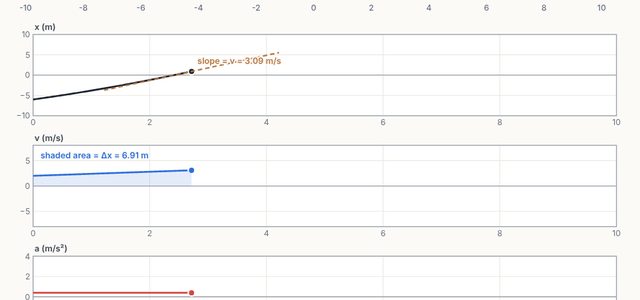
Open the Motion Graphs simulation and test every idea on this page yourself.
Open the simulation →