The big idea
Some curves, such as circles, cannot be written as a single y = f(x). Implicit differentiation differentiates both sides as they stand, treating y as a function of x. Every time you differentiate a y-term, the chain rule adds a factor of dy/dx.
Key ideas
- Differentiate both sides with respect to x. A term in y picks up dy/dx: d/dx(y2) = 2y · dy/dx.
- Terms like xy need the product rule: d/dx(xy) = y + x · dy/dx.
- Collect the dy/dx terms on one side, factor, and divide.
- The slope of an inverse function is the reciprocal of the original slope at the matching point.
Equations
| d/dx [yn] = nyn−1 · dy/dx | chain rule on y |
| d/dx [xy] = y + x · dy/dx | product rule |
| (f−1)′(b) = 1/f′(a), where f(a) = b | derivative of an inverse |
| d2y/dx2 = d/dx (dy/dx) | second derivative |
Worked questions: easy, medium, hard
Three questions that climb in difficulty, each solved one step at a time. Try each one before you read the steps.
Find dy/dx for the circle x2 + y2 = 25 and the slope at (3, 4).
- Differentiate both sides: 2x + 2y · dy/dx = 0.
- Solve: dy/dx = −x/y.
- At (3, 4): dy/dx = −3/4.
Find the slope of x2 + xy + y2 = 7 at the point (1, 2).
- Differentiate: 2x + (y + x · dy/dx) + 2y · dy/dx = 0.
- Collect: dy/dx (x + 2y) = −(2x + y), so dy/dx = −(2x + y)/(x + 2y).
- At (1, 2): −(2 + 2)/(1 + 4) = −4/5.
For x2 + y2 = 25, find d2y/dx2 in terms of y and its value at (3, 4).
- Start from dy/dx = −x/y.
- Quotient rule: d2y/dx2 = −[1 · y − x · dy/dx]/y2.
- Substitute dy/dx = −x/y: −[y + x2/y]/y2 = −(y2 + x2)/y3.
- On the circle x2 + y2 = 25, so d2y/dx2 = −25/y3. At (3, 4): −25/64.
Common mistakes
- Forgetting dy/dx when differentiating a y-term.
- Differentiating xy as just dy/dx. It needs the product rule.
- Differentiating the constant on the right to itself instead of 0.
Now you try: easy to hard
Six more questions, two at each level. These are the questions on the worksheet; each solution opens when you are ready.
Easy 1. Find dy/dx if y3 = x2.
Show the step-by-step solution
3y2 · dy/dx = 2x, so dy/dx = 2x/(3y2).
Easy 2. Find the slope of x2 − y2 = 16 at (5, 3).
Show the step-by-step solution
2x − 2y · dy/dx = 0, so dy/dx = x/y = 5/3.
Medium 3. Use implicit differentiation on sin y = x to find dy/dx in terms of x (for −π/2 < y < π/2).
Show the step-by-step solution
cos y · dy/dx = 1, so dy/dx = 1/cos y. Since cos y = √(1 − sin2 y) = √(1 − x2), dy/dx = 1/√(1 − x2). This is the derivative of sin−1 x.
Medium 4. Find the tangent line to xy = 12 at (3, 4).
Show the step-by-step solution
Product rule: y + x · dy/dx = 0, so dy/dx = −y/x = −4/3. Line: y − 4 = −(4/3)(x − 3).
Hard 5. f(x) = x3 + x + 1. Find (f−1)′(3).
Show the step-by-step solution
Find a with f(a) = 3: f(1) = 1 + 1 + 1 = 3, so a = 1. f′(x) = 3x2 + 1, f′(1) = 4. So (f−1)′(3) = 1/4.
Hard 6. Find the slope of the folium x3 + y3 = 6xy at (3, 3).
Show the step-by-step solution
3x2 + 3y2 y′ = 6y + 6x y′. So y′(3y2 − 6x) = 6y − 3x2 and y′ = (6y − 3x2)/(3y2 − 6x). At (3, 3): (18 − 27)/(27 − 18) = −1.
6 questions to print or save, with full step-by-step answers at the end.
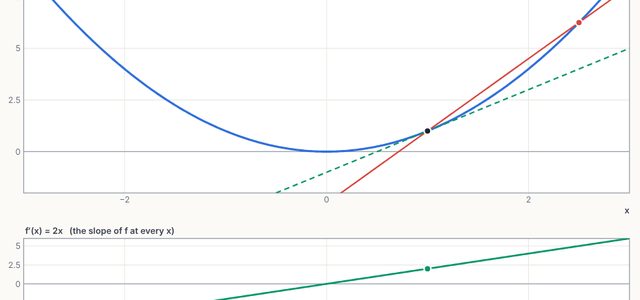
Open the Derivative Explorer simulation and test every idea on this page yourself.
Open the simulation →