The big idea
Beyond powers of x there is a short table of derivatives to memorise. Each one combines with the chain rule in the same way: differentiate the outside function, then multiply by the derivative of whatever is inside it.
Key ideas
- sin x → cos x and cos x → −sin x. Every "co" function brings a minus sign.
- ex is its own derivative. For ekx the chain rule gives kekx.
- ln x → 1/x, so ln(g(x)) → g′(x)/g(x).
- For a variable in both base and power (like xx), take ln of both sides first: logarithmic differentiation.
Equations
| (sin x)′ = cos x, (cos x)′ = −sin x, (tan x)′ = sec2 x | trig |
| (ex)′ = ex, (ax)′ = ax ln a | exponentials |
| (ln x)′ = 1/x, (loga x)′ = 1/(x ln a) | logarithms |
| (sin−1 x)′ = 1/√(1 − x2), (tan−1 x)′ = 1/(1 + x2) | inverse trig |
Worked questions: easy, medium, hard
Three questions that climb in difficulty, each solved one step at a time. Try each one before you read the steps.
Differentiate y = 3 sin x − 2ex.
- The derivative of sin x is cos x, so 3 sin x → 3 cos x.
- ex is its own derivative, so −2ex stays −2ex.
- y′ = 3 cos x − 2ex.
Differentiate y = e2x cos 3x.
- This is a product: u = e2x, v = cos 3x.
- Chain rule on each: u′ = 2e2x, v′ = −3 sin 3x.
- y′ = u′v + uv′ = 2e2x cos 3x − 3e2x sin 3x = e2x(2 cos 3x − 3 sin 3x).
Differentiate y = xsin x for x > 0.
- The variable is in the base and the power, so take logs: ln y = sin x · ln x.
- Differentiate both sides. Left: y′/y. Right (product rule): cos x · ln x + sin x · (1/x).
- Multiply by y: y′ = xsin x (cos x ln x + (sin x)/x).
Common mistakes
- Writing the derivative of cos x as +sin x.
- Using the power rule on ex or 2x. The power rule needs the variable in the base.
- Forgetting the inside derivative: (sin 5x)′ is 5 cos 5x, not cos 5x.
Now you try: easy to hard
Six more questions, two at each level. These are the questions on the worksheet; each solution opens when you are ready.
Easy 1. Differentiate y = tan x + ln x.
Show the step-by-step solution
y′ = sec2 x + 1/x.
Easy 2. Differentiate y = 5x + e−3x.
Show the step-by-step solution
(5x)′ = 5x ln 5 and (e−3x)′ = −3e−3x. So y′ = 5x ln 5 − 3e−3x.
Medium 3. Differentiate y = ln(x2 + 1).
Show the step-by-step solution
Inside g = x2 + 1, g′ = 2x. y′ = g′/g = 2x/(x2 + 1).
Medium 4. Differentiate y = sin2(4x).
Show the step-by-step solution
Three layers: square, sine, 4x. y′ = 2 sin(4x) · cos(4x) · 4 = 8 sin 4x cos 4x, which equals 4 sin 8x.
Hard 5. Differentiate y = tan−1(2x).
Show the step-by-step solution
y′ = 1/(1 + (2x)2) · 2 = 2/(1 + 4x2).
Hard 6. Find the slope of y = ex/(1 + ex) at x = 0.
Show the step-by-step solution
Quotient rule: y′ = [ex(1 + ex) − ex · ex]/(1 + ex)2 = ex/(1 + ex)2. At x = 0: 1/(2)2 = 1/4.
6 questions to print or save, with full step-by-step answers at the end.
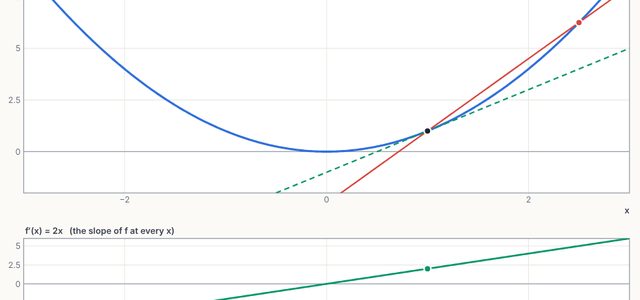
Open the Derivative Explorer simulation and test every idea on this page yourself.
Open the simulation →