The big idea
Nobody uses the limit definition every time. A handful of rules do the work: the power rule for xn, the product and quotient rules for functions multiplied or divided, and the chain rule for a function inside another function.
Key ideas
- Power rule: bring the power down and reduce it by one. Rewrite roots and 1/xn as powers first.
- Constants multiply through, and sums differentiate term by term.
- Product rule: first times derivative of second plus second times derivative of first.
- Quotient rule: (bottom × derivative of top − top × derivative of bottom) over bottom squared.
- Chain rule: differentiate the outside (leave the inside alone), then multiply by the derivative of the inside.
Equations
| d/dx (xn) = nxn−1 | power rule |
| (uv)′ = u′v + uv′ | product rule |
| (u/v)′ = (u′v − uv′)/v2 | quotient rule |
| d/dx f(g(x)) = f′(g(x)) · g′(x) | chain rule |
Worked questions: easy, medium, hard
Three questions that climb in difficulty, each solved one step at a time. Try each one before you read the steps.
Differentiate y = 4x5 − 3x2 + 7x − 2.
- Apply the power rule to each term: 4 · 5x4 = 20x4, 3 · 2x = 6x, and 7x gives 7.
- The constant −2 differentiates to 0.
- y′ = 20x4 − 6x + 7.
Differentiate y = (x2 + 1)(3x − 2) with the product rule.
- u = x2 + 1, u′ = 2x. v = 3x − 2, v′ = 3.
- y′ = u′v + uv′ = 2x(3x − 2) + 3(x2 + 1).
- Expand: 6x2 − 4x + 3x2 + 3 = 9x2 − 4x + 3.
Find the slope of y = (2x − 1)3/(x2 + 1) at x = 1.
- Top: u = (2x − 1)3. Chain rule: u′ = 3(2x − 1)2 · 2 = 6(2x − 1)2.
- Bottom: v = x2 + 1, v′ = 2x.
- At x = 1: u = 1, u′ = 6, v = 2, v′ = 2.
- Quotient rule: (u′v − uv′)/v2 = (6 · 2 − 1 · 2)/4 = 10/4 = 5/2.
Common mistakes
- Differentiating a product as "derivative times derivative". (uv)′ is not u′v′.
- Forgetting the inside derivative in the chain rule.
- Getting the order wrong in the quotient rule. The bottom goes first: u′v − uv′.
Now you try: easy to hard
Six more questions, two at each level. These are the questions on the worksheet; each solution opens when you are ready.
Easy 1. Differentiate y = 3x4 − 5x + 9.
Show the step-by-step solution
Term by term: y′ = 12x3 − 5.
Easy 2. Differentiate y = 6/x2 + √x.
Show the step-by-step solution
Rewrite: y = 6x−2 + x1/2. Then y′ = −12x−3 + (1/2)x−1/2 = −12/x3 + 1/(2√x).
Medium 3. Differentiate y = (3x + 1)4.
Show the step-by-step solution
Chain rule: outside power 4, inside 3x + 1 with derivative 3. y′ = 4(3x + 1)3 · 3 = 12(3x + 1)3.
Medium 4. Differentiate y = x/(x + 2).
Show the step-by-step solution
Quotient rule with u = x, v = x + 2: y′ = [1(x + 2) − x(1)]/(x + 2)2 = 2/(x + 2)2.
Hard 5. Differentiate y = x2 √(1 + x2) and simplify.
Show the step-by-step solution
Product + chain: y′ = 2x√(1 + x2) + x2 · x/√(1 + x2). Put over a common denominator: [2x(1 + x2) + x3]/√(1 + x2) = (2x + 3x3)/√(1 + x2).
Hard 6. Given f(2) = 1, f′(2) = 2, f′(3) = 4, g(2) = 3 and g′(2) = −5, find h′(2) for h(x) = f(g(x)) and k′(2) for k(x) = f(x)g(x).
Show the step-by-step solution
Chain rule: h′(2) = f′(g(2)) · g′(2) = f′(3) · (−5) = 4(−5) = −20. Product rule: k′(2) = f′(2)g(2) + f(2)g′(2) = 2(3) + 1(−5) = 1.
6 questions to print or save, with full step-by-step answers at the end.
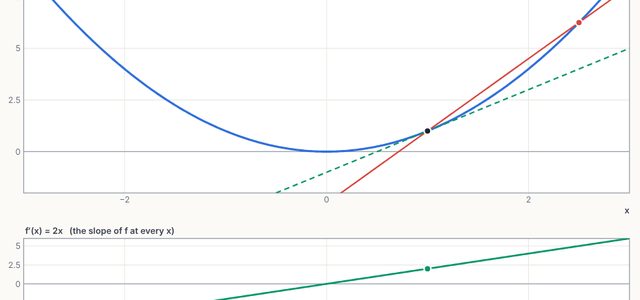
Open the Derivative Explorer simulation and test every idea on this page yourself.
Open the simulation →