The big idea
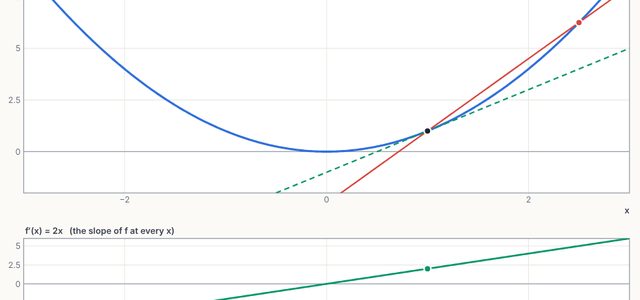
The slope between two points on a curve is the average rate of change. Slide the second point toward the first and the secant line turns into the tangent line. The limit of those slopes is the derivative, the instantaneous rate of change.
Key ideas
- Average rate of change on [a, b] is [f(b) − f(a)]/(b − a), the slope of the secant line.
- The derivative f′(a) is the limit of the secant slope as the gap h shrinks to 0.
- f′(a) is the slope of the tangent line at x = a.
- A function is not differentiable at a corner, a cusp, a vertical tangent or a discontinuity.
- Differentiable implies continuous, but continuous does not imply differentiable.
Equations
| f′(x) = limh→0 [f(x + h) − f(x)]/h | definition of the derivative |
| f′(a) = limx→a [f(x) − f(a)]/(x − a) | alternative form |
| [f(b) − f(a)]/(b − a) | average rate of change |
| y − f(a) = f′(a)(x − a) | tangent line at x = a |
Worked questions: easy, medium, hard
Three questions that climb in difficulty, each solved one step at a time. Try each one before you read the steps.
Use the limit definition to find f′(3) for f(x) = x2.
- Write the difference quotient: [(3 + h)2 − 32]/h.
- Expand: (9 + 6h + h2 − 9)/h = (6h + h2)/h = 6 + h.
- Let h → 0: f′(3) = 6.
Use the limit definition to differentiate f(x) = 1/x.
- Difference quotient: [1/(x + h) − 1/x]/h.
- Combine the fractions on top: [x − (x + h)]/[x(x + h)] = −h/[x(x + h)].
- Divide by h: −1/[x(x + h)].
- Let h → 0: f′(x) = −1/x2.
(a) The limit limh→0 (√(9 + h) − 3)/h is the derivative of which function at which point? Evaluate it. (b) Is f(x) = |x − 2| differentiable at x = 2?
- (a) Match the pattern [f(a + h) − f(a)]/h: f(x) = √x and a = 9.
- Multiply by the conjugate: (9 + h − 9)/[h(√(9 + h) + 3)] = 1/(√(9 + h) + 3) → 1/6.
- (b) For x > 2, f = x − 2 with slope +1. For x < 2, f = 2 − x with slope −1.
- The left and right slopes disagree, so f′(2) does not exist. The graph has a corner.
Common mistakes
- Forgetting to subtract all of f(x): the minus sign applies to every term.
- Setting h = 0 before simplifying, which gives 0/0.
- Assuming a continuous function must be differentiable. |x| is the classic counter-example.
Now you try: easy to hard
Six more questions, two at each level. These are the questions on the worksheet; each solution opens when you are ready.
Easy 1. Find the average rate of change of f(x) = x2 + 1 on [1, 3].
Show the step-by-step solution
[f(3) − f(1)]/(3 − 1) = (10 − 2)/2 = 4.
Easy 2. Use the limit definition to differentiate f(x) = 3x − 7.
Show the step-by-step solution
[3(x + h) − 7 − (3x − 7)]/h = 3h/h = 3. The limit is 3, the slope of the line.
Medium 3. Use the limit definition to differentiate f(x) = x2 + 2x.
Show the step-by-step solution
[(x + h)2 + 2(x + h) − x2 − 2x]/h = (2xh + h2 + 2h)/h = 2x + h + 2. Let h → 0: f′(x) = 2x + 2.
Medium 4. Find the tangent line to y = x2 at x = −1.
Show the step-by-step solution
Slope: f′(x) = 2x, so f′(−1) = −2. Point: (−1, 1). Line: y − 1 = −2(x + 1), that is y = −2x − 1.
Hard 5. Evaluate limh→0 [(1 + h)10 − 1]/h without expanding.
Show the step-by-step solution
This is the definition of f′(1) for f(x) = x10. Since f′(x) = 10x9, the limit is 10(1)9 = 10.
Hard 6. Use the limit definition to differentiate f(x) = x3.
Show the step-by-step solution
(x + h)3 = x3 + 3x2h + 3xh2 + h3. Subtract x3 and divide by h: 3x2 + 3xh + h2. Let h → 0: f′(x) = 3x2.
6 questions to print or save, with full step-by-step answers at the end.
Open the Derivative Explorer simulation and test every idea on this page yourself.
Open the simulation →