The big idea
A function is continuous at x = a if you can draw through that point without lifting your pen. In limit language: the limit exists, the function has a value there, and the two are equal. When one of those fails you get a hole, a jump or an asymptote.
Key ideas
- Continuity at a needs three things: f(a) exists, limx→a f(x) exists, and they are equal.
- A removable discontinuity (hole) comes from a factor that cancels. A vertical asymptote comes from a factor left in the bottom.
- A jump happens when the left and right limits are different numbers.
- Horizontal asymptotes are the limits as x → ±∞.
- Intermediate Value Theorem: if f is continuous on [a, b], it takes every value between f(a) and f(b). A sign change guarantees a root.
Equations
| limx→a f(x) = f(a) | definition of continuous at a |
| limx→a⁻ f(x) = limx→a⁺ f(x) | needed for the limit to exist |
| y = limx→±∞ f(x) | horizontal asymptote |
| f(a) < N < f(b) ⇒ f(c) = N for some c in (a, b) | IVT (f continuous) |
Worked questions: easy, medium, hard
Three questions that climb in difficulty, each solved one step at a time. Try each one before you read the steps.
f(x) = (x2 − 4)/(x − 2) for x ≠ 2 and f(2) = k. Find k so that f is continuous at x = 2.
- Find the limit: (x2 − 4)/(x − 2) = (x − 2)(x + 2)/(x − 2) = x + 2, which → 4 as x → 2.
- Continuity needs f(2) to equal that limit.
- So k = 4.
f(x) = ax + 1 for x < 2 and f(x) = x2 − a for x ≥ 2. Find a so that f is continuous everywhere.
- Each piece is a polynomial, so the only possible problem is at x = 2.
- Left-hand limit: a(2) + 1 = 2a + 1. Right-hand limit and value: 22 − a = 4 − a.
- Set them equal: 2a + 1 = 4 − a, so 3a = 3 and a = 1.
Find and classify every discontinuity of f(x) = (x2 − x − 6)/(x2 − 9), and give its horizontal asymptote.
- Factor: top = (x − 3)(x + 2), bottom = (x − 3)(x + 3).
- The factor (x − 3) cancels, so x = 3 is a hole. The limit there is (3 + 2)/(3 + 3) = 5/6.
- The factor (x + 3) stays in the bottom, so x = −3 is a vertical asymptote.
- As x → ±∞ the degrees are equal, so f → 1/1: horizontal asymptote y = 1.
Common mistakes
- Saying a function is continuous because the limit exists. The value must exist and match too.
- Calling every zero of the denominator a vertical asymptote. Check whether the factor cancels first.
- Using the IVT without stating that the function is continuous on the closed interval.
Now you try: easy to hard
Six more questions, two at each level. These are the questions on the worksheet; each solution opens when you are ready.
Easy 1. Is f(x) = 1/(x − 5) continuous at x = 5? Explain.
Show the step-by-step solution
No. f(5) is undefined and the function grows without bound near 5, so there is an infinite discontinuity (vertical asymptote) at x = 5.
Easy 2. g(x) = 2x + 1 for x < 4 and g(x) = 9 for x ≥ 4. Is g continuous at x = 4?
Show the step-by-step solution
Left-hand limit: 2(4) + 1 = 9. Right-hand limit: 9. g(4) = 9. All three agree, so yes, g is continuous at 4.
Medium 3. f(x) = cx2 + 1 for x ≤ 1 and f(x) = 4x − c for x > 1. Find c so that f is continuous.
Show the step-by-step solution
At x = 1: left value c + 1, right limit 4 − c. Set equal: c + 1 = 4 − c, so 2c = 3 and c = 3/2.
Medium 4. Find all asymptotes of y = (3x2 + 1)/(x2 − 4).
Show the step-by-step solution
Bottom = (x − 2)(x + 2), and neither factor cancels, so vertical asymptotes at x = 2 and x = −2. Equal degrees, so the horizontal asymptote is the ratio of leading coefficients: y = 3.
Hard 5. Show that cos x = x has a solution between 0 and π/2.
Show the step-by-step solution
Let g(x) = cos x − x, which is continuous everywhere. g(0) = 1 > 0 and g(π/2) = 0 − π/2 < 0. g changes sign, so by the IVT there is a c in (0, π/2) with g(c) = 0, that is cos c = c.
Hard 6. f(x) = x + 1 for x < 1, f(x) = ax + b for 1 ≤ x ≤ 3, and f(x) = x2 for x > 3. Find a and b so that f is continuous.
Show the step-by-step solution
At x = 1: 1 + 1 = a + b, so a + b = 2. At x = 3: 3a + b = 9. Subtract: 2a = 7, so a = 7/2, and b = 2 − 7/2 = −3/2.
6 questions to print or save, with full step-by-step answers at the end.
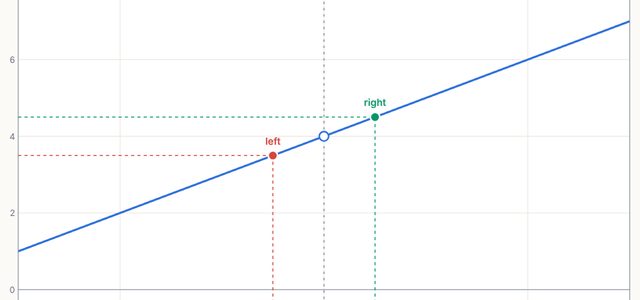
Open the Limits Explorer simulation and test every idea on this page yourself.
Open the simulation →