The big idea
To measure the length of a curve, break it into tiny straight pieces. Each piece is the hypotenuse of a triangle with sides dx and dy, so its length is √(dx² + dy²). Adding the pieces gives the arc length integral.
Key ideas
- Find dy/dx, square it, add 1, take the square root, and integrate.
- Exam questions are often built so that 1 + (y′)2 is a perfect square.
- Many arc length integrals have no neat antiderivative. Setting up the integral is then the whole answer (a calculator does the rest).
- For a straight line the formula reduces to the distance formula.
Equations
| L = ∫ab √(1 + (dy/dx)2) dx | arc length of y = f(x) |
| L = ∫cd √(1 + (dx/dy)2) dy | for x = g(y) |
| ds = √(dx2 + dy2) | the small piece |
| L = ∫ √((dx/dt)2 + (dy/dt)2) dt | parametric form |
Worked questions: easy, medium, hard
Three questions that climb in difficulty, each solved one step at a time. Try each one before you read the steps.
Find the length of y = 2x + 1 from x = 0 to x = 3.
- dy/dx = 2, so √(1 + 4) = √5.
- L = ∫03 √5 dx = 3√5.
- L ≈ 6.71, the same as the distance formula between (0, 1) and (3, 7).
Find the length of y = (2/3)x3/2 from x = 0 to x = 3.
- dy/dx = x1/2, so (dy/dx)2 = x.
- L = ∫03 √(1 + x) dx = [(2/3)(1 + x)3/2] from 0 to 3.
- L = (2/3)(8 − 1) = 14/3 ≈ 4.67.
Find the length of y = x2/2 − (ln x)/4 from x = 1 to x = 2.
- dy/dx = x − 1/(4x).
- 1 + (dy/dx)2 = 1 + x2 − 1/2 + 1/(16x2) = x2 + 1/2 + 1/(16x2) = (x + 1/(4x))2.
- So the integrand is simply x + 1/(4x).
- L = [x2/2 + (ln x)/4] from 1 to 2 = 3/2 + (ln 2)/4 ≈ 1.673.
Common mistakes
- Forgetting to square the derivative.
- Writing √(1 + y′) or √(1 + y2).
- Splitting √(a + b) into √a + √b.
Now you try: easy to hard
Six more questions, two at each level. These are the questions on the worksheet; each solution opens when you are ready.
Easy 1. Find the length of y = 3x − 2 from x = 1 to x = 5.
Show the step-by-step solution
√(1 + 9) = √10. L = 4√10 ≈ 12.65.
Easy 2. Set up (do not evaluate) the integral for the length of y = x2 from x = 0 to x = 1.
Show the step-by-step solution
dy/dx = 2x, so L = ∫01 √(1 + 4x2) dx (a calculator gives 1.479).
Medium 3. Find the length of y = x3/2 from x = 0 to x = 4.
Show the step-by-step solution
dy/dx = (3/2)x1/2, so L = ∫04 √(1 + 9x/4) dx = (8/27)[(1 + 9x/4)3/2] = (8/27)(103/2 − 1) ≈ 9.07.
Medium 4. Find the length of y = ln(cos x) from x = 0 to x = π/4.
Show the step-by-step solution
dy/dx = −tan x, and 1 + tan2 x = sec2 x. L = ∫0π/4 sec x dx = [ln(sec x + tan x)] = ln(√2 + 1) ≈ 0.881.
Hard 5. Find the length of y = (ex + e−x)/2 from x = 0 to x = 1.
Show the step-by-step solution
dy/dx = (ex − e−x)/2, and 1 + (dy/dx)2 = [(ex + e−x)/2]2. L = ∫01 (ex + e−x)/2 dx = (e − 1/e)/2 ≈ 1.175.
Hard 6. Use the arc length formula to show that a circle of radius r has circumference 2πr.
Show the step-by-step solution
Top-right quarter: y = √(r2 − x2), dy/dx = −x/√(r2 − x2), so 1 + (dy/dx)2 = r2/(r2 − x2). L = ∫0r r/√(r2 − x2) dx = r[sin−1(x/r)] = rπ/2. Four quarters: 2πr.
6 questions to print or save, with full step-by-step answers at the end.
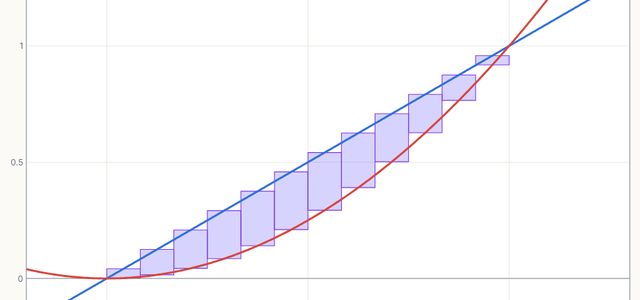
Open the Area, Volume & Arc Length simulation and test every idea on this page yourself.
Open the simulation →