The big idea
Any volume can be found by slicing. If each slice at position x has area A(x), the volume is the integral of A(x). Spinning a region about an axis makes circular slices: solid disks, or washers if there is a hole.
Key ideas
- Disk: the slice is a circle of radius R, so its area is πR2.
- Washer: a big circle minus a small one, π(R2 − r2). Measure both radii from the axis of rotation.
- Rotating about a line such as y = 2 changes the radii to distances from that line.
- Known cross-sections: write the area of one slice (square, semicircle, triangle) in terms of x.
- Cylindrical shells, 2π(radius)(height), are a useful alternative (not required for AB).
Equations
| V = π ∫ab R2 dx | disks |
| V = π ∫ab (R2 − r2) dx | washers |
| V = ∫ab A(x) dx | known cross-sections |
| V = 2π ∫ab (radius)(height) dx | shells |
Worked questions: easy, medium, hard
Three questions that climb in difficulty, each solved one step at a time. Try each one before you read the steps.
The region under y = x from x = 0 to x = 2 is rotated about the x-axis. Find the volume.
- Each slice is a disk of radius R = x.
- V = π ∫02 x2 dx = π[x3/3].
- V = 8π/3 ≈ 8.38 (a cone).
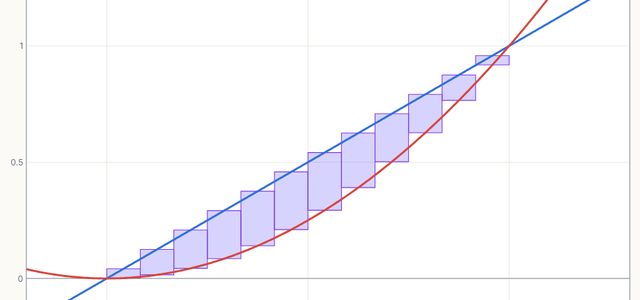
The region between y = x and y = x2 is rotated about the x-axis. Find the volume.
- The curves meet at x = 0 and 1. The outer radius is the line, R = x; the inner radius is the parabola, r = x2.
- V = π ∫01 (x2 − x4) dx = π[x3/3 − x5/5].
- V = π(1/3 − 1/5) = 2π/15 ≈ 0.419.
The same region (between y = x and y = x2) is rotated about the line y = 2. Find the volume.
- Distances from y = 2: the parabola is further away, so R = 2 − x2; the line is nearer, r = 2 − x.
- R2 − r2 = (4 − 4x2 + x4) − (4 − 4x + x2) = x4 − 5x2 + 4x.
- V = π ∫01 (x4 − 5x2 + 4x) dx = π[x5/5 − 5x3/3 + 2x2].
- V = π(1/5 − 5/3 + 2) = 8π/15 ≈ 1.68.
Common mistakes
- Writing π(R − r)2 instead of π(R2 − r2).
- Measuring radii from the x-axis when the rotation is about another line.
- Forgetting the π.
Now you try: easy to hard
Six more questions, two at each level. These are the questions on the worksheet; each solution opens when you are ready.
Easy 1. Rotate the region under y = √x from 0 to 4 about the x-axis. Find the volume.
Show the step-by-step solution
V = π ∫04 x dx = π[x2/2] = 8π.
Easy 2. Rotate the region under y = x2 from 0 to 1 about the x-axis. Find the volume.
Show the step-by-step solution
V = π ∫01 x4 dx = π/5.
Medium 3. The region bounded by y = x2, y = 4 and the y-axis (first quadrant) is rotated about the y-axis. Find the volume.
Show the step-by-step solution
Horizontal disks of radius x = √y: V = π ∫04 y dy = π[y2/2] = 8π.
Medium 4. The region between y = √x and y = x/2 is rotated about the x-axis. Find the volume.
Show the step-by-step solution
They meet at x = 0 and 4, with √x on top. V = π ∫04 (x − x2/4) dx = π[x2/2 − x3/12] = π(8 − 16/3) = 8π/3.
Hard 5. The base of a solid is the circle x2 + y2 = 4. Cross-sections perpendicular to the x-axis are squares. Find the volume.
Show the step-by-step solution
Side of the square = 2√(4 − x2), so A(x) = 4(4 − x2). V = ∫−22 4(4 − x2) dx = 4(32/3) = 128/3.
Hard 6. Use shells to find the volume when the region under y = x2 from 0 to 2 is rotated about the y-axis.
Show the step-by-step solution
Shell radius x, height x2: V = 2π ∫02 x3 dx = 2π(4) = 8π.
6 questions to print or save, with full step-by-step answers at the end.
Open the Area, Volume & Arc Length simulation and test every idea on this page yourself.
Open the simulation →