The big idea
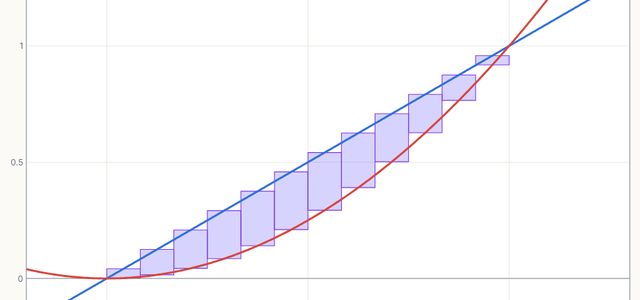
The area between two curves is built from thin rectangles whose height is the gap between the curves. So the integrand is top minus bottom, and the limits are usually the x-values where the curves intersect.
Key ideas
- Find the intersection points by setting the two functions equal.
- Decide which curve is on top (test a point between the intersections).
- Area = ∫ (top − bottom) dx.
- If the curves cross inside the interval, split the integral there.
- For curves given as x = g(y), integrate (right − left) with respect to y.
Equations
| A = ∫ab [f(x) − g(x)] dx | f on top |
| A = ∫cd [right − left] dy | horizontal strips |
| f(x) = g(x) | gives the limits |
| A = ∫ab |f(x) − g(x)| dx | when the curves cross |
Worked questions: easy, medium, hard
Three questions that climb in difficulty, each solved one step at a time. Try each one before you read the steps.
Find the area between y = x and y = x2.
- Intersections: x = x2 gives x = 0 and x = 1.
- Between them (try x = 0.5) the line is on top: 0.5 > 0.25.
- A = ∫01 (x − x2) dx = [x2/2 − x3/3] = 1/2 − 1/3 = 1/6.
Find the area between y = x2 and y = x + 2.
- Intersections: x2 = x + 2, so (x − 2)(x + 1) = 0, x = −1 and x = 2.
- At x = 0 the line (2) is above the parabola (0).
- A = ∫−12 (x + 2 − x2) dx = [x2/2 + 2x − x3/3].
- At 2: 2 + 4 − 8/3 = 10/3. At −1: 1/2 − 2 + 1/3 = −7/6. Difference: 10/3 + 7/6 = 9/2.
Find the area between y = sin x and y = cos x from x = 0 to x = π/2.
- The curves cross where sin x = cos x, at x = π/4. Before that cos x is on top; after it sin x is.
- A = ∫0π/4 (cos x − sin x) dx + ∫π/4π/2 (sin x − cos x) dx.
- First: [sin x + cos x] from 0 to π/4 = √2 − 1. Second: [−cos x − sin x] from π/4 to π/2 = −1 + √2.
- Total: 2(√2 − 1) ≈ 0.828.
Common mistakes
- Integrating bottom − top and getting a negative area.
- Not splitting the integral where the curves cross, so regions cancel.
- Using the wrong limits. They come from the intersection points.
Now you try: easy to hard
Six more questions, two at each level. These are the questions on the worksheet; each solution opens when you are ready.
Easy 1. Find the area between y = 4 − x2 and the x-axis.
Show the step-by-step solution
Roots at x = ±2. ∫−22 (4 − x2) dx = [4x − x3/3] = (8 − 8/3) − (−8 + 8/3) = 32/3.
Easy 2. Find the area between y = 2x and y = x2.
Show the step-by-step solution
Intersections at x = 0 and 2, line on top. ∫02 (2x − x2) dx = [x2 − x3/3] = 4 − 8/3 = 4/3.
Medium 3. Find the total area between y = x3 and y = x.
Show the step-by-step solution
They meet at −1, 0 and 1. On (0, 1) the line is on top: ∫01 (x − x3) dx = 1/2 − 1/4 = 1/4. By symmetry the other region is also 1/4. Total 1/2.
Medium 4. Find the area between y = ex and y = x from x = 0 to x = 1.
Show the step-by-step solution
ex is on top. ∫01 (ex − x) dx = [ex − x2/2] = (e − 1/2) − 1 = e − 1.5 ≈ 1.218.
Hard 5. Find the area between x = y2 and x = y + 2 by integrating with respect to y.
Show the step-by-step solution
y2 = y + 2 gives y = −1 and 2. The line is on the right. ∫−12 (y + 2 − y2) dy = 9/2.
Hard 6. Find the area between y = x2 − 4 and y = 4 − x2.
Show the step-by-step solution
They meet at x = ±2, with 4 − x2 on top. ∫−22 (8 − 2x2) dx = [8x − 2x3/3] = 2(16 − 16/3) = 64/3.
6 questions to print or save, with full step-by-step answers at the end.
Open the Area, Volume & Arc Length simulation and test every idea on this page yourself.
Open the simulation →