The big idea
If you know how fast something is changing, the integral of that rate over a time interval gives the net change. Add the starting amount and you have the final amount. For motion, integrating velocity gives displacement, and integrating speed gives distance.
Key ideas
- Net change: F(b) = F(a) + ∫ from a to b of F′(t) dt.
- Displacement is ∫ v dt. Total distance is ∫ |v| dt: split the integral where v changes sign.
- With a rate in and a rate out, integrate (in − out).
- An accumulation function g(x) = ∫ from a to x of f has g′ = f, so g rises where f is positive.
Equations
| F(b) = F(a) + ∫ab F′(t) dt | net change theorem |
| displacement = ∫ab v(t) dt | signed |
| distance = ∫ab |v(t)| dt | never negative |
| v(t) = v(0) + ∫0t a(u) du | velocity from acceleration |
Worked questions: easy, medium, hard
Three questions that climb in difficulty, each solved one step at a time. Try each one before you read the steps.
A particle has velocity v(t) = 3t2 m/s. Find its displacement from t = 0 to t = 2 s.
- Displacement = ∫02 3t2 dt.
- Antiderivative: t3.
- 23 − 0 = 8 m.
A particle has velocity v(t) = t2 − 4t + 3 for 0 ≤ t ≤ 3. Find its displacement and the total distance travelled.
- Antiderivative: G(t) = t3/3 − 2t2 + 3t. Displacement = G(3) − G(0) = 9 − 18 + 9 = 0.
- v = (t − 1)(t − 3) changes sign at t = 1: positive before, negative after.
- From 0 to 1: G(1) − G(0) = 1/3 − 2 + 3 = 4/3. From 1 to 3: G(3) − G(1) = 0 − 4/3 = −4/3.
- Distance = 4/3 + 4/3 = 8/3.
A tank holds 100 L. Water enters at R(t) = 20 + 6t L/min and leaves at a steady 30 L/min. How much water is in the tank at t = 5 min, and what is the least amount it ever holds?
- Net rate: (20 + 6t) − 30 = 6t − 10.
- Amount at t = 5: 100 + ∫05 (6t − 10) dt = 100 + [3t2 − 10t] = 100 + 75 − 50 = 125 L.
- The amount falls while the net rate is negative and rises after it turns positive, so the minimum is when 6t − 10 = 0, t = 5/3 min.
- Amount then: 100 + 3(25/9) − 50/3 = 100 − 8.33 = 91.7 L.
Common mistakes
- Reporting displacement when asked for distance.
- Forgetting to add the initial amount.
- Integrating only the rate in and ignoring the rate out.
Now you try: easy to hard
Six more questions, two at each level. These are the questions on the worksheet; each solution opens when you are ready.
Easy 1. a(t) = 6t and v(0) = 2. Find v(3).
Show the step-by-step solution
v(3) = 2 + ∫03 6t dt = 2 + [3t2] = 2 + 27 = 29.
Easy 2. f(2) = 5 and ∫26 f′(x) dx = 7. Find f(6).
Show the step-by-step solution
Net change: f(6) = f(2) + 7 = 12.
Medium 3. A population grows at 200e0.1t people per year. By how much does it grow in the first 10 years?
Show the step-by-step solution
∫010 200e0.1t dt = [2000e0.1t] = 2000(e − 1) ≈ 3437 people.
Medium 4. v(t) = 6 − 2t for 0 ≤ t ≤ 5. Find the displacement and the distance.
Show the step-by-step solution
Displacement: [6t − t2] from 0 to 5 = 30 − 25 = 5. v = 0 at t = 3: from 0 to 3 the particle moves +9, from 3 to 5 it moves −4. Distance = 9 + 4 = 13.
Hard 5. a(t) = 6t − 6, v(0) = 0 and s(0) = 1. Find the total distance travelled on 0 ≤ t ≤ 3.
Show the step-by-step solution
v = 3t2 − 6t and s = t3 − 3t2 + 1. v = 3t(t − 2) changes sign at t = 2. s(0) = 1, s(2) = −3, s(3) = 1. Distance = 4 + 4 = 8.
Hard 6. f(t) = 2 for 0 ≤ t ≤ 2, then falls in a straight line to −2 at t = 4. Let g(x) = ∫0x f(t) dt. Find the maximum of g on [0, 4].
Show the step-by-step solution
g′ = f, which is positive until the line crosses zero at t = 3, then negative. So g peaks at x = 3. g(3) = rectangle 2 × 2 = 4 plus triangle (1/2)(1)(2) = 1, giving g(3) = 5.
6 questions to print or save, with full step-by-step answers at the end.
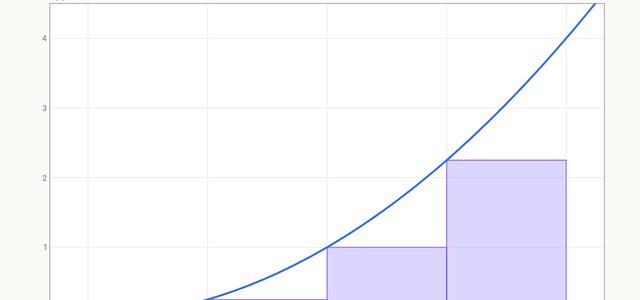
Open the Riemann Sums & the Fundamental Theorem simulation and test every idea on this page yourself.
Open the simulation →