The big idea
Euler's method follows a slope field in small straight steps to approximate a solution you cannot or do not want to find exactly. The logistic equation describes growth that starts off exponential and then levels off as it approaches a carrying capacity.
Key ideas
- Euler step: new y = old y + (slope at the old point) × (step size).
- Smaller steps give better accuracy. Where the solution is concave up, Euler underestimates.
- Logistic growth dP/dt = kP(1 − P/L) levels off at the carrying capacity L.
- A logistic population grows fastest when P = L/2.
- If P starts above L, it decreases toward L.
Equations
| yn+1 = yn + h · f(xn, yn) | Euler's method, step h |
| dP/dt = kP(1 − P/L) | logistic equation |
| P(t) = L/(1 + Ae−kt), A = (L − P0)/P0 | logistic solution |
| limt→∞ P(t) = L | carrying capacity |
Worked questions: easy, medium, hard
Three questions that climb in difficulty, each solved one step at a time. Try each one before you read the steps.
Use Euler's method with step 0.5 to estimate y(1) for dy/dx = x + y, y(0) = 1.
- Start at (0, 1). Slope = 0 + 1 = 1. New y = 1 + 0.5(1) = 1.5, at x = 0.5.
- At (0.5, 1.5): slope = 0.5 + 1.5 = 2. New y = 1.5 + 0.5(2) = 2.5, at x = 1.
- y(1) ≈ 2.5.
A population follows dP/dt = 0.2P(1 − P/500) with P(0) = 50. Find the carrying capacity, the population at which it grows fastest, and that fastest rate.
- Compare with kP(1 − P/L): k = 0.2 and L = 500.
- Growth is fastest at half the carrying capacity: P = 250.
- Rate there: 0.2(250)(1 − 250/500) = 0.2(250)(0.5) = 25 per unit time.
For the same population, write P(t) and find when it reaches 250.
- A = (L − P0)/P0 = (500 − 50)/50 = 9.
- P(t) = 500/(1 + 9e−0.2t).
- Set P = 250: 1 + 9e−0.2t = 2, so e−0.2t = 1/9.
- t = 5 ln 9 ≈ 11.0.
Common mistakes
- Using the slope at the new point instead of the old point in an Euler step.
- Reading the carrying capacity wrongly when the equation is not in the form kP(1 − P/L). Factor it first.
- Saying the population grows fastest at the start. It is fastest at L/2.
Now you try: easy to hard
Six more questions, two at each level. These are the questions on the worksheet; each solution opens when you are ready.
Easy 1. Use Euler's method with step 1 to estimate y(2) for dy/dx = 2x, y(0) = 0.
Show the step-by-step solution
Step 1: slope 0, y stays 0 at x = 1. Step 2: slope 2, y = 0 + 1(2) = 2. (Exact: y = x2 = 4.)
Easy 2. For dP/dt = 0.3P(1 − P/1000), find the limit of P as t → ∞ and say what happens if P = 1200.
Show the step-by-step solution
The carrying capacity is 1000. At P = 1200 the bracket is negative, so dP/dt < 0 and the population decreases toward 1000.
Medium 3. Use Euler's method with step 0.25 to estimate y(1) for dy/dx = y, y(0) = 1.
Show the step-by-step solution
Each step multiplies y by (1 + 0.25). After 4 steps: 1.254 ≈ 2.44. (Exact: e ≈ 2.718; Euler underestimates because the curve is concave up.)
Medium 4. For dP/dt = 0.04P(200 − P), find the carrying capacity and the maximum growth rate.
Show the step-by-step solution
dP/dt = 0 at P = 200, the carrying capacity. Growth is fastest at P = 100: 0.04(100)(100) = 400 per unit time.
Hard 5. Use Euler's method with step 0.5 to estimate y(1) for dy/dx = x − y, y(0) = 2.
Show the step-by-step solution
At (0, 2): slope −2, y = 2 + 0.5(−2) = 1. At (0.5, 1): slope −0.5, y = 1 + 0.5(−0.5) = 0.75.
Hard 6. Solve dP/dt = 0.5P(1 − P/80) with P(0) = 20 and find P(4).
Show the step-by-step solution
A = (80 − 20)/20 = 3, so P = 80/(1 + 3e−0.5t). P(4) = 80/(1 + 3e−2) = 80/1.406 ≈ 56.9.
6 questions to print or save, with full step-by-step answers at the end.
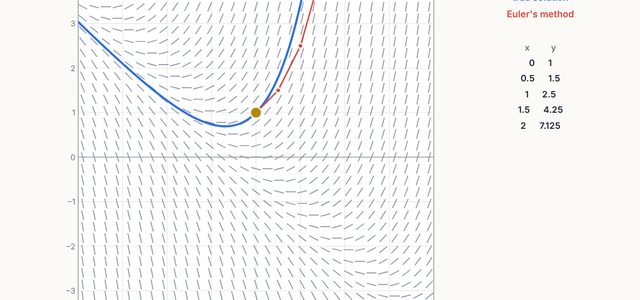
Open the Slope Fields & Euler's Method simulation and test every idea on this page yourself.
Open the simulation →