The big idea
The first derivative tells you whether a graph is going up or down. The second derivative tells you which way it bends. Put both on a sign chart and you can sketch a curve, and find its highest and lowest points, without plotting dozens of points.
Key ideas
- Critical points are where f′ = 0 or f′ is undefined. Extrema can only happen there or at endpoints.
- First derivative test: f′ changing + to − gives a local maximum; − to + gives a local minimum.
- f″ > 0 means concave up (holds water); f″ < 0 means concave down.
- An inflection point is where the concavity actually changes sign.
- For absolute extrema on a closed interval, compare f at the critical points and at both endpoints.
Equations
| f′(x) > 0 ⇒ increasing; f′(x) < 0 ⇒ decreasing | first derivative |
| f″(x) > 0 ⇒ concave up; f″(x) < 0 ⇒ concave down | second derivative |
| f′(c) = 0 and f″(c) > 0 ⇒ local minimum | second derivative test |
| f′(c) = 0 and f″(c) < 0 ⇒ local maximum | second derivative test |
Worked questions: easy, medium, hard
Three questions that climb in difficulty, each solved one step at a time. Try each one before you read the steps.
Find the minimum value of f(x) = x2 − 6x + 2.
- f′(x) = 2x − 6 = 0 at x = 3.
- f″(x) = 2 > 0, so this is a minimum.
- f(3) = 9 − 18 + 2 = −7.
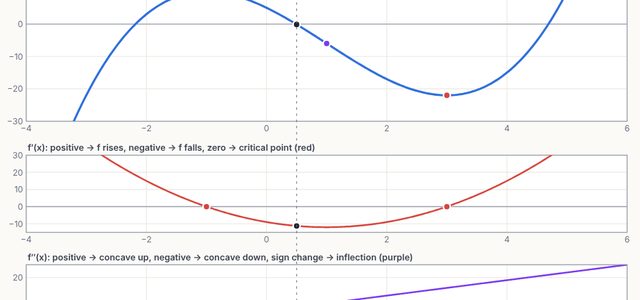
Find the local extrema and the inflection point of f(x) = x3 − 3x2 − 9x + 5.
- f′(x) = 3x2 − 6x − 9 = 3(x − 3)(x + 1), so the critical points are x = −1 and x = 3.
- Sign of f′: + for x < −1, − between, + for x > 3. So x = −1 is a local max and x = 3 is a local min.
- f(−1) = −1 − 3 + 9 + 5 = 10 and f(3) = 27 − 27 − 27 + 5 = −22.
- f″(x) = 6x − 6 = 0 at x = 1, and it changes sign there. f(1) = −6, so the inflection point is (1, −6).
For f(x) = xe−x, find the local maximum, the inflection point, and the absolute extrema on [0, 3].
- Product rule: f′(x) = e−x − xe−x = e−x(1 − x). Since e−x > 0, f′ = 0 only at x = 1, changing + to −: a maximum, f(1) = 1/e ≈ 0.368.
- f″(x) = −e−x(1 − x) − e−x = e−x(x − 2), which changes sign at x = 2. Inflection point (2, 2/e2) ≈ (2, 0.271).
- Closed interval: compare f(0) = 0, f(1) = 0.368 and f(3) = 3/e3 ≈ 0.149.
- Absolute maximum 1/e at x = 1; absolute minimum 0 at x = 0.
Common mistakes
- Calling every point with f′ = 0 an extremum. The sign of f′ must change.
- Calling every point with f″ = 0 an inflection point. The concavity must change.
- Forgetting to check the endpoints for absolute extrema.
Now you try: easy to hard
Six more questions, two at each level. These are the questions on the worksheet; each solution opens when you are ready.
Easy 1. On what interval is f(x) = x2 + 4x increasing?
Show the step-by-step solution
f′ = 2x + 4 > 0 when x > −2.
Easy 2. Find and classify the critical points of f(x) = x3 − 12x.
Show the step-by-step solution
f′ = 3x2 − 12 = 3(x − 2)(x + 2). Sign: +, −, +. Local max at (−2, 16), local min at (2, −16).
Medium 3. Find where f(x) = x4 − 6x2 is concave down, and its inflection points.
Show the step-by-step solution
f″ = 12x2 − 12 = 12(x − 1)(x + 1), negative for −1 < x < 1. The concavity changes at x = ±1, where f = 1 − 6 = −5: inflection points (−1, −5) and (1, −5).
Medium 4. Find the absolute maximum and minimum of f(x) = x3 − 3x + 1 on [0, 2].
Show the step-by-step solution
f′ = 3x2 − 3 = 0 at x = 1 (x = −1 is outside). f(0) = 1, f(1) = −1, f(2) = 3. Max 3 at x = 2, min −1 at x = 1.
Hard 5. Use the second derivative test on f(x) = x + 4/x for x > 0.
Show the step-by-step solution
f′ = 1 − 4/x2 = 0 at x = 2. f″ = 8/x3, and f″(2) = 1 > 0, so there is a local minimum at x = 2 with f(2) = 4.
Hard 6. The derivative of f is f′(x) = (x − 1)2(x + 2). At which x does f have a local extremum, and of what type?
Show the step-by-step solution
f′ = 0 at x = 1 and x = −2. (x − 1)2 is never negative, so the sign of f′ is the sign of (x + 2): − before −2 and + after. Local minimum at x = −2. At x = 1 the sign does not change, so there is no extremum there.
6 questions to print or save, with full step-by-step answers at the end.
Open the Curve Sketching & Optimisation simulation and test every idea on this page yourself.
Open the simulation →