The big idea
Optimisation problems ask for the biggest area, the least material or the shortest distance. The calculus is short. The real work is writing the quantity you want as a function of one variable, using a constraint to remove the others.
Key ideas
- Name the quantity to optimise and write a formula for it.
- Use the constraint to eliminate all but one variable.
- State the domain (lengths cannot be negative).
- Differentiate, set equal to zero, and solve.
- Confirm it is a max or min (sign change, second derivative, or endpoints) and answer the question that was asked.
Equations
| Q = f(x) | objective written in one variable |
| f′(x) = 0 | candidates |
| f″(x) < 0 ⇒ maximum | check |
| f″(x) > 0 ⇒ minimum | check |
Worked questions: easy, medium, hard
Three questions that climb in difficulty, each solved one step at a time. Try each one before you read the steps.
Two positive numbers add up to 20. What is the largest possible product?
- Let the numbers be x and 20 − x. Product: P = x(20 − x) = 20x − x2.
- P′ = 20 − 2x = 0 at x = 10. P″ = −2 < 0, so this is a maximum.
- Both numbers are 10 and the product is 100.
An open box is made from a 12 cm × 12 cm sheet by cutting a square of side x from each corner and folding up the sides. Find the largest possible volume.
- The base is (12 − 2x) by (12 − 2x) and the height is x: V = x(12 − 2x)2, with 0 < x < 6.
- V′ = (12 − 2x)2 + x · 2(12 − 2x)(−2) = (12 − 2x)(12 − 6x).
- V′ = 0 at x = 2 (x = 6 gives zero volume). V′ changes + to − there, so it is a maximum.
- V = 2(8)2 = 128 cm³.
A closed cylindrical can must hold 1000 cm³. Find the radius and height that use the least metal.
- Constraint: πr2h = 1000, so h = 1000/(πr2).
- Surface area: S = 2πr2 + 2πrh = 2πr2 + 2000/r.
- S′ = 4πr − 2000/r2 = 0 gives r3 = 500/π, so r = 5.42 cm. S″ = 4π + 4000/r3 > 0, a minimum.
- h = 1000/(π · 5.422) = 10.84 cm, exactly twice the radius. S ≈ 554 cm².
Common mistakes
- Differentiating before reducing to one variable.
- Finding x and stopping, when the question asked for the area or volume.
- Not checking that the critical point is the kind of extremum you want.
Now you try: easy to hard
Six more questions, two at each level. These are the questions on the worksheet; each solution opens when you are ready.
Easy 1. A rectangle has perimeter 40 m. What is its largest possible area?
Show the step-by-step solution
Sides x and 20 − x. A = 20x − x2, A′ = 20 − 2x = 0 at x = 10. A = 100 m² (a square).
Easy 2. A farmer has 120 m of fence for three sides of a rectangular field along a river. Find the largest area.
Show the step-by-step solution
Two sides of length x and one of 120 − 2x. A = 120x − 2x2, A′ = 120 − 4x = 0 at x = 30. Dimensions 30 m × 60 m, A = 1800 m².
Medium 3. Profit is P(x) = −2x2 + 80x − 300. Find the maximum profit.
Show the step-by-step solution
P′ = −4x + 80 = 0 at x = 20. P″ = −4 < 0. P(20) = −800 + 1600 − 300 = 500.
Medium 4. A rectangle sits on the x-axis with its top corners on y = 12 − x2. Find its largest area.
Show the step-by-step solution
Corners at ±x, so width 2x and height 12 − x2. A = 24x − 2x3, A′ = 24 − 6x2 = 0 at x = 2. A = 4 × 8 = 32.
Hard 5. An open-top box with a square base must hold 32 m³. Find the dimensions that use the least material.
Show the step-by-step solution
Base x by x, height h = 32/x2. S = x2 + 4xh = x2 + 128/x. S′ = 2x − 128/x2 = 0 gives x3 = 64, x = 4. 4 m × 4 m × 2 m, with S = 48 m².
Hard 6. Find the points on y = x2 closest to (0, 3).
Show the step-by-step solution
Minimise D2 = x2 + (x2 − 3)2. Derivative: 2x + 2(x2 − 3)(2x) = 2x(2x2 − 5) = 0. x = 0 gives D = 3; x2 = 5/2 gives D2 = 2.5 + 0.25 = 2.75, D ≈ 1.66. Closest points: (±1.58, 2.5).
6 questions to print or save, with full step-by-step answers at the end.
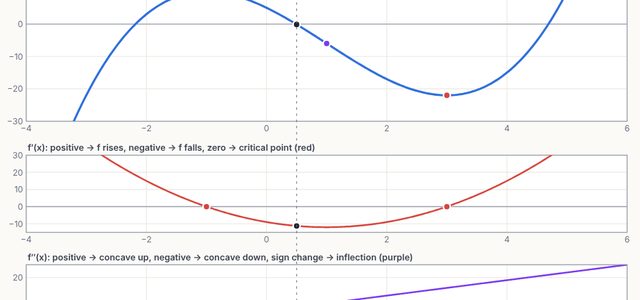
Open the Curve Sketching & Optimisation simulation and test every idea on this page yourself.
Open the simulation →