The big idea
Integration undoes differentiation. An antiderivative of f is any function whose derivative is f, and since constants differentiate to zero there is a whole family of them, written with + C. Substitution is the chain rule run backwards.
Key ideas
- Reverse power rule: raise the power by one and divide by the new power (not for n = −1, which gives ln|x|).
- Every indefinite integral needs + C. An initial condition fixes its value.
- u-substitution: let u be the inside function, find du, and rewrite the whole integral in u.
- If du is off only by a constant factor, adjust with that constant.
- Check any answer by differentiating it.
Equations
| ∫ xn dx = xn+1/(n + 1) + C | n ≠ −1 |
| ∫ (1/x) dx = ln|x| + C | the n = −1 case |
| ∫ ex dx = ex + C, ∫ cos x dx = sin x + C, ∫ sin x dx = −cos x + C | basic table |
| ∫ f(g(x)) g′(x) dx = ∫ f(u) du | substitution, u = g(x) |
Worked questions: easy, medium, hard
Three questions that climb in difficulty, each solved one step at a time. Try each one before you read the steps.
Find ∫ (6x2 − 4x + 5) dx.
- Integrate term by term: 6x3/3 = 2x3, 4x2/2 = 2x2, and 5 becomes 5x.
- Add the constant.
- 2x3 − 2x2 + 5x + C.
Find ∫ 2x(x2 + 1)5 dx.
- The inside function is x2 + 1, and its derivative 2x is sitting outside. Let u = x2 + 1, du = 2x dx.
- The integral becomes ∫ u5 du = u6/6 + C.
- Substitute back: (x2 + 1)6/6 + C.
Find ∫ x√(x + 1) dx.
- Let u = x + 1, so du = dx and x = u − 1.
- The integral becomes ∫ (u − 1)u1/2 du = ∫ (u3/2 − u1/2) du.
- Integrate: (2/5)u5/2 − (2/3)u3/2 + C.
- Substitute back: (2/5)(x + 1)5/2 − (2/3)(x + 1)3/2 + C.
Common mistakes
- Leaving out + C.
- Integrating a product as a product of integrals.
- Leaving a stray x in an integral that is supposed to be entirely in u.
Now you try: easy to hard
Six more questions, two at each level. These are the questions on the worksheet; each solution opens when you are ready.
Easy 1. Find ∫ (1/x2 + √x) dx.
Show the step-by-step solution
Rewrite as x−2 + x1/2. Integrate: −1/x + (2/3)x3/2 + C.
Easy 2. Find ∫ (cos x − 3ex) dx.
Show the step-by-step solution
sin x − 3ex + C.
Medium 3. Find ∫ xex2 dx.
Show the step-by-step solution
Let u = x2, du = 2x dx, so x dx = du/2. ∫ (1/2)eu du = (1/2)ex2 + C.
Medium 4. f′(x) = 3x2 − 2 and f(1) = 4. Find f(x).
Show the step-by-step solution
f(x) = x3 − 2x + C. Use f(1) = 4: 1 − 2 + C = 4, so C = 5. f(x) = x3 − 2x + 5.
Hard 5. Find ∫ (ln x)2/x dx.
Show the step-by-step solution
Let u = ln x, du = dx/x. ∫ u2 du = u3/3 + C = (ln x)3/3 + C.
Hard 6. Find ∫ x/√(2x + 1) dx.
Show the step-by-step solution
Let u = 2x + 1, so dx = du/2 and x = (u − 1)/2. The integral is (1/4)∫ (u1/2 − u−1/2) du = (1/4)[(2/3)u3/2 − 2u1/2] + C = (1/6)(2x + 1)3/2 − (1/2)(2x + 1)1/2 + C.
6 questions to print or save, with full step-by-step answers at the end.
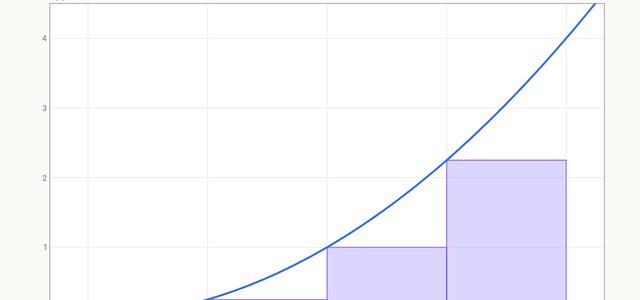
Open the Riemann Sums & the Fundamental Theorem simulation and test every idea on this page yourself.
Open the simulation →