The big idea
Chop the area under a curve into thin rectangles and add them up: that is a Riemann sum. As the rectangles get thinner the sum approaches the definite integral. The Fundamental Theorem of Calculus then says you can get that exact value from an antiderivative.
Key ideas
- Left, right and midpoint sums use the height at the left end, right end or middle of each strip. A trapezoid sum averages the left and right heights.
- For an increasing function, left sums underestimate and right sums overestimate.
- FTC part 2: ∫ from a to b of f equals F(b) − F(a), where F is any antiderivative.
- FTC part 1: the derivative of ∫ from a to x of f(t) dt is f(x). With an upper limit g(x), multiply by g′(x).
- Area below the x-axis counts as negative.
Equations
| ∫ab f(x) dx = F(b) − F(a) | FTC part 2 |
| d/dx ∫ax f(t) dt = f(x) | FTC part 1 |
| d/dx ∫ag(x) f(t) dt = f(g(x)) · g′(x) | with the chain rule |
| favg = (1/(b − a)) ∫ab f(x) dx | average value |
Worked questions: easy, medium, hard
Three questions that climb in difficulty, each solved one step at a time. Try each one before you read the steps.
Evaluate ∫13 (2x + 1) dx.
- Antiderivative: F(x) = x2 + x.
- F(3) = 12 and F(1) = 2.
- F(3) − F(1) = 10.
Estimate ∫02 x2 dx with 4 equal strips using left, right and trapezoid sums. Compare with the exact value.
- Δx = 0.5, and the heights at x = 0, 0.5, 1, 1.5, 2 are 0, 0.25, 1, 2.25, 4.
- Left sum: 0.5(0 + 0.25 + 1 + 2.25) = 1.75.
- Right sum: 0.5(0.25 + 1 + 2.25 + 4) = 3.75.
- Trapezoid: the average of the two, 2.75. Exact: [x3/3] from 0 to 2 = 8/3 ≈ 2.667.
Let g(x) = ∫0x (t2 − 4) dt for x ≥ 0. Find where g has a local minimum and the minimum value.
- By FTC part 1, g′(x) = x2 − 4.
- g′ = 0 at x = 2, and g′ changes from − to + there, so g has a local minimum at x = 2.
- g(2) = [t3/3 − 4t] from 0 to 2 = 8/3 − 8 = −16/3.
Common mistakes
- Computing F(a) − F(b) instead of F(b) − F(a).
- Forgetting the chain rule factor when the upper limit is a function of x.
- Treating a definite integral as an area when part of the graph is below the axis.
Now you try: easy to hard
Six more questions, two at each level. These are the questions on the worksheet; each solution opens when you are ready.
Easy 1. Evaluate ∫02 3x2 dx.
Show the step-by-step solution
[x3] from 0 to 2 = 8.
Easy 2. Evaluate ∫0π sin x dx.
Show the step-by-step solution
[−cos x] from 0 to π = −(−1) − (−1) = 2.
Medium 3. Use a midpoint sum with 2 strips to estimate ∫04 x2 dx.
Show the step-by-step solution
Δx = 2, midpoints 1 and 3. Sum = 2(1 + 9) = 20 (exact 64/3 ≈ 21.3).
Medium 4. A table gives f(0) = 3, f(2) = 5, f(4) = 4, f(6) = 8. Estimate ∫06 f(x) dx with three trapezoids.
Show the step-by-step solution
Each width is 2. Sum = (2/2)[3 + 2(5) + 2(4) + 8] = 29.
Hard 5. Find d/dx ∫2x3 cos(t2) dt.
Show the step-by-step solution
FTC part 1 with the chain rule: cos((x3)2) · 3x2 = 3x2 cos(x6).
Hard 6. Find the average value of f(x) = x2 on [0, 3] and the value of c where f(c) equals it.
Show the step-by-step solution
Average = (1/3)∫03 x2 dx = (1/3)(9) = 3. f(c) = c2 = 3 gives c = √3 ≈ 1.73.
6 questions to print or save, with full step-by-step answers at the end.
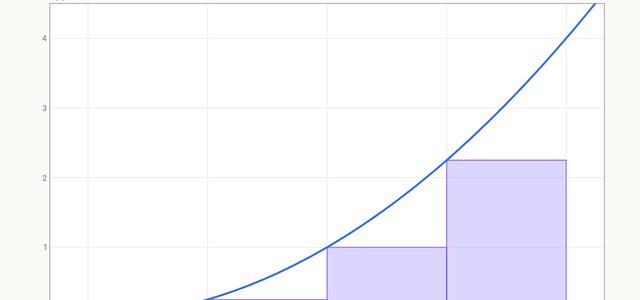
Open the Riemann Sums & the Fundamental Theorem simulation and test every idea on this page yourself.
Open the simulation →