The big idea
Integration by parts is the product rule run backwards. It trades one integral for another that should be easier. Partial fractions break a fraction with a factorable denominator into a sum of simple fractions, each of which integrates to a logarithm.
Key ideas
- By parts: choose u (to differentiate) and dv (to integrate). Good choices for u, in order: logs, inverse trig, algebraic, trig, exponential.
- Sometimes you apply parts twice, or the original integral reappears and you solve for it.
- Partial fractions need the degree of the top to be less than the bottom, and a factored bottom.
- Find the constants by substituting the roots of the denominator.
Equations
| ∫ u dv = uv − ∫ v du | integration by parts |
| ∫ab u dv = [uv]ab − ∫ab v du | definite version |
| (px + q)/[(x − a)(x − b)] = A/(x − a) + B/(x − b) | partial fractions |
| ∫ dx/(x − a) = ln|x − a| + C | each piece |
Worked questions: easy, medium, hard
Three questions that climb in difficulty, each solved one step at a time. Try each one before you read the steps.
Find ∫ xex dx.
- Choose u = x (gets simpler when differentiated) and dv = ex dx. Then du = dx and v = ex.
- Apply the formula: xex − ∫ ex dx.
- xex − ex + C.
Find ∫ x2 ln x dx.
- Logs make the best u: u = ln x, dv = x2 dx. Then du = dx/x and v = x3/3.
- Formula: (x3/3) ln x − ∫ (x3/3)(1/x) dx = (x3/3) ln x − ∫ x2/3 dx.
- (x3 ln x)/3 − x3/9 + C.
Find ∫ (5x + 1)/[(x − 1)(x + 2)] dx.
- Write (5x + 1)/[(x − 1)(x + 2)] = A/(x − 1) + B/(x + 2), so 5x + 1 = A(x + 2) + B(x − 1).
- Put x = 1: 6 = 3A, so A = 2. Put x = −2: −9 = −3B, so B = 3.
- Integrate each piece: ∫ 2/(x − 1) dx + ∫ 3/(x + 2) dx.
- 2 ln|x − 1| + 3 ln|x + 2| + C.
Common mistakes
- Choosing u and dv so the new integral is harder than the old one. Swap them.
- Dropping the minus sign in uv − ∫ v du.
- Using partial fractions when the top has the same or higher degree. Divide first.
Now you try: easy to hard
Six more questions, two at each level. These are the questions on the worksheet; each solution opens when you are ready.
Easy 1. Find ∫ xe2x dx.
Show the step-by-step solution
u = x, dv = e2x dx, v = e2x/2. Result: xe2x/2 − e2x/4 + C.
Easy 2. Find ∫ ln x dx.
Show the step-by-step solution
u = ln x, dv = dx, v = x. x ln x − ∫ x(1/x) dx = x ln x − x + C.
Medium 3. Evaluate ∫01 xe−x dx.
Show the step-by-step solution
u = x, v = −e−x. [−xe−x] from 0 to 1 + ∫01 e−x dx = −1/e + (1 − 1/e) = 1 − 2/e ≈ 0.264.
Medium 4. Find ∫ dx/(x2 − 1).
Show the step-by-step solution
1/[(x − 1)(x + 1)] = A/(x − 1) + B/(x + 1) with A = 1/2, B = −1/2. Result: (1/2) ln|(x − 1)/(x + 1)| + C.
Hard 5. Find ∫ x2ex dx.
Show the step-by-step solution
Parts twice. First: x2ex − ∫ 2xex dx. Second: ∫ 2xex dx = 2xex − 2ex. Result: ex(x2 − 2x + 2) + C.
Hard 6. Find ∫ ex sin x dx.
Show the step-by-step solution
Let I be the integral. Parts twice (u = sin x, then u = cos x): I = ex sin x − ex cos x − I. So 2I = ex(sin x − cos x) and I = ex(sin x − cos x)/2 + C.
6 questions to print or save, with full step-by-step answers at the end.
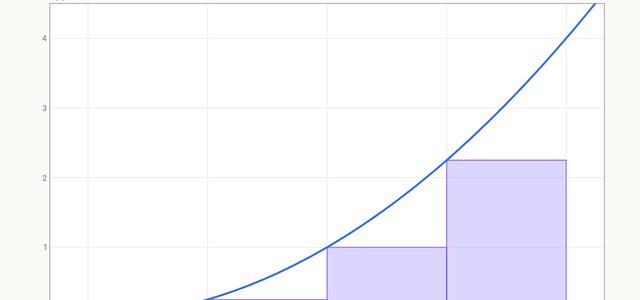
Open the Riemann Sums & the Fundamental Theorem simulation and test every idea on this page yourself.
Open the simulation →