The big idea
An integral is improper if a limit of integration is infinite or the function blows up somewhere on the interval. You cannot substitute ∞ directly. Replace it with a letter, integrate, then take a limit. If the limit is a finite number the integral converges; otherwise it diverges.
Key ideas
- Infinite limit: ∫ from a to ∞ means the limit as b → ∞ of ∫ from a to b.
- Infinite integrand: approach the asymptote with a limit from inside the interval.
- p-test at infinity: ∫ from 1 to ∞ of 1/xp converges only when p > 1.
- p-test at zero: ∫ from 0 to 1 of 1/xp converges only when p < 1.
Equations
| ∫a∞ f(x) dx = limb→∞ ∫ab f(x) dx | infinite interval |
| ∫1∞ dx/xp = 1/(p − 1) if p > 1 | diverges if p ≤ 1 |
| ∫01 dx/xp = 1/(1 − p) if p < 1 | diverges if p ≥ 1 |
| ∫0∞ e−kx dx = 1/k | k > 0 |
Worked questions: easy, medium, hard
Three questions that climb in difficulty, each solved one step at a time. Try each one before you read the steps.
Evaluate ∫1∞ dx/x2.
- Replace ∞ with b: ∫1b x−2 dx = [−1/x] from 1 to b = 1 − 1/b.
- Let b → ∞: 1/b → 0.
- The integral converges to 1.
Decide whether each integral converges, and evaluate it if it does: (a) ∫0∞ e−2x dx, (b) ∫1∞ dx/x.
- (a) ∫0b e−2x dx = [−e−2x/2] = 1/2 − e−2b/2.
- As b → ∞ the exponential vanishes: converges to 1/2.
- (b) ∫1b dx/x = ln b, which grows without bound as b → ∞.
- So (b) diverges, even though 1/x → 0.
Evaluate ∫0∞ xe−x dx.
- Integrate by parts with u = x, dv = e−x dx: ∫ xe−x dx = −xe−x − e−x.
- From 0 to b: (−be−b − e−b) − (0 − 1) = 1 − (b + 1)e−b.
- As b → ∞, (b + 1)/eb → 0 (L'Hôpital).
- The integral converges to 1.
Common mistakes
- Substituting ∞ as if it were a number instead of writing a limit.
- Assuming an integral converges because the function tends to 0. 1/x is the counter-example.
- Missing an asymptote inside the interval, such as ∫ from −1 to 1 of 1/x2.
Now you try: easy to hard
Six more questions, two at each level. These are the questions on the worksheet; each solution opens when you are ready.
Easy 1. Evaluate ∫1∞ dx/x3.
Show the step-by-step solution
[−1/(2x2)] from 1 to b = 1/2 − 1/(2b2) → 1/2.
Easy 2. Does ∫1∞ dx/√x converge?
Show the step-by-step solution
p = 1/2 ≤ 1. ∫1b x−1/2 dx = 2√b − 2 → ∞. It diverges.
Medium 3. Evaluate ∫01 x−1/3 dx.
Show the step-by-step solution
The integrand blows up at 0. ∫a1 x−1/3 dx = (3/2)(1 − a2/3) → 3/2 as a → 0.
Medium 4. Evaluate ∫−∞0 e3x dx.
Show the step-by-step solution
[e3x/3] from a to 0 = 1/3 − e3a/3 → 1/3 as a → −∞.
Hard 5. Evaluate ∫0∞ dx/(1 + x2).
Show the step-by-step solution
[tan−1 x] from 0 to b = tan−1 b → π/2.
Hard 6. Evaluate ∫2∞ dx/(x2 − 1).
Show the step-by-step solution
Partial fractions: antiderivative (1/2) ln[(x − 1)/(x + 1)]. As x → ∞ the fraction → 1 and the log → 0. At x = 2 it is (1/2) ln(1/3). Result: 0 − (1/2) ln(1/3) = (1/2) ln 3 ≈ 0.549.
6 questions to print or save, with full step-by-step answers at the end.
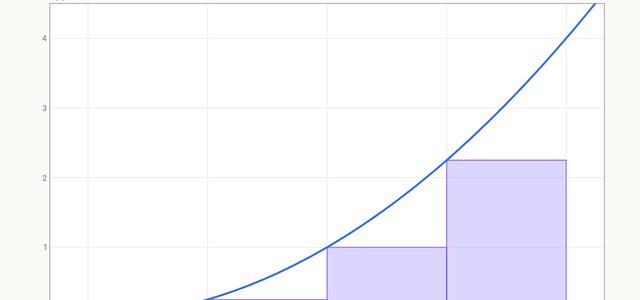
Open the Riemann Sums & the Fundamental Theorem simulation and test every idea on this page yourself.
Open the simulation →