The big idea
A Taylor polynomial matches a function's value and its first few derivatives at one point, so it hugs the curve near there. Keep adding terms forever and you get a Taylor series, which for many functions equals the function itself on an interval.
Key ideas
- The coefficient of (x − a)n is the nth derivative at a, divided by n!.
- A Maclaurin series is a Taylor series centred at a = 0.
- Build new series from known ones by substituting, multiplying, differentiating or integrating.
- Use the ratio test to find the radius of convergence, then test each endpoint separately.
- Lagrange error bound: the error of a degree-n polynomial is at most M|x − a|n+1/(n + 1)!, where M bounds the next derivative.
Equations
| f(x) = Σ f(n)(a)(x − a)n/n! | Taylor series about a |
| ex = 1 + x + x2/2! + x3/3! + … | all x |
| sin x = x − x3/3! + x5/5! − …, cos x = 1 − x2/2! + x4/4! − … | all x |
| 1/(1 − x) = 1 + x + x2 + x3 + … | |x| < 1 |
Worked questions: easy, medium, hard
Three questions that climb in difficulty, each solved one step at a time. Try each one before you read the steps.
Write the Maclaurin polynomial of degree 3 for ex and use it to estimate e0.1.
- Every derivative of ex is ex, which equals 1 at x = 0.
- P3(x) = 1 + x + x2/2 + x3/6.
- P3(0.1) = 1 + 0.1 + 0.005 + 0.000167 = 1.105167 (true value 1.105171).
Start from the series for 1/(1 − x) and find a power series for tan−1 x.
- Replace x with −x2: 1/(1 + x2) = 1 − x2 + x4 − x6 + …, valid for |x| < 1.
- tan−1 x is the integral of 1/(1 + x2) from 0 to x.
- Integrate term by term: tan−1 x = x − x3/3 + x5/5 − x7/7 + …
Find the interval of convergence of Σ (x − 2)n/(n · 3n), n ≥ 1.
- Ratio test: |an+1/an| = |x − 2| · n/[3(n + 1)] → |x − 2|/3.
- Converges when |x − 2|/3 < 1: −1 < x < 5. The radius is 3.
- At x = 5 the series is Σ 1/n, the harmonic series, which diverges.
- At x = −1 it is Σ (−1)n/n, the alternating harmonic series, which converges.
Common mistakes
- Leaving out the factorials.
- Giving the radius of convergence and forgetting to test the endpoints.
- Re-deriving a series from scratch when a substitution into a known series would do.
Now you try: easy to hard
Six more questions, two at each level. These are the questions on the worksheet; each solution opens when you are ready.
Easy 1. Write the Maclaurin polynomial of degree 4 for cos x and estimate cos 0.2.
Show the step-by-step solution
P4 = 1 − x2/2 + x4/24. P4(0.2) = 1 − 0.02 + 0.0000667 = 0.980067.
Easy 2. Find the first three non-zero terms of the Maclaurin series for e−x2.
Show the step-by-step solution
Substitute −x2 into eu = 1 + u + u2/2: 1 − x2 + x4/2.
Medium 3. Find the degree-2 Taylor polynomial for √x about x = 4.
Show the step-by-step solution
f(4) = 2. f′ = 1/(2√x) = 1/4. f″ = −(1/4)x−3/2 = −1/32, and dividing by 2! gives −1/64. P2 = 2 + (x − 4)/4 − (x − 4)2/64.
Medium 4. Find the radius of convergence of Σ xn/n! and of Σ nxn.
Show the step-by-step solution
First: ratio |x|/(n + 1) → 0 for every x, so R = ∞. Second: ratio |x|(n + 1)/n → |x|, so R = 1.
Hard 5. Bound the error when sin x is approximated by x − x3/6 for |x| ≤ 0.5.
Show the step-by-step solution
The series alternates, and the next term is x5/120. Error ≤ 0.55/120 = 0.03125/120 ≈ 0.00026.
Hard 6. Find the interval of convergence of Σ (x + 1)n/(n2 · 2n), n ≥ 1.
Show the step-by-step solution
Ratio → |x + 1|/2 < 1 gives −3 < x < 1. At both endpoints the terms have size 1/n2, a convergent p-series. Interval: −3 ≤ x ≤ 1.
6 questions to print or save, with full step-by-step answers at the end.
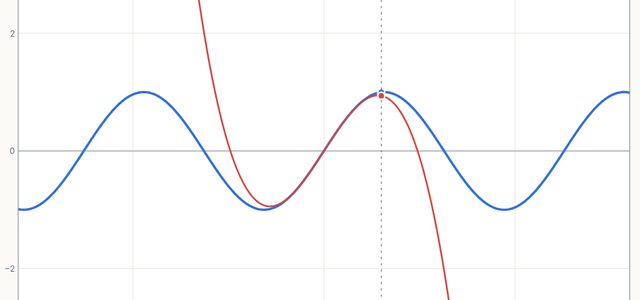
Open the Taylor Polynomials & Series simulation and test every idea on this page yourself.
Open the simulation →