The big idea
An infinite series adds infinitely many terms. Sometimes the running total settles down to a number (it converges) and sometimes it does not (it diverges). A toolbox of tests decides which, often without finding the sum.
Key ideas
- nth-term test: if the terms do not go to 0, the series diverges. (Terms going to 0 proves nothing.)
- Geometric series converge when |r| < 1, to a/(1 − r).
- p-series Σ 1/np converge when p > 1. The harmonic series (p = 1) diverges.
- Ratio test: limit of |an+1/an| below 1 converges, above 1 diverges, equal to 1 is inconclusive. Best for factorials and exponentials.
- An alternating series converges if its terms shrink to 0. The error is less than the first term left out.
- Absolute convergence means Σ|an| converges. Conditional convergence means only the alternating version does.
Equations
| Σn=0∞ arn = a/(1 − r), |r| < 1 | geometric series |
| Σ 1/np converges ⇔ p > 1 | p-series |
| L = lim |an+1/an| | ratio test: L < 1 converges |
| |S − Sn| ≤ |an+1| | alternating series error bound |
Worked questions: easy, medium, hard
Three questions that climb in difficulty, each solved one step at a time. Try each one before you read the steps.
Find the sum of 3 + 3/2 + 3/4 + 3/8 + …
- This is geometric with first term a = 3 and ratio r = 1/2.
- |r| < 1, so it converges.
- Sum = a/(1 − r) = 3/(1/2) = 6.
Does Σ n2/2n (from n = 1) converge?
- There is an exponential, so use the ratio test.
- an+1/an = [(n + 1)2/2n+1] · [2n/n2] = (1/2)((n + 1)/n)2.
- As n → ∞ this tends to 1/2.
- 1/2 < 1, so the series converges.
Does Σ (−1)n/√n (from n = 1) converge absolutely, converge conditionally, or diverge?
- Alternating series test: 1/√n decreases and tends to 0, so the series converges.
- Absolute values: Σ 1/√n is a p-series with p = 1/2 ≤ 1, which diverges.
- It converges, but not absolutely.
- So it converges conditionally.
Common mistakes
- Concluding a series converges because its terms go to 0. The harmonic series is the counter-example.
- Using the ratio test on a p-series. It always gives 1 there.
- Using a/(1 − r) with the wrong first term when the sum does not start at n = 0.
Now you try: easy to hard
Six more questions, two at each level. These are the questions on the worksheet; each solution opens when you are ready.
Easy 1. Find the sum of Σ 2/3n from n = 1 to ∞.
Show the step-by-step solution
Geometric with first term 2/3 and r = 1/3. Sum = (2/3)/(1 − 1/3) = 1.
Easy 2. Does Σ n/(2n + 1) converge?
Show the step-by-step solution
The terms tend to 1/2, not 0. By the nth-term test it diverges.
Medium 3. Classify Σ 1/n1.5 and Σ 1/√n.
Show the step-by-step solution
p-series: p = 1.5 > 1 converges; p = 0.5 ≤ 1 diverges.
Medium 4. Does Σ n!/10n converge?
Show the step-by-step solution
Ratio: [(n + 1)!/10n+1] · [10n/n!] = (n + 1)/10 → ∞. Greater than 1, so it diverges.
Hard 5. Use the integral test on Σ 1/(n ln n) from n = 2.
Show the step-by-step solution
∫2∞ dx/(x ln x): let u = ln x, giving ln(ln x), which grows without bound. The integral diverges, so the series diverges.
Hard 6. How many terms of Σ (−1)n+1/n2 are needed for an error below 0.01?
Show the step-by-step solution
The error is at most the next term, 1/(n + 1)2. Need 1/(n + 1)2 < 0.01, so n + 1 > 10. n = 10 terms (then the bound is 1/121 ≈ 0.0083).
6 questions to print or save, with full step-by-step answers at the end.
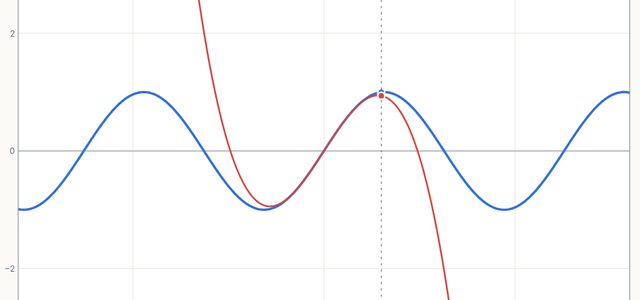
Open the Taylor Polynomials & Series simulation and test every idea on this page yourself.
Open the simulation →