The big idea
Fractions, decimals and percentages are three ways of writing the same number. Fractions need a common denominator to add or subtract. Percentage changes are quickest with a multiplier: an increase of 15% means multiplying by 1.15.
Key ideas
- To add or subtract fractions, rewrite them with a common denominator. To multiply, multiply tops and bottoms. To divide, flip the second fraction and multiply.
- Percentage to decimal: divide by 100. An increase of p% has multiplier 1 + p/100; a decrease has 1 − p/100.
- For a reverse percentage, divide the final amount by the multiplier.
- A recurring decimal becomes a fraction by multiplying by a power of 10 and subtracting.
Equations
| a/b + c/d = (ad + bc)/(bd) | adding fractions |
| a/b ÷ c/d = a/b × d/c | dividing fractions |
| new = original × (1 ± p/100) | percentage change |
| original = new ÷ multiplier | reverse percentage |
Worked questions: easy, medium, hard
Three questions that climb in difficulty, each solved one step at a time. Try each one before you read the steps.
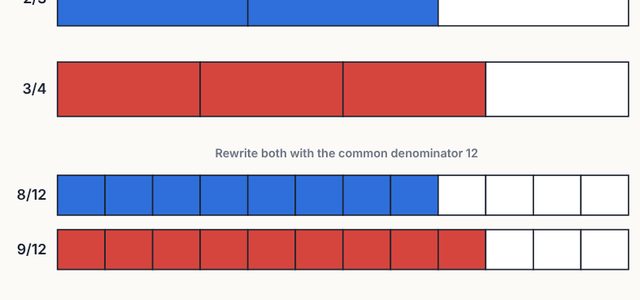
Work out 2/3 + 3/4.
- The common denominator of 3 and 4 is 12.
- 2/3 = 8/12 and 3/4 = 9/12.
- 8/12 + 9/12 = 17/12 = 1 5/12.
A phone costs $80. Its price rises by 15% and is then reduced by 10% in a sale. Find the sale price and the overall percentage change.
- Rise of 15%: 80 × 1.15 = 92.
- Reduction of 10%: 92 × 0.90 = $82.80.
- Overall multiplier: 1.15 × 0.90 = 1.035, an increase of 3.5% (not 5%).
After a 15% discount a jacket costs $68. What was the original price?
- A 15% discount leaves 85%, so the multiplier is 0.85.
- original × 0.85 = 68.
- original = 68 ÷ 0.85 = $80.
- Check: 15% of 80 is 12, and 80 − 12 = 68.
Common mistakes
- Adding tops and bottoms: 1/2 + 1/3 is not 2/5.
- Finding 15% of the sale price to undo a 15% discount. Divide by the multiplier instead.
- Adding percentage changes. A 15% rise then a 10% fall is not a 5% rise.
Now you try: easy to hard
Six more questions, two at each level. These are the questions on the worksheet; each solution opens when you are ready.
Easy 1. Find 3/5 of 45.
Show the step-by-step solution
45 ÷ 5 = 9, and 9 × 3 = 27.
Easy 2. Work out 7/8 − 1/6.
Show the step-by-step solution
Common denominator 24: 21/24 − 4/24 = 17/24.
Medium 3. Work out 2 1/2 ÷ 3/4.
Show the step-by-step solution
2 1/2 = 5/2. Flip and multiply: 5/2 × 4/3 = 20/6 = 10/3 = 3 1/3.
Medium 4. Increase 240 by 12.5%.
Show the step-by-step solution
Multiplier 1.125: 240 × 1.125 = 270.
Hard 5. Write the recurring decimal 0.454545… as a fraction.
Show the step-by-step solution
Let x = 0.4545… Then 100x = 45.4545… Subtract: 99x = 45, so x = 45/99 = 5/11.
Hard 6. A town's population rose by 8% to 5940. What was it before?
Show the step-by-step solution
Multiplier 1.08: 5940 ÷ 1.08 = 5500.
6 questions to print or save, with full step-by-step answers at the end.
Open the Number Lab simulation and test every idea on this page yourself.
Open the simulation →