The big idea
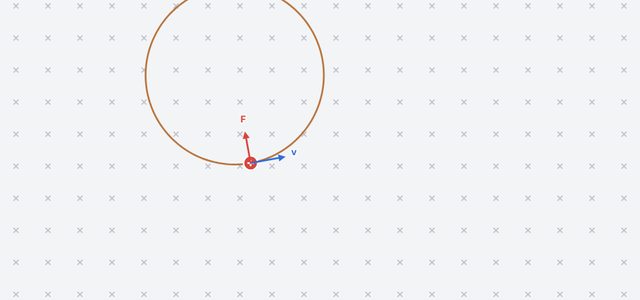
A magnetic field pushes only on moving charges, and always sideways, perpendicular to both the velocity and the field. Because it never pushes along the motion, a magnetic force can turn a particle but never speed it up. A current is just moving charge, so wires in fields feel forces too.
Key ideas
- F = |q|vB sin θ. The direction comes from the right-hand rule, reversed for negative charges.
- The force is perpendicular to v, so it does no work: the speed stays constant, and the particle moves in a circle.
- Circle radius r = mv/(|q|B). The period T = 2πm/(|q|B) does not depend on speed.
- Velocity selector: crossed E and B fields let through only particles with v = E/B.
- Force on a wire: F = ILB sin θ. This is the principle behind electric motors.
Equations
| F = qv × B | force on a moving charge |
| F = |q|vB sin θ | magnitude |
| r = mv/(|q|B) | radius of circular path |
| v = E/B | velocity selector |
| F = ILB sin θ | force on a wire |
Worked example
A proton (m = 1.67 × 10⁻²⁷ kg) moves at 3.0 × 10⁵ m/s perpendicular to a 0.050 T field. Find the force on it and the radius of its path.
- F = qvB = (1.6 × 10⁻¹⁹)(3.0 × 10⁵)(0.050) = 2.4 × 10⁻¹⁵ N.
- The magnetic force provides the centripetal force: qvB = mv²/r.
- r = mv/(qB) = (1.67 × 10⁻²⁷)(3.0 × 10⁵)/[(1.6 × 10⁻¹⁹)(0.050)] = 0.063 m (6.3 cm).
- An electron at the same speed would curve the other way, on a circle 1836 times smaller.
Common mistakes
- Using the right-hand rule for a negative charge without reversing the result.
- Saying the magnetic force speeds a particle up. It only changes the direction.
- Expecting a force on a charge moving parallel to B (sin 0° = 0).
Try it yourself
In a velocity selector, E = 1000 V/m and B = 0.010 T. What speed passes straight through?
Show the answer
v = E/B = 1000/0.010 = 1.0 × 10⁵ m/s.
Going deeper: AP Physics C
This part goes beyond the algebra course: calculus derivations, harder multi-step problems and exam-style practice, written at the level of the AP Physics C exam.
The vector form
The force on a moving charge is F = qv × B, and on a current-carrying wire it is dF = I dℓ × B. Because the force is always perpendicular to v, a magnetic field does no work: it changes the direction of motion but never the speed. In a uniform field, a curved wire between two points feels the same force as a straight wire joining them.
Torque on a current loop
A loop with N turns, area A and current I has magnetic dipole moment μ = NIAn̂, where n̂ is given by the right-hand rule around the current. In a field B:
τ = μ × B U = −μ·BThis torque is what drives electric motors and moving-coil meters.
Mass spectrometers and velocity selectors
Accelerate an ion through a potential difference V, so ½mv² = qV. Then bend it in a field B: r = mv/(qB) = √(2mV/q)/B. A velocity selector with crossed E and B fields lets through only ions with v = E/B.
More worked examples
Example 1. A rectangular coil of 50 turns and area 4.0 × 10⁻³ m² carries 2.0 A in a 0.30 T field. Find the maximum torque.
- μ = NIA = (50)(2.0)(4.0 × 10⁻³) = 0.40 A·m².
- τmax = μB (when μ ⊥ B) = (0.40)(0.30) = 0.12 N·m.
Example 2. A proton, starting from rest, is accelerated through 2000 V and then enters a 0.20 T field at right angles. Find the radius of its path.
- v = √(2qV/m) = √(2(1.6 × 10⁻¹⁹)(2000)/(1.67 × 10⁻²⁷)) = 6.2 × 10⁵ m/s.
- r = mv/(qB) = (1.67 × 10⁻²⁷)(6.2 × 10⁵)/((1.6 × 10⁻¹⁹)(0.20)) = 3.2 cm.
Exam-style practice
1. A 0.50 m wire carrying 3.0 A makes 30° with a 0.40 T field. What force acts on it?
Show the solution
F = ILB sin θ = (3)(0.5)(0.4)(0.5) = 0.30 N.
2. A semicircular wire of radius R carrying current I lies in a uniform field B perpendicular to its plane. What is the net force on it?
Show the solution
The same as for the straight diameter: F = 2IRB.
3. Why can't a static magnetic field change a charged particle's kinetic energy?
Show the solution
F ⊥ v always, so P = F·v = 0.
Open the Magnetic Force simulation and test every idea on this page yourself.
Open the simulation →