The big idea
When a capacitor charges or discharges through a resistor, nothing happens instantly. The current starts at its largest and dies away exponentially, and the capacitor voltage creeps toward its final value. The time constant τ = RC sets the pace.
Key ideas
- An uncharged capacitor acts like a wire at the first instant: I₀ = ε/R.
- A fully charged capacitor acts like an open circuit: I = 0 and VC = ε.
- After 1τ: 63% charged (charging), or 37% remaining (discharging). After 5τ it's essentially done.
- Kirchhoff's loop rule gives ε − IR − q/C = 0, a differential equation (C: E&M).
- A larger R or C gives a slower circuit.
Equations
| τ = RC | time constant |
| VC(t) = ε(1 − e−t/τ) | charging |
| I(t) = (ε/R)e−t/τ | charging current |
| VC(t) = V₀e−t/τ | discharging |
Worked example
A 10 kΩ resistor and a 200 µF capacitor are connected to a 9.0 V battery through a switch. Find τ, the initial current, VC after 2.0 s, and the time to reach 90% charge.
- τ = RC = (10 × 10³)(200 × 10⁻⁶) = 2.0 s.
- Initial current: I₀ = ε/R = 9.0/10 000 = 0.90 mA.
- At t = 2.0 s = τ: VC = 9.0(1 − e⁻¹) = 5.7 V.
- 90%: 1 − e−t/τ = 0.90 → t = τ ln 10 = 4.6 s.
Common mistakes
- Thinking the capacitor charges in a straight line.
- Forgetting that the current reverses direction when the capacitor discharges.
- Using τ = R/C or C/R.
Try it yourself
How long does the same capacitor take to discharge to half its starting voltage?
Show the answer
e−t/τ = ½ → t = τ ln 2 = 2.0 × 0.693 ≈ 1.4 s.
Going deeper: AP Physics C
This part goes beyond the algebra course: calculus derivations, harder multi-step problems and exam-style practice, written at the level of the AP Physics C exam.
Deriving the charging curve
Kirchhoff's loop rule around a charging RC circuit: ε − iR − q/C = 0, with i = dq/dt. This is a separable differential equation:
dqCε − q = dtRC ⇒ q(t) = Cε(1 − e−t/RC), i(t) = εRe−t/RCDischarging: q = Q₀e−t/RC. The time constant τ = RC is how long it takes to reach 63% of the final charge, or to fall to 37% when discharging.
Where the energy goes
While charging, the battery delivers Qε = Cε² of energy. Only half of it, ½Cε², ends up stored in the capacitor. The other half becomes heat in the resistor, whatever the value of R. You can check this by integrating ∫i²R dt from 0 to ∞.
Instant and long-term behaviour
Just after the switch closes, an uncharged capacitor acts like a wire. Long afterwards, it acts like a break in the circuit. Use these two limits to find the initial and final currents in complicated circuits without solving any differential equation.
More worked examples
Example 1. For an RC circuit with τ = 2.0 s, how long does the capacitor take to reach 99% of its final charge?
- 1 − e−t/τ = 0.99 → e−t/τ = 0.01.
- t = τ ln 100 = 2.0 × 4.61 = 9.2 s, about 4.6 time constants.
Example 2. A 4.0 mF capacitor is charged through a resistor by a 20 V battery. Find the energy supplied by the battery, the energy stored, and the heat produced.
- Final charge Q = Cε = 0.080 C. The battery supplies Qε = 1.6 J.
- Stored: ½Cε² = ½(4.0 × 10⁻³)(400) = 0.80 J.
- Heat in the resistor = 1.6 − 0.80 = 0.80 J, independent of R.
Exam-style practice
1. How long does a discharging capacitor take to lose half its charge?
Show the solution
t = τ ln 2 ≈ 0.69 RC.
2. A 10 V battery, a 5 kΩ resistor and an uncharged capacitor are in series. What is the current the instant the switch closes?
Show the solution
The capacitor acts like a wire: I = 10/5000 = 2 mA.
3. Show that RC has units of seconds.
Show the solution
Ω·F = (V/A)(C/V) = C/A = C/(C/s) = s.
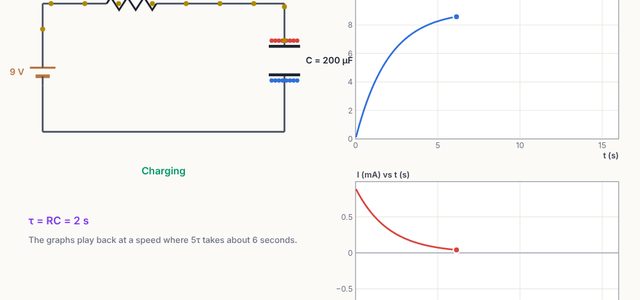
Open the RC Circuits simulation and test every idea on this page yourself.
Open the simulation →