The big idea
Circuit analysis rests on two conservation laws. Charge is conserved at every junction (the current in equals the current out). Energy is conserved around every loop (the voltage gains equal the voltage drops). Combined with Ohm's law, these let you find any current or voltage.
Key ideas
- Ohm's law: V = IR. Power: P = IV = I²R = V²/R.
- Series: the same current, the voltages add, and Req = R₁ + R₂ + … (always larger than any one of them).
- Parallel: the same voltage, the currents add, and 1/Req = 1/R₁ + 1/R₂ + … (always smaller than the smallest).
- Simplify from the innermost group outward, then work back in to find each current.
- Kirchhoff: ΣIin = ΣIout at a junction, and ΣΔV = 0 around any closed loop.
Equations
| V = IR | Ohm's law |
| R = ρL/A | resistance of a wire |
| Rser = ΣR | series |
| 1/Rpar = Σ1/R | parallel |
| P = IV = I²R = V²/R | power |
Worked example
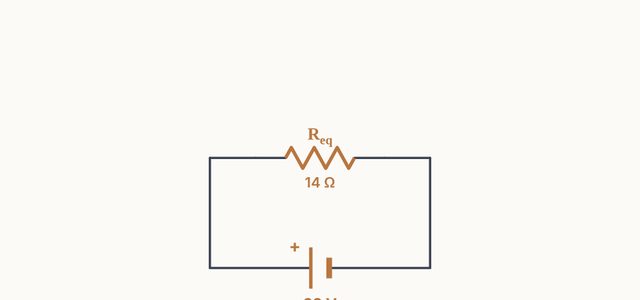
A 28 V battery drives 4 Ω in series with (6 Ω ∥ 3 Ω) and then 8 Ω. Find Req, the total current, and the current through the 6 Ω and 3 Ω resistors.
- Parallel pair first: 6 × 3/(6 + 3) = 2 Ω.
- Series: Req = 4 + 2 + 8 = 14 Ω.
- Total current: I = V/Req = 28/14 = 2.0 A, through the 4 Ω, the pair, and the 8 Ω.
- Voltage across the pair: V = IR = (2.0)(2) = 4.0 V.
- I₆ = 4.0/6 = 0.67 A, I₃ = 4.0/3 = 1.33 A. Check: 0.67 + 1.33 = 2.0 ✓
Common mistakes
- Adding parallel resistors directly.
- Thinking current is "used up" by a resistor. The current is the same all the way along a series path.
- Assuming every resistor has the full battery voltage across it.
Try it yourself
Find the equivalent resistance of 30 Ω, 60 Ω and 20 Ω in parallel.
Show the answer
1/R = 1/30 + 1/60 + 1/20 = 6/60 → R = 10 Ω.
Going deeper: AP Physics C
This part goes beyond the algebra course: calculus derivations, harder multi-step problems and exam-style practice, written at the level of the AP Physics C exam.
 Simulation for this sectionKirchhoff's Rules: Two LoopsOpen it →
Current density and resistivity
Microscopically, current is I = nqvdA. The resistance of a wire depends on its material and shape: R = ρL/A. Resistivity ρ rises with temperature for metals. Power dissipated is P = IV = I²R = V²/R.
Real batteries: EMF and internal resistance
A battery is an ideal EMF ε in series with a small internal resistance r. With a load R connected, I = ε/(R + r), and the terminal voltage is V = ε − Ir, which is less than ε whenever current flows. The power delivered to the load is greatest when R = r.
Kirchhoff's rules for multi-loop circuits
Junction rule: the current in equals the current out (charge conservation). Loop rule: the sum of ΔV around any closed loop is zero (energy conservation). Guess a direction for each branch current. If an answer comes out negative, the current simply flows the other way, so you don't need to redo anything. You need as many independent equations as unknown currents.
Meters
An ideal ammeter goes in series and has zero resistance. An ideal voltmeter goes in parallel and has infinite resistance. A real meter disturbs the circuit slightly.
More worked examples
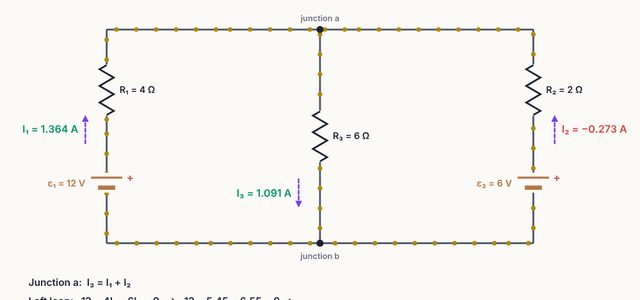
Example 1. Two batteries share a middle branch. The left branch has 12 V with R₁ = 4.0 Ω, the right branch has 6.0 V with R₂ = 2.0 Ω, and the middle branch is R₃ = 6.0 Ω. Both batteries have their + terminals toward the top junction. Find all three currents.
- Let I₁ and I₂ flow up through the left and right branches and I₃ flow down through the middle: I₃ = I₁ + I₂.
- Left loop: 12 − 4I₁ − 6I₃ = 0. Right loop: 6 − 2I₂ − 6I₃ = 0.
- Substituting and solving: I₁ = 15/11 = 1.36 A, I₂ = −3/11 = −0.27 A, I₃ = 12/11 = 1.09 A.
- The minus sign means current actually flows down through the 6 V battery: the 12 V battery is charging it.
Example 2. A 9.0 V battery with internal resistance 0.50 Ω powers a 4.0 Ω resistor. Find the current, the terminal voltage, and the power wasted inside the battery.
- I = ε/(R + r) = 9.0/4.5 = 2.0 A.
- V = ε − Ir = 9.0 − 1.0 = 8.0 V.
- Pinternal = I²r = 2.0 W.
Exam-style practice
1. Find the resistance of 10 m of copper wire (ρ = 1.7 × 10⁻⁸ Ω·m) with cross-section 1.0 mm².
Show the solution
R = ρL/A = (1.7 × 10⁻⁸)(10)/(1.0 × 10⁻⁶) = 0.17 Ω.
2. A battery has ε = 12 V and r = 2 Ω. What load resistance draws the maximum power, and how much?
Show the solution
R = r = 2 Ω; I = 3 A, so P = 9 × 2 = 18 W.
3. A voltmeter reads the terminal voltage of a battery as 1.5 V with nothing else connected. Why might it read less when a bulb is connected?
Show the solution
Current now flows through the internal resistance, so V = ε − Ir drops.
Open the Resistor Network Simplifier simulation and test every idea on this page yourself.
Open the simulation →