The big idea
A capacitor stores charge, and energy, in the electric field between two conductors. How much charge it holds per volt is its capacitance, which depends only on geometry and on the material between the plates. The key exam skill is knowing what stays constant when something changes.
Key ideas
- C = Q/V, measured in farads (F). Parallel plates: C = κε₀A/d.
- A dielectric (κ > 1) increases C by polarizing and partly cancelling the field.
- Energy stored: U = ½CV² = ½QV = Q²/(2C).
- Connected to a battery: V is fixed. Isolated: Q is fixed.
- In parallel the capacitances add: C = C₁ + C₂. In series: 1/C = 1/C₁ + 1/C₂ (the opposite of resistors).
Equations
| C = Q/V | definition |
| C = κε₀A/d | parallel plates |
| U = ½CV² = ½QV | stored energy |
| E = V/d = σ/(κε₀) | field between the plates |
| Cpar = ΣC, 1/Cser = Σ1/C | combinations |
Worked example
Parallel plates of area 0.010 m² are 2.0 mm apart in air, connected to 12 V. Find C, Q and U. What happens to Q if a dielectric with κ = 4 is inserted while it is still connected?
- C = ε₀A/d = (8.85 × 10⁻¹²)(0.010)/(0.0020) = 44 pF.
- Q = CV = (44.3 × 10⁻¹²)(12) = 0.53 nC.
- U = ½CV² = ½(44.3 × 10⁻¹²)(144) = 3.2 nJ.
- With the dielectric, C becomes 4 × 44 = 177 pF. V stays 12 V (battery), so Q = CV goes up 4×, to 2.1 nC. More charge flows on from the battery.
Common mistakes
- Changing V when the capacitor is isolated, or changing Q while it's still connected.
- Using the resistor rules for capacitor combinations.
- Forgetting to convert mm to m and cm² to m².
Try it yourself
An isolated charged capacitor has its plate separation doubled. What happens to C, V and U?
Show the answer
C halves, Q is fixed, so V = Q/C doubles, and U = Q²/2C doubles. The extra energy comes from the work done pulling the plates apart.
Going deeper: AP Physics C
This part goes beyond the algebra course: calculus derivations, harder multi-step problems and exam-style practice, written at the level of the AP Physics C exam.
Deriving capacitance
The recipe always runs the same way: assume charge ±Q on the plates, find E (usually with Gauss's law), integrate to get ΔV, and then C = Q/ΔV. The geometry is all that remains.
Parallel plates: C = ε₀A/d Spherical: C = 4πε₀abb − a Cylindrical: C = 2πε₀Lln(b/a)Energy stored in the field
Charging a capacitor takes work, U = ½CV² = Q²/(2C). That energy lives in the electric field, with energy density
u = ½ε₀E²Dielectrics, and what is held constant
A dielectric multiplies C by κ. What happens next depends on the connection. If the capacitor is still connected to a battery, V stays fixed, so Q and U both rise by κ. If it is isolated, Q stays fixed, so V and U both fall by κ. When two capacitors share charge, the total charge is conserved but energy is always lost, to heat and radiation in the wires.
More worked examples
Example 1. A 3.0 µF capacitor charged to 12 V is disconnected and connected across an uncharged 6.0 µF capacitor. Find the final voltage and the energy before and after.
- Q = (3.0 µF)(12 V) = 36 µC, and it is conserved.
- In parallel: V = Q/(C₁ + C₂) = 36/9.0 = 4.0 V.
- Before: ½(3.0 × 10⁻⁶)(12)² = 216 µJ. After: ½(9.0 × 10⁻⁶)(4.0)² = 72 µJ.
- Two-thirds of the energy is lost, however small the resistance of the wires.
Example 2. Derive the capacitance of two concentric spherical shells (radii a = 1.0 cm and b = 3.0 cm) and evaluate it.
- Between the shells, Gauss gives E = kQ/r².
- ΔV = ∫ab kQ/r² dr = kQ(1/a − 1/b) = kQ(b − a)/(ab).
- C = Q/ΔV = ab/(k(b − a)) = 4πε₀ab/(b − a).
- C = (0.010)(0.030)/((8.99 × 10⁹)(0.020)) = 1.7 pF.
Example 3. Find the capacitance per metre of a coaxial cable with b/a = 3.
- Gauss: E = λ/(2πε₀r) between the conductors.
- ΔV = (λ/2πε₀) ln(b/a), so C/L = 2πε₀/ln(b/a).
- C/L = (5.56 × 10⁻¹¹)/ln 3 = 51 pF/m.
Exam-style practice
1. 2.0 µF and 4.0 µF capacitors are in series, and that pair is in parallel with a 6.0 µF capacitor. Find the equivalent capacitance.
Show the solution
Series: (2 × 4)/(2 + 4) = 1.33 µF. Adding 6 in parallel gives 7.33 µF.
2. What is the energy density in a field of 1.0 × 10⁵ V/m?
Show the solution
u = ½ε₀E² = 0.044 J/m³.
3. An isolated charged capacitor has a κ = 3 dielectric slid in. What happens to V and U?
Show the solution
Q is fixed and C triples, so V and U each drop to ⅓. The dielectric is pulled in.
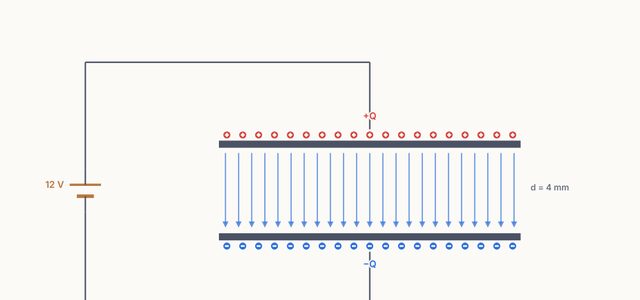
Open the Parallel-Plate Capacitor simulation and test every idea on this page yourself.
Open the simulation →