The big idea
A nucleus is a tiny, dense knot of protons and neutrons held together by the strong nuclear force, which overpowers the protons' electric repulsion at very short range. Unstable nuclei change into more stable ones by emitting radiation. Because some mass becomes energy (E = mc²), nuclear reactions release millions of times more energy per atom than chemical ones.
Key ideas
- A nuclide is written AZX: Z = protons (atomic number), A = protons + neutrons (mass number), N = A − Z. Isotopes have the same Z but different N.
- Alpha decay emits 42He: A falls by 4 and Z by 2. Beta-minus decay turns a neutron into a proton and emits an electron: Z rises by 1, A is unchanged. Gamma decay emits a photon: A and Z are unchanged.
- Every reaction conserves nucleon number and charge, so the top and bottom numbers each balance.
- Decay is random for a single nucleus, but a large sample halves every half-life: after n half-lives, (½)ⁿ remains.
- The nucleus weighs less than its parts. The mass defect Δm is the binding energy, E = Δmc², with 1 u = 931.5 MeV.
Equations
| AZX, N = A − Z | nuclide notation |
| N = N₀(½)t/T½ | radioactive decay |
| E = Δm c² | mass–energy equivalence |
| 1 u ↔ 931.5 MeV | handy conversion |
| EB = (Zmp + Nmn − mnucleus)c² | binding energy |
Worked example
Uranium-238 (Z = 92) decays by alpha emission. Identify the daughter nucleus. If you start with 80 mg of a radioactive isotope with a half-life of 8 days, how much remains after 24 days?
- Alpha decay: A = 238 − 4 = 234 and Z = 92 − 2 = 90, so the daughter is thorium-234: 23892U → 23490Th + 42He.
- Half-life: 24 days = 3 half-lives, so 80 → 40 → 20 → 10 mg remain.
Common mistakes
- Thinking the whole sample is gone after two half-lives. After two half-lives a quarter is left, and it never quite reaches zero.
- Forgetting that beta-minus decay raises Z by 1. A neutron turns into a proton, so the element changes but A doesn't.
- Adding the masses and expecting them to balance. Only nucleon number and charge balance; the "missing" mass is the energy released.
Try it yourself
Polonium-210 (Z = 84) is an alpha emitter with a half-life of 138 days. What is the daughter, and what fraction remains after 414 days?
Show the answer
A = 206, Z = 82: lead-206. 414/138 = 3 half-lives, so 1/8 remains.
Going deeper: AP Physics 2
Exam-level reasoning for AP Physics 2: sign conventions, "what is held constant?" questions, multi-step problems and the traps the exam likes to set.
Conservation rules for every nuclear reaction
In any reaction or decay, two totals are conserved: nucleon number (the top numbers, A) and charge (the bottom numbers, Z). Use them to identify a missing particle. α = 42He, β⁻ = 0−1e, β⁺ = 0+1e, neutron = 10n, and γ = 00γ. Energy and momentum are conserved too. Mass alone is not, because some of it turns into energy.
Mass defect and binding energy
A nucleus weighs less than its separate protons and neutrons. The missing mass Δm is the binding energy, E = Δmc², which is what it would take to pull the nucleus apart. Use 1 u = 931.5 MeV. The binding energy per nucleon peaks near iron-56. Splitting very heavy nuclei (fission) or joining very light ones (fusion) moves toward that peak, so both release energy.
More worked examples
Example 1. Find the binding energy of helium-4 (nuclear mass 4.001506 u) and its binding energy per nucleon. Use mp = 1.007276 u and mn = 1.008665 u.
- Separate parts: 2(1.007276) + 2(1.008665) = 4.031882 u.
- Mass defect: 4.031882 − 4.001506 = 0.030376 u.
- EB = 0.030376 × 931.5 = 28.3 MeV, which is 7.07 MeV per nucleon. That is unusually high for such a light nucleus, which is why α particles are so stable.
Example 2. Carbon-14 (T½ = 5730 years) decays by β⁻. Write the decay, and date a bone with 1/8 of its original C-14.
- 146C → 147N + 0−1e (+ antineutrino). Check: A 14 = 14 + 0 and Z 6 = 7 − 1 ✓
- 1/8 = (½)³, so 3 half-lives have passed: 3 × 5730 = 17 200 years.
Exam-style practice
1. Complete the reaction: 10n + 23592U → 14156Ba + 9236Kr + ?
Show the solution
A: 236 = 141 + 92 + 3, and Z: 92 = 56 + 36, so the missing products are 3 neutrons.
2. How much energy would converting 1.0 g of mass completely to energy release?
Show the solution
E = mc² = (0.001)(9 × 10¹⁶) = 9 × 10¹³ J, about the energy of a large power station running for a day.
3. Radium-226 emits an alpha particle. What nucleus is left?
Show the solution
A − 4 = 222 and Z − 2 = 86: radon-222.
5 questions to print or save, with full step-by-step answers at the end.
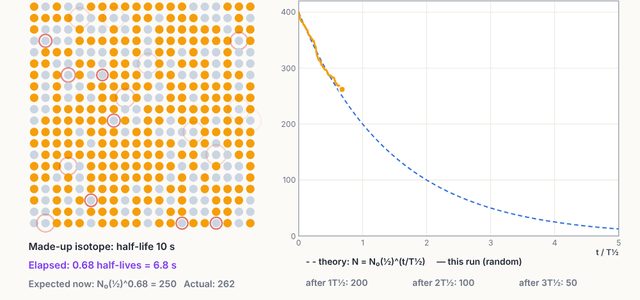
Open the Nuclear Decay & Binding Energy simulation and test every idea on this page yourself.
Open the simulation →