The big idea
A rolling object both moves forward and spins, so its kinetic energy has two parts. When it rolls without slipping, the two are locked together by v = ωR. Objects with more of their mass far from the axis put more energy into spinning, so they move more slowly.
Key ideas
- Rolling without slipping: vcm = ωR.
- Total KE = ½Mv² + ½Iω². Write I = βMR² to compare shapes.
- Down a ramp from rest: Mgh = ½Mv²(1 + β), so v = √(2gh/(1 + β)).
- The mass and radius cancel, so only the shape (β) matters. Order of finish: sphere (β = 2/5), disk (1/2), hollow sphere (2/3), hoop (1).
- Static friction makes the rolling happen but does no work when there's no slipping.
Equations
| vcm = ωR | rolling without slipping |
| K = ½Mv² + ½Iω² | total kinetic energy |
| v = √(2gh/(1 + β)) | speed after dropping h |
| a = g sin θ / (1 + β) | acceleration down an incline |
Worked example
A solid sphere rolls without slipping from rest down a ramp 1.4 m high. How fast is it moving at the bottom? Compare it with a frictionless sliding block.
- For a solid sphere, I = (2/5)MR², so β = 0.4.
- Energy: Mgh = ½Mv² + ½(0.4MR²)(v/R)² = 0.7Mv².
- v = √(gh/0.7) = √(10gh/7) = √(10 × 9.8 × 1.4 / 7) = 4.4 m/s.
- A sliding block gets √(2gh) = 5.2 m/s. The sphere is slower because 2/7 of its energy goes into spinning.
Common mistakes
- Leaving out the rotational KE term.
- Thinking a heavier or bigger sphere rolls faster. M and R cancel.
- Saying friction "wastes" energy in rolling without slipping. It does no work.
Try it yourself
A hoop rolls from rest down the same 1.4 m high ramp. What is its speed at the bottom?
Show the answer
For a hoop β = 1, so v = √(gh) = √(9.8 × 1.4) ≈ 3.7 m/s.
Going deeper: AP Physics 1
Exam-level reasoning in algebra: answers in symbols, "what happens if it doubles?" questions, multi-step problems and the conceptual traps the AP Physics 1 exam likes to set.
Who wins the race?
For an object rolling from rest down height h: mgh = ½mv² + ½Iω², with ω = v/R. Writing I = βmR² gives v = √(2gh/(1 + β)). Mass and radius cancel. Only the shape (how the mass is spread out) matters. Ranking: solid sphere (β = ⅖) beats solid cylinder (½), which beats hoop (1). Any object sliding without friction beats all of them.
Rolling without slipping
The contact point is momentarily at rest, so vcentre = ωR, and the top of the wheel moves at 2v. Static friction makes the rolling possible but does no work, so mechanical energy is conserved.
More worked examples
Example 1. A solid sphere rolls without slipping from rest down a ramp 1.5 m high. Find its speed at the bottom and compare it with a block sliding down a frictionless ramp of the same height.
- β = 2/5: v = √(2gh/1.4) = √(10gh/7) = √(21) = 4.6 m/s.
- Sliding block: √(2gh) = 5.4 m/s. The sphere is slower because 2/7 of its energy goes into spinning.
Example 2. A hoop and a solid disk with the same mass and radius race down a ramp. Which wins, and what is the ratio of their speeds at the bottom?
- Hoop: v = √(2gh/2) = √(gh). Disk: v = √(2gh/1.5) = √(4gh/3).
- vhoop/vdisk = √(3/4) = 0.87. The disk wins.
Exam-style practice
1. What fraction of a rolling solid disk's kinetic energy is rotational?
Show the solution
Krot/K = ½β/(½(1 + β)) with β = ½: 1/3.
2. If a rolling sphere's mass doubles, how does its speed at the bottom of a ramp change?
Show the solution
Not at all: mass cancels.
3. A wheel rolls at 5 m/s. How fast are its top and bottom points moving relative to the ground?
Show the solution
Top 10 m/s; bottom (contact point) 0.
Going deeper: AP Physics C
This part goes beyond the algebra course: calculus derivations, harder multi-step problems and exam-style practice, written at the level of the AP Physics C exam.
Dynamics of rolling
For an object rolling down an incline, write two equations: translation, Mg sin θ − f = Ma, and rotation about the centre, fR = Iα = I(a/R). Solving gives a = g sin θ/(1 + I/MR²) and f = Mg sin θ · β/(1 + β), where β = I/MR².
Minimum friction to roll without slipping
Static friction cannot exceed μsMg cos θ. Setting f ≤ μsN gives the steepest slope it can roll down without skidding: tan θ ≤ μs(1 + β)/β.
More worked examples
Example 1. A solid cylinder rolls without slipping down a 30° incline. Find its acceleration and the minimum μs needed.
- β = ½: a = g sin 30°/(1.5) = 9.8(0.5)/1.5 = 3.27 m/s².
- f = Mg sin θ − Ma = M(4.9 − 3.27) = 1.63M.
- μs ≥ f/N = 1.63M/(M × 9.8 × cos 30°) = tan 30°/3 ≈ 0.19.
Exam-style practice
1. What fraction of a rolling hoop's kinetic energy is rotational?
Show the solution
β = 1, so the KE splits equally: ½.
2. A solid sphere rolls at 4 m/s. Find its total KE per kg.
Show the solution
K = ½v²(1 + 2/5) = 0.7 × 16 = 11.2 J/kg.
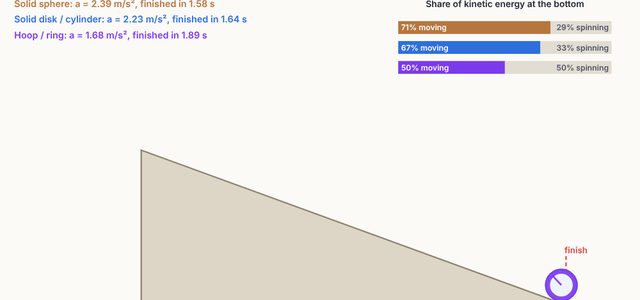
Open the Rolling Race simulation and test every idea on this page yourself.
Open the simulation →