The big idea
Whenever a restoring force is proportional to displacement (F = −kx), the result is simple harmonic motion: a smooth, repeating sinusoid. Masses on springs, and pendulums at small angles, are the two classic examples.
Key ideas
- The period of a mass on a spring depends on m and k only, not on the amplitude.
- A pendulum's period depends on L and g only, not on the mass, and it's only approximate at large angles.
- At the equilibrium position the speed is maximum and the acceleration is zero. At the turning points it's the reverse.
- Energy swaps between K and U, and the total ½kA² stays constant.
- C: Mechanics: x(t) = A cos(ωt + φ), where ω = √(k/m) and φ is set by the starting conditions.
Equations
| T = 2π√(m/k) | mass–spring period |
| T = 2π√(L/g) | simple pendulum (small angles) |
| x(t) = A cos(ωt + φ) | position |
| vmax = Aω, amax = Aω² | maximum speed and acceleration |
| E = ½kA² | total energy |
Worked example
A 0.50 kg mass on a spring with k = 200 N/m oscillates with amplitude 0.10 m. Find the period, the maximum speed and the total energy.
- T = 2π√(m/k) = 2π√(0.50/200) = 0.31 s.
- ω = √(k/m) = √400 = 20 rad/s, so vmax = Aω = (0.10)(20) = 2.0 m/s.
- E = ½kA² = ½(200)(0.10)² = 1.0 J.
- Check: ½m vmax² = ½(0.50)(2.0)² = 1.0 J ✓
Common mistakes
- Thinking a bigger amplitude means a longer period.
- Putting the mass into the pendulum formula.
- Saying the acceleration is zero at the turning points. It's at its maximum there.
Try it yourself
How long must a pendulum be to have a period of 2.0 s on Earth?
Show the answer
L = gT²/(4π²) = 9.8(4.0)/39.5 ≈ 0.99 m.
Going deeper: AP Physics 1
Exam-level reasoning in algebra: answers in symbols, "what happens if it doubles?" questions, multi-step problems and the conceptual traps the AP Physics 1 exam likes to set.
What sets the period, and what doesn't
Mass–spring: T = 2π√(m/k), which depends on m and k only. It is the same horizontally, vertically, on the Moon, and at any amplitude. Simple pendulum: T = 2π√(L/g), which depends on L and g only, not on mass or (small) amplitude. These "what does NOT matter" facts appear on almost every exam.
Energy in SHM
Total energy is ½kA². At the endpoints, everything is potential (v = 0, |a| maximum). At equilibrium, everything is kinetic (v maximum, a = 0). So vmax = A√(k/m), and at any position ½kA² = ½kx² + ½mv². Doubling the amplitude doubles vmax and quadruples the energy, but leaves the period unchanged.
Reading x, v and a graphs
If x(t) is a cosine, then v(t) is a negative sine (a quarter period out of step) and a(t) is a negative cosine. The acceleration is always opposite to the displacement, which is the defining property of SHM.
More worked examples
Example 1. A 0.40 kg block on a spring (k = 160 N/m) oscillates with amplitude 0.10 m. Find the period, the maximum speed, the maximum acceleration, and the speed at x = 0.050 m.
- ω = √(k/m) = 20 rad/s, so T = 2π/20 = 0.31 s.
- vmax = Aω = 2.0 m/s; amax = Aω² = 40 m/s².
- Energy: ½kA² = ½kx² + ½mv² → v = ω√(A² − x²) = 20√(0.0075) = 1.7 m/s.
Example 2. A 1.0 m pendulum clock is taken to the Moon (g = 1.62 m/s²). Find its period on Earth and on the Moon. Does the clock run fast or slow?
- Earth: T = 2π√(1.0/9.8) = 2.0 s.
- Moon: T = 2π√(1.0/1.62) = 4.9 s, which is √(9.8/1.62) ≈ 2.5 times longer.
- Each tick takes longer, so the clock runs slow.
Exam-style practice
1. The mass on a spring is quadrupled. What happens to the period?
Show the solution
T ∝ √m, so it doubles.
2. The amplitude of a mass–spring system is doubled. What happens to the period, maximum speed and total energy?
Show the solution
Period unchanged; vmax ×2; energy ×4.
3. Where in the motion is the acceleration greatest?
Show the solution
At the endpoints (x = ±A), where the restoring force is greatest and the speed is zero.
Going deeper: AP Physics C
This part goes beyond the algebra course: calculus derivations, harder multi-step problems and exam-style practice, written at the level of the AP Physics C exam.
The differential equation of SHM
Newton's 2nd law for a block on a spring gives m d²x/dt² = −kx, or
d²x/dt² = −ω²x, ω = √(k/m)Any system whose equation of motion has this form is a simple harmonic oscillator, with angular frequency equal to the square root of the coefficient. The general solution is x(t) = A cos(ωt + φ). The amplitude A and phase φ are set by the initial position x₀ and velocity v₀: A = √(x₀² + (v₀/ω)²) and tan φ = −v₀/(ωx₀).
Vertical springs and spring combinations
A hanging mass stretches the spring by mg/k to a new equilibrium. It then oscillates about that point with the same period, because gravity only shifts the centre. Springs in parallel: keff = k₁ + k₂. In series: 1/keff = 1/k₁ + 1/k₂.
Physical pendulum
A rigid body swinging about a pivot a distance d from its centre of mass: τ = −mgd sin θ ≈ −mgd θ = Iα, so
T = 2π√(I/(mgd))The simple pendulum is the special case I = mL² and d = L.
More worked examples
Example 1. A 0.50 kg block on a spring (k = 50 N/m) starts at x₀ = 0.030 m with v₀ = −0.40 m/s. Find ω, A and φ, and write x(t).
- ω = √(50/0.5) = 10 rad/s.
- A = √(0.030² + (0.40/10)²) = √(0.0009 + 0.0016) = 0.050 m.
- tan φ = −v₀/(ωx₀) = 0.40/0.30 → φ = +53° (0.93 rad). Check: x₀ = A cos φ = 0.03 ✓, and v₀ = −Aω sin φ = −0.40 ✓
- x(t) = 0.050 cos(10t + 0.93) m.
Example 2. A uniform 1.0 m rod swings about a pivot at one end. Find its period for small oscillations.
- I = mL²/3 and d = L/2.
- T = 2π√(I/(mgd)) = 2π√((L²/3)/(gL/2)) = 2π√(2L/(3g)).
- T = 2π√(2/(3 × 9.8)) = 1.64 s. That's shorter than a simple pendulum of the same length (2.0 s).
Exam-style practice
1. A 1.5 kg mass hangs from a spring with k = 300 N/m. How far does the spring stretch at equilibrium, and what is the period?
Show the solution
Δy = mg/k = 4.9 cm; T = 2π√(1.5/300) = 0.44 s.
2. Two identical springs (k each) are joined in series to a mass m. How does the period compare with one spring?
Show the solution
keff = k/2, so T increases by a factor of √2.
3. For x = 0.04 cos(5t), find vmax and amax.
Show the solution
vmax = Aω = 0.20 m/s; amax = Aω² = 1.0 m/s².
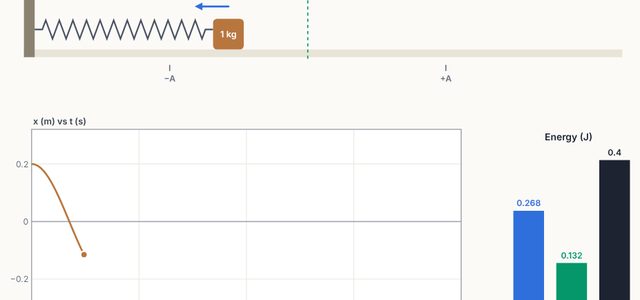
Open the Simple Harmonic Motion simulation and test every idea on this page yourself.
Open the simulation →