The big idea
Fluids push in all directions. The deeper you go, the more fluid is above you, so the pressure rises. That pressure difference produces buoyancy. When fluids flow, conservation of mass and energy give us the continuity and Bernoulli equations.
Key ideas
- Pressure at depth h: P = P₀ + ρgh. Only the depth matters, not the shape of the container.
- Archimedes: the buoyant force equals the weight of the fluid displaced, Fb = ρfluidVsubg.
- An object floats if its average density is less than the fluid's. Fraction submerged = ρobject/ρfluid.
- Continuity: A₁v₁ = A₂v₂, so the fluid speeds up where the pipe narrows.
- Bernoulli: P + ½ρv² + ρgy is constant along a streamline, so faster flow means lower pressure.
Equations
| ρ = m/V, P = F/A | density, pressure |
| P = P₀ + ρgh | pressure at depth |
| Fb = ρfluidVsubg | buoyant force |
| A₁v₁ = A₂v₂ | continuity |
| P₁ + ½ρv₁² + ρgy₁ = P₂ + ½ρv₂² + ρgy₂ | Bernoulli |
Worked example
A solid aluminium cube (ρ = 2700 kg/m³) with 0.20 m sides is fully submerged in water. Find its weight, the buoyant force, and its apparent weight in water.
- Volume V = (0.20)³ = 0.008 m³.
- Weight = ρVg = (2700)(0.008)(9.8) = 212 N.
- Buoyant force = ρwaterVg = (1000)(0.008)(9.8) = 78 N.
- Apparent weight = 212 − 78 = 133 N. That is what a spring scale would read.
Common mistakes
- Using the object's density in the buoyant-force formula. Use the fluid's density.
- Thinking the shape of the container affects the pressure at a given depth.
- Saying faster flow means higher pressure. It's the opposite.
Try it yourself
Water flows at 2.0 m/s in a pipe 4.0 cm wide that narrows to 2.0 cm. Find the new speed and the pressure drop (same height).
Show the answer
Area ratio = (4/2)² = 4, so v₂ = 8.0 m/s; ΔP = ½ρ(v₂² − v₁²) = ½(1000)(64 − 4) = 30 kPa lower.
Going deeper: AP Physics 1
Exam-level reasoning in algebra: answers in symbols, "what happens if it doubles?" questions, multi-step problems and the conceptual traps the AP Physics 1 exam likes to set.
Buoyancy: what the displaced fluid weighs
FB = ρfluidVsubg. A floating object displaces its own weight, so the fraction submerged equals ρobject/ρfluid. Apparent weight in a fluid = true weight − buoyant force, which gives a neat way to measure volume and density.
Continuity and Bernoulli together
An incompressible fluid has the same volume flow rate everywhere: A₁v₁ = A₂v₂. Where the pipe narrows the fluid speeds up, and by Bernoulli (P + ½ρv² + ρgy = constant) its pressure drops. Pressure at depth: P = P₀ + ρgh (absolute), or ρgh alone (gauge).
More worked examples
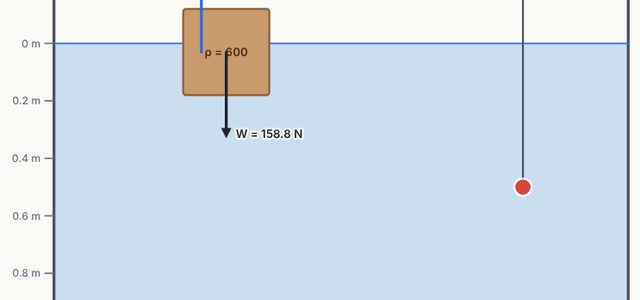
Example 1. A 0.020 m³ block of wood (ρ = 600 kg/m³) floats in water. What fraction is submerged, and what extra load placed on top would just sink it completely?
- Fraction submerged = 600/1000 = 0.60.
- Fully submerged: FB = 1000(0.020)(9.8) = 196 N. Weight of block = 600(0.020)(9.8) = 118 N.
- Extra load = 196 − 118 = 78 N.
Example 2. Water flows at 2.0 m/s through a horizontal pipe 4.0 cm across, which narrows to 2.0 cm. Find the speed in the narrow part and the pressure difference.
- The area falls by a factor of 4, so the speed rises by 4: 8.0 m/s.
- Bernoulli (same height): ΔP = ½ρ(v₂² − v₁²) = ½(1000)(64 − 4) = 3.0 × 10⁴ Pa, lower in the narrow part.
Exam-style practice
1. A rock weighs 30 N in air and 20 N fully submerged in water. Find its volume and density.
Show the solution
FB = 10 N → V = 10/(1000 × 9.8) = 1.0 × 10⁻³ m³; ρ = (30/9.8)/V ≈ 3000 kg/m³.
2. What is the gauge pressure 10 m under water? What is the absolute pressure?
Show the solution
Gauge ρgh = 98 kPa; absolute ≈ 98 + 101 = 199 kPa.
Open the Fluids Lab simulation and test every idea on this page yourself.
Open the simulation →