The big idea
Real objects moving through air or liquid feel a drag force that grows with speed. Newton's 2nd law becomes a differential equation, m dv/dt = mg − F(v), and its solution shows the object approaching a terminal velocity where the drag balances the weight.
Key ideas
- Linear drag F = bv suits small, slow objects. Quadratic drag F = cv² suits everyday objects at normal speeds.
- Terminal velocity is where the net force is zero: mg = bvT, or mg = cvT².
- Linear drag gives v(t) = vT(1 − e−t/τ) with τ = m/b. After one τ, v reaches 63% of vT.
- The acceleration starts at g and falls to zero as v → vT.
- To solve, separate the variables: dv/(g − bv/m) = dt, then integrate.
Equations
| m dv/dt = mg − bv | linear drag |
| vT = mg/b, τ = m/b | terminal velocity, time constant |
| v(t) = vT(1 − e−t/τ) | solution from rest |
| vT = √(mg/c) | quadratic drag |
Worked example
A 2.0 kg object falls from rest with linear drag b = 0.50 kg/s. Find vT, τ and the speed after 4.0 s.
- vT = mg/b = (2.0)(9.8)/0.50 = 39.2 m/s.
- τ = m/b = 2.0/0.50 = 4.0 s.
- At t = 4.0 s = τ: v = 39.2(1 − e⁻¹) = 39.2(0.632) = 24.8 m/s.
- Without drag it would be going gt = 39.2 m/s already, so drag clearly matters.
Common mistakes
- Treating the acceleration as constant. It changes as v changes.
- Getting the sign of the drag force wrong. It always opposes the velocity.
- Thinking a heavier object has the same terminal velocity. A larger m gives a larger vT.
Try it yourself
A 70 kg skydiver has quadratic drag with c = 0.25 kg/m. Find the terminal velocity.
Show the answer
vT = √(mg/c) = √(70 × 9.8 / 0.25) ≈ 52 m/s.
Going deeper: AP Physics C
This part goes beyond the algebra course: calculus derivations, harder multi-step problems and exam-style practice, written at the level of the AP Physics C exam.
Solving the linear-drag equation
Start from m dv/dt = mg − bv. Separate the variables: dv/(g − (b/m)v) = dt. Integrate from 0 to v:
v(t) = mgb(1 − e−bt/m)Integrate once more for the position: y(t) = vTt − vTτ(1 − e−t/τ). At long times the object moves at vT, but lags τ·vT behind where it would be had it started at vT.
Horizontal motion with drag
With no driving force (a coasting boat), m dv/dt = −bv gives v = v₀e−t/τ, and the total stopping distance is ∫v dt = v₀τ = mv₀/b.
More worked examples
Example 1. A 200 kg boat coasts with drag F = −bv, b = 40 kg/s, starting at 5.0 m/s. How long until v = 1.0 m/s, and how far does it travel in total?
- τ = m/b = 5.0 s. v = 5e−t/5 = 1 → t = 5 ln 5 = 8.0 s.
- Total distance = mv₀/b = (200)(5.0)/40 = 25 m.
Exam-style practice
1. For linear drag, what is the acceleration when v = vT/2?
Show the solution
a = g − (b/m)(vT/2) = g − g/2 = g/2.
2. A raindrop reaches 95% of vT after how many time constants (linear drag)?
Show the solution
1 − e−t/τ = 0.95 → t = τ ln 20 ≈ 3.0 τ.
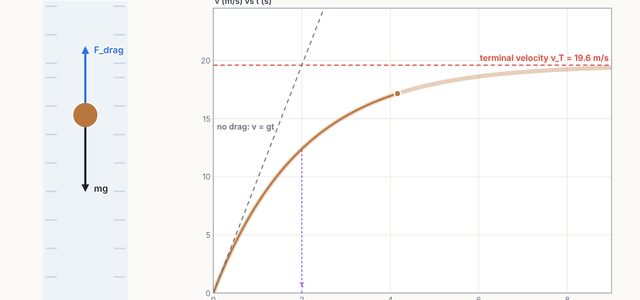
Open the Drag & Terminal Velocity simulation and test every idea on this page yourself.
Open the simulation →