The big idea
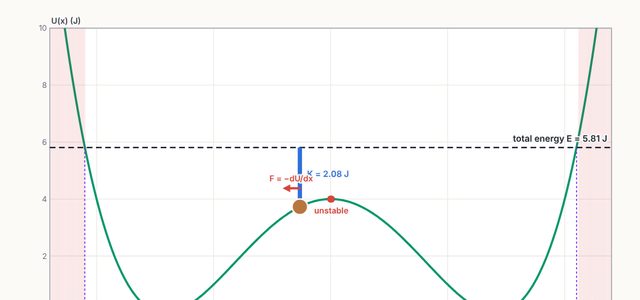
For a conservative force, all the information about the force is stored in the potential energy function U(x). The force is the negative slope, F = −dU/dx. A U(x) graph with a horizontal line for the total energy E tells you where a particle can go, where it turns around, and where it can rest.
Key ideas
- F = −dU/dx: the force points "downhill" on the U(x) graph.
- The particle is only allowed where U(x) ≤ E. Where they meet are the turning points.
- K = E − U(x) is the vertical gap between the energy line and the curve.
- At an equilibrium dU/dx = 0. It's stable at a minimum (d²U/dx² > 0) and unstable at a maximum.
- Near a stable minimum, the motion is approximately simple harmonic.
Equations
| F(x) = −dU/dx | force from potential |
| ΔU = −∫F dx | potential from force |
| E = K + U(x) | mechanical energy |
| dU/dx = 0 | equilibrium condition |
Worked example
A particle moves in U(x) = 3x² − x³ (U in J, x in m). Find the equilibrium points and classify them. How much energy does a particle resting at x = 0 need to escape past the hump?
- F = −dU/dx = −(6x − 3x²) = 3x² − 6x.
- Equilibrium where dU/dx = 6x − 3x² = 3x(2 − x) = 0, so x = 0 and x = 2 m.
- d²U/dx² = 6 − 6x: at x = 0 it's +6 (stable), and at x = 2 it's −6 (unstable).
- The hump height is U(2) = 12 − 8 = 4 J, so it needs more than 4 J of kinetic energy.
Common mistakes
- Forgetting the minus sign in F = −dU/dx.
- Reading U(x) as the particle's height or path. It's an energy graph.
- Classifying equilibrium by where U is zero instead of by the slope and curvature.
Try it yourself
For U(x) = 4x² (J), what is the force at x = 0.50 m?
Show the answer
F = −dU/dx = −8x = −4.0 N, pointing back toward x = 0.
Going deeper: AP Physics C
This part goes beyond the algebra course: calculus derivations, harder multi-step problems and exam-style practice, written at the level of the AP Physics C exam.
Small oscillations about a minimum
Near a stable equilibrium x₀, expand U as a parabola: U ≈ U(x₀) + ½U″(x₀)(x − x₀)². That is a spring with keff = U″(x₀), so the particle oscillates with
ω = √(U″(x₀)/m)This is why so many systems, such as molecules, pendulums and floating objects, behave like simple harmonic oscillators for small displacements.
Finding U from F
Going the other way: U(x) = −∫F(x)dx + C. Only differences in U matter, so pick a convenient reference point. For gravity far from Earth the usual choice is U(∞) = 0, which makes U = −GMm/r.
More worked examples
Example 1. A 2.0 kg particle moves in U(x) = 3x² − x³ (J). Find the angular frequency of small oscillations about the stable equilibrium.
- U′ = 6x − 3x² = 0 → stable equilibrium at x = 0.
- U″ = 6 − 6x → U″(0) = 6 J/m².
- ω = √(6/2.0) = √3 ≈ 1.73 rad/s, so T = 2π/ω ≈ 3.6 s.
Example 2. A force F(x) = −4x³ N acts on a particle. Find U(x), taking U(0) = 0, and its turning points if E = 4 J.
- U = −∫F dx = ∫4x³ dx = x⁴ (J).
- The turning points are where U = E: x⁴ = 4 → x = ±√2 ≈ ±1.41 m.
- The motion is oscillatory but not simple harmonic: the period depends on the amplitude.
Exam-style practice
1. U(x) = 5x² − 2x (J). Where is the equilibrium, and is it stable?
Show the solution
U′ = 10x − 2 = 0 → x = 0.2 m; U″ = 10 > 0, so it is stable.
2. What is the force at x = 1 m for U(x) = 2/x (J)?
Show the solution
F = −dU/dx = 2/x² = +2 N, which is repulsive.
Open the Potential Energy Curves simulation and test every idea on this page yourself.
Open the simulation →