The big idea
The same force that pulls an apple down keeps the Moon in orbit. Newton's law of universal gravitation, together with conservation of energy and angular momentum, explains circular and elliptical orbits, Kepler's laws, and the speed needed to escape a planet completely.
Key ideas
- F = GMm/r²: an inverse-square law, always attractive.
- In a circular orbit, gravity provides the centripetal force: GMm/r² = mv²/r → v = √(GM/r).
- Kepler 2 (equal areas in equal times) is conservation of angular momentum. Planets move fastest when they are closest.
- Kepler 3: T² ∝ a³. For a circular orbit, T² = 4π²r³/(GM).
- Gravitational PE is U = −GMm/r. Escaping needs a total energy of at least zero: vesc = √(2GM/r).
Equations
| F = GMm/r² | universal gravitation |
| v = √(GM/r) | circular orbit speed |
| T² = 4π²r³/(GM) | Kepler's 3rd law |
| U = −GMm/r | gravitational PE |
| vesc = √(2GM/r) | escape speed |
Worked example
A satellite orbits 400 km above Earth's surface (RE = 6.37 × 10⁶ m, GME = 3.99 × 10¹⁴ m³/s²). Find its speed and period.
- Orbital radius r = 6.37 × 10⁶ + 0.40 × 10⁶ = 6.77 × 10⁶ m.
- v = √(GM/r) = √(3.99 × 10¹⁴ / 6.77 × 10⁶) = 7.67 km/s.
- T = 2πr/v = 2π(6.77 × 10⁶)/7670 = 5540 s ≈ 92 minutes.
- Compare escape speed from the surface: √(2GM/R) ≈ 11.2 km/s.
Common mistakes
- Using the altitude instead of the distance from the planet's centre.
- Thinking astronauts in orbit feel no gravity. They are in free fall.
- Using mgh for large heights. Use U = −GMm/r.
Try it yourself
A planet orbits the Sun with a semi-major axis of 4.0 AU. What is its period?
Show the answer
In years and AU, T² = a³, so T = √(4³) = 8.0 years.
Going deeper: AP Physics 1
Exam-level reasoning in algebra: answers in symbols, "what happens if it doubles?" questions, multi-step problems and the conceptual traps the AP Physics 1 exam likes to set.
Inverse-square reasoning
F = Gm₁m₂/r², with r measured from the centres. Double the distance and the force falls to ¼. Triple it and the force falls to 1/9. Near a planet's surface g = GM/R², so a planet with twice Earth's mass and twice its radius has g = 2/4 = ½ of Earth's.
Weightless is not gravity-free
On the International Space Station, gravity is still about 90% as strong as on the ground. Astronauts feel weightless because they and the station are falling together (in orbit), so nothing pushes on them: the normal force is zero. For a circular orbit, gravity supplies the centripetal force: GMm/r² = mv²/r, so v = √(GM/r).
More worked examples
Example 1. What is the value of g at an altitude equal to Earth's radius?
- Distance from Earth's centre: 2R.
- g ∝ 1/r², so g = 9.8/4 = 2.45 m/s².
Example 2. Find the speed and period of the International Space Station, 400 km above the surface (RE = 6.37 × 10⁶ m, GME = 3.99 × 10¹⁴ m³/s²).
- r = 6.37 × 10⁶ + 0.40 × 10⁶ = 6.77 × 10⁶ m.
- v = √(GM/r) = √(3.99 × 10¹⁴/6.77 × 10⁶) = 7.7 km/s.
- T = 2πr/v = 5540 s ≈ 92 min.
Exam-style practice
1. The distance between two masses triples. What happens to the gravitational force?
Show the solution
It becomes 1/9 as large.
2. Earth pulls on the Moon with force F. How hard does the Moon pull on Earth?
Show the solution
Also F (a Newton's 3rd law pair). Earth's acceleration is just much smaller.
3. Planet X has twice Earth's mass and twice its radius. What is g there?
Show the solution
g ∝ M/R² = 2/4, so 4.9 m/s².
Going deeper: AP Physics C
This part goes beyond the algebra course: calculus derivations, harder multi-step problems and exam-style practice, written at the level of the AP Physics C exam.
Shell theorem and gravity inside a planet
A uniform spherical shell attracts outside masses as if all its mass were at its centre, and exerts zero net force on masses inside it. So inside a uniform planet only the mass closer to the centre counts: M(r) = M r³/R³, which gives g(r) = GMr/R³. Gravity grows linearly from zero at the centre to its surface value, the same mathematics as Gauss's law.
Energy of an orbit
For a circular orbit, K = GMm/(2r) and U = −GMm/r, so the total energy is
E = −GMm2rFor an ellipse, replace r with the semi-major axis a. To move a satellite to a higher orbit you must add energy, yet it ends up moving slower.
Elliptical orbits
Two conservation laws relate perigee (p) and apogee (a): angular momentum, rpvp = rava, and energy, ½vp² − GM/rp = ½va² − GM/ra. Together they give vp = √(2GM ra/(rp(rp + ra))).
More worked examples
Example 1. A 500 kg satellite is in a circular orbit of radius 7.0 × 10⁶ m. Find its total energy, and the work needed to move it to a circular orbit of twice the radius.
- E₁ = −GMm/(2r) = −(3.99 × 10¹⁴)(500)/(1.4 × 10⁷) = −1.42 × 10¹⁰ J.
- E₂ at 2r is half as negative: −7.12 × 10⁹ J.
- W = E₂ − E₁ = +7.1 × 10⁹ J.
Example 2. A satellite's orbit has perigee 7.0 × 10⁶ m and apogee 1.4 × 10⁷ m from Earth's centre. Find its speeds at perigee and apogee.
- vp = √(2GM ra/(rp(rp + ra))) = √(2(3.99 × 10¹⁴)(1.4 × 10⁷)/((7.0 × 10⁶)(2.1 × 10⁷))) = 8.7 km/s.
- Angular momentum: va = vp(rp/ra) = 8.71/2 = 4.4 km/s.
Example 3. Find the radius of a geosynchronous orbit (T = 23.9 h = 86 164 s).
- T² = 4π²r³/(GM) → r = (GMT²/4π²)1/3.
- r = ((3.99 × 10¹⁴)(86 164)²/39.5)1/3 = 4.22 × 10⁷ m, about 35 800 km above the surface.
Exam-style practice
1. What is g halfway to the centre of a uniform Earth?
Show the solution
g ∝ r inside, so 4.9 m/s².
2. By what factor must a satellite's orbital radius increase to double its period?
Show the solution
T ∝ r3/2 → r ∝ T2/3: a factor of 22/3 ≈ 1.59.
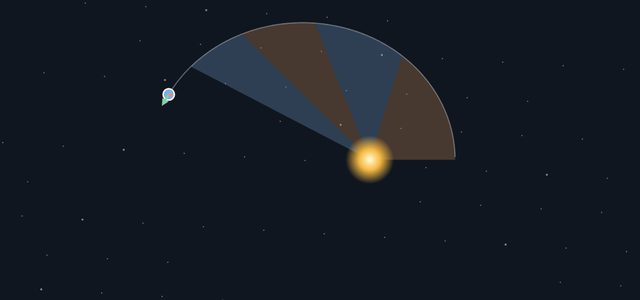
Open the Orbits & Kepler's Laws simulation and test every idea on this page yourself.
Open the simulation →