The big idea
A gas is a huge number of molecules in random motion. Temperature measures their average kinetic energy, and pressure comes from their collisions with the walls. The ideal gas law links P, V and T. The first law of thermodynamics is conservation of energy: the internal energy changes when heat flows in or work is done on the gas.
Key ideas
- PV = nRT, with T in kelvin. Double T at constant V and P doubles.
- For an ideal monatomic gas, U = (3/2)nRT, so U depends only on T.
- First law (AP convention): ΔU = Q + W, where W is the work done on the gas, W = −PΔV.
- The area under a path on a PV diagram is the magnitude of the work. For a full cycle, it's the enclosed area.
- Isothermal: ΔU = 0. Isochoric: W = 0. Adiabatic: Q = 0. Isobaric: W = −PΔV.
Equations
| PV = nRT = NkBT | ideal gas law |
| ΔU = Q + W | first law (W done on the gas) |
| W = −PΔV | work at constant pressure |
| U = (3/2)nRT | monatomic ideal gas |
| Kavg = (3/2)kBT | average KE per molecule |
Worked example
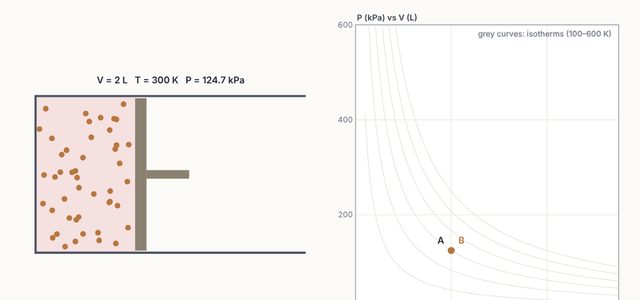
0.10 mol of a monatomic ideal gas at 300 K expands at constant pressure from 2.0 L to 4.0 L. Find P, the final temperature, W, ΔU and Q.
- P = nRT/V = (0.10)(8.31)(300)/(0.0020) = 125 kPa.
- At constant P, V doubles, so T doubles: Tf = 600 K.
- W (on gas) = −PΔV = −(1.25 × 10⁵)(0.0020) = −249 J. The gas does 249 J of work.
- ΔU = (3/2)nRΔT = 1.5(0.10)(8.31)(300) = 374 J.
- Q = ΔU − W = 374 − (−249) = 623 J of heat added.
Answer: P = 125 kPa, T = 600 K, W = −249 J, ΔU = 374 J, Q = 623 J
Common mistakes
- Using °C instead of kelvin.
- Mixing up the sign of W: AP uses work done on the gas.
- Thinking heat and temperature are the same thing. Heat is energy transferred, and temperature measures the average KE.
Try it yourself
A gas is compressed isothermally, and 300 J of work is done on it. Find ΔU and Q.
Show the answer
Isothermal means ΔU = 0, so Q = −W = −300 J: 300 J of heat flows out.
See it in action
Open the Gas Laws & PV Diagrams simulation and test every idea on this page yourself.
Open the simulation →