The big idea
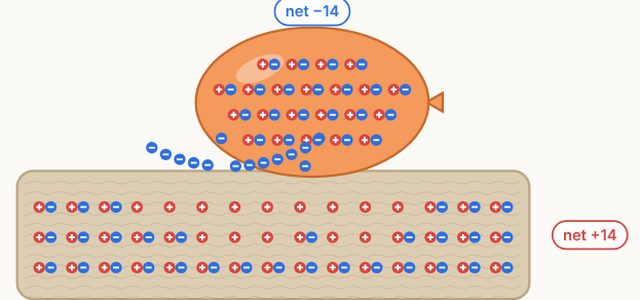
Charge comes in two types, positive and negative, and it is conserved: it can move from one object to another but is never created or destroyed. In solids, it's the electrons that move. How an object gets charged depends on whether electrons are passed across by rubbing, by touching, or pushed around by a nearby charge.
Key ideas
- Charge is quantized: q = ne, with e = 1.6 × 10⁻¹⁹ C.
- Friction: electrons move between insulators, which end up equal and opposite.
- Conduction: charge flows on contact. The neutral object ends up with the same sign, and identical conductors share the charge equally.
- Induction: a nearby charge polarizes a conductor, grounding lets electrons leave or arrive, and the final charge is opposite to the inducing charge, with no contact.
- Polarization explains why a charged object attracts a neutral one.
Equations
| q = ne | charge quantization |
| e = 1.6 × 10⁻¹⁹ C | elementary charge |
| q′ = (q₁ + q₂)/2 | identical conductors after touching |
| Σqbefore = Σqafter | conservation of charge |
Worked example
Identical metal spheres carry +6.0 µC and −2.0 µC. They touch and are then separated. Find the final charge on each, and how many electrons moved.
- Total charge = +6.0 + (−2.0) = +4.0 µC, which is conserved.
- Identical spheres share it equally: each ends with +2.0 µC.
- The first sphere went from +6.0 to +2.0 µC, so it gained 4.0 µC of electrons.
- n = q/e = 4.0 × 10⁻⁶ / 1.6 × 10⁻¹⁹ = 2.5 × 10¹³ electrons moved from the second sphere to the first.
Common mistakes
- Saying protons move. In solids, only electrons transfer.
- Removing the rod before disconnecting the ground during induction, which leaves the object neutral.
- Forgetting that a charged object attracts neutral objects too, through polarization.
Try it yourself
A negatively charged rod is used to charge a sphere by induction. What sign does the sphere end with?
Show the answer
Positive. The rod repels electrons into the ground, and they can't come back once the ground is disconnected.
Going deeper: AP Physics C
This part goes beyond the algebra course: calculus derivations, harder multi-step problems and exam-style practice, written at the level of the AP Physics C exam.
Conductors in electrostatic equilibrium
Once the charges in a conductor stop moving, four facts follow, and the C exam uses all of them:
- The electric field inside the conducting material is zero. If it weren't, free charges would still be moving.
- Any excess charge sits on the outer surface.
- Just outside the surface, the field is perpendicular to it, with magnitude E = σ/ε₀.
- The whole conductor is an equipotential, including its hollow interior.
Sharing charge between connected spheres
Connect two conducting spheres with a long thin wire and charge flows until they reach the same potential: kq₁/r₁ = kq₂/r₂. So charge is proportional to radius, and the surface field (∝ q/r²) is proportional to 1/r. The smaller sphere ends up with the stronger field. That's why charge "leaks" from sharp points and why lightning rods are pointed.
q₁/q₂ = r₁/r₂ E₁/E₂ = r₂/r₁More worked examples
Example 1. Two conducting spheres, radii 1.0 cm and 3.0 cm, far apart, are joined by a thin wire and share a total charge of 8.0 nC. Find the charge on each and the field at each surface.
- Equal potentials: q₁/r₁ = q₂/r₂, so q₁ : q₂ = 1 : 3.
- q₁ = 2.0 nC and q₂ = 6.0 nC.
- E₁ = kq₁/r₁² = (8.99 × 10⁹)(2.0 × 10⁻⁹)/(0.010)² = 1.8 × 10⁵ N/C.
- E₂ = (8.99 × 10⁹)(6.0 × 10⁻⁹)/(0.030)² = 6.0 × 10⁴ N/C. The small sphere's field is 3× stronger.
Exam-style practice
1. A point charge +Q sits at the centre of a neutral conducting spherical shell. What charge appears on the inner and outer surfaces of the shell?
Show the solution
Inner surface −Q (so that E = 0 in the metal); outer surface +Q (so the shell stays neutral).
2. Why is the field just outside a charged conductor always perpendicular to the surface?
Show the solution
A parallel component would push free charges along the surface, so the conductor would not be in equilibrium.
Open the Charging Methods simulation and test every idea on this page yourself.
Open the simulation →