The big idea
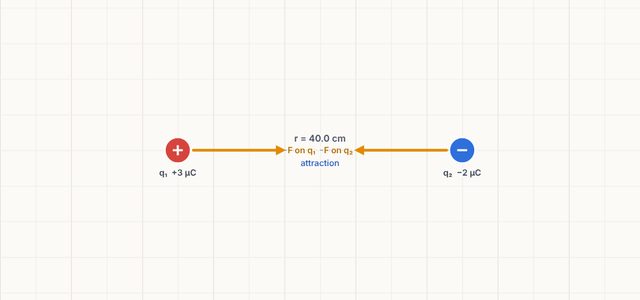
Two point charges exert equal and opposite forces on each other, proportional to the product of the charges and inversely proportional to the square of the distance between them. With more than two charges, use superposition: find each force separately, then add them as vectors.
Key ideas
- F = k|q₁q₂|/r². Like charges repel, and opposite charges attract.
- Inverse square: double r and F drops to ¼.
- The forces on the two charges are always equal in size (Newton's 3rd law), even when the charges are different.
- Superposition: Fnet = F₁ + F₂ + … Add the x and y components separately.
- Only add magnitudes directly when every force points along the same line.
Equations
| F = k|q₁q₂|/r² | Coulomb's law |
| k = 1/(4πε₀) = 8.99 × 10⁹ N·m²/C² | Coulomb constant |
| Fnet = ΣFi | superposition |
| |F| = √(ΣFx² + ΣFy²) | magnitude from components |
Worked example
A +1.0 µC test charge sits at the origin. +4.0 µC is 0.30 m directly above it, and −3.0 µC is 0.40 m to its right. Find the net force on the test charge.
- From the +4.0 µC charge: F₁ = (8.99 × 10⁹)(4.0 × 10⁻⁶)(1.0 × 10⁻⁶)/(0.30)² = 0.400 N, pushing down (repulsion).
- From the −3.0 µC charge: F₂ = (8.99 × 10⁹)(3.0 × 10⁻⁶)(1.0 × 10⁻⁶)/(0.40)² = 0.169 N, pulling right (attraction).
- They're perpendicular: Fnet = √(0.400² + 0.169²) = 0.43 N.
- Direction: tan θ = 0.400/0.169 → θ = 67° below the +x axis.
Common mistakes
- Adding the force magnitudes when the forces point in different directions.
- Plugging the signs of the charges into the formula to get the direction. Use the magnitude, then decide the direction from attract or repel.
- Forgetting to convert µC and cm into C and m.
Try it yourself
Two charges attract with 0.60 N. The distance between them is doubled. What is the new force?
Show the answer
Inverse square: F/4 = 0.15 N.
Going deeper: AP Physics C
This part goes beyond the algebra course: calculus derivations, harder multi-step problems and exam-style practice, written at the level of the AP Physics C exam.
Coulomb's law in vector form
The force on q₂ due to q₁ is
F₁₂ = kq₁q₂r² r̂₁₂where r̂₁₂ points from q₁ to q₂. With several charges, find each force in components and add them. Use symmetry to spot components that cancel before you calculate anything.
Equilibrium problems
Charged objects hanging on threads, or a test charge placed on a line between two charges, are force-balance problems. Draw the free-body diagram, resolve the forces into components, and then use ΣF = 0. Between two like charges, the zero-force point lies closer to the smaller charge.
More worked examples
Example 1. Two identical 2.0 g pith balls hang from the same point on 0.50 m threads. Each carries +50 nC. Find their separation at equilibrium.
- Each thread makes angle θ with the vertical, and the separation is x = 2L sin θ.
- Balance: T cos θ = mg and T sin θ = kq²/x² → tan θ = kq²/(mgx²).
- Solve numerically (small-angle: tan θ ≈ sin θ = x/2L gives x³ = 2Lkq²/mg).
- x³ = (2)(0.50)(8.99 × 10⁹)(50 × 10⁻⁹)²/(0.002 × 9.8) = 1.15 × 10⁻³ → x ≈ 0.105 m. Here θ ≈ 6°, so the approximation is excellent.
Example 2. Charges +4.0 µC and +1.0 µC are 0.30 m apart. Where between them would a third charge feel no net force?
- Let d be the distance from the 4 µC charge: k(4)/d² = k(1)/(0.30 − d)².
- Take square roots: 2/d = 1/(0.30 − d) → 0.60 − 2d = d.
- d = 0.20 m from the 4 µC charge, closer to the smaller charge as expected. The sign and size of the third charge don't matter.
Exam-style practice
1. Two +2.0 µC charges sit at (−0.30 m, 0) and (+0.30 m, 0). Find the force on a +1.0 µC charge at (0, 0.40 m).
Show the solution
Each is 0.50 m away: F = 0.072 N. The x-components cancel and the y-components add: 2(0.072)(0.8) = 0.115 N, in the +y direction.
2. If the distance between two charges is tripled and one charge is doubled, what happens to the force?
Show the solution
F × 2/9, so it becomes 2/9 of the original.
Open the Coulomb's Law & Superposition simulation and test every idea on this page yourself.
Open the simulation →