The big idea
Instead of asking about the force on one particular charge, we describe the effect of a charge on the space around it. The electric field E is the force per unit charge (a vector). The electric potential V is the potential energy per unit charge (a scalar). Field lines always cross equipotential surfaces at right angles.
Key ideas
- E = F/q₀. It points away from + charges and toward − charges.
- Point charge: E = kq/r² and V = kq/r (V falls off as 1/r, not 1/r²).
- Potentials are scalars, so they simply add, with signs. Fields are vectors.
- Work by the field: W = −qΔV. A positive charge moves naturally toward lower V.
- In a uniform field between parallel plates: E = ΔV/d. E points "downhill" in potential.
Equations
| E = F/q₀ | definition of the field |
| E = kq/r² | point charge field |
| V = kq/r | point charge potential |
| ΔU = qΔV | change in potential energy |
| E = ΔV/d | uniform field |
| Ex = −dV/dx | field from potential (C: E&M) |
Worked example
A +5.0 nC point charge is fixed in place. At 0.10 m away, find E and V. How much work is needed to bring a +2.0 nC charge in from infinity to that point?
- E = kq/r² = (8.99 × 10⁹)(5.0 × 10⁻⁹)/(0.10)² = 4.5 × 10³ N/C, pointing away from the charge.
- V = kq/r = (8.99 × 10⁹)(5.0 × 10⁻⁹)/0.10 = 450 V.
- Work needed = ΔU = qΔV = (2.0 × 10⁻⁹)(450 − 0) = 9.0 × 10⁻⁷ J.
- This is positive work, because you push against the repulsion.
Common mistakes
- Treating V as a vector, or E as a scalar.
- Thinking E = 0 means V = 0 (or the other way round). They are different quantities.
- Losing the signs when adding potentials from negative charges.
Try it yourself
Parallel plates 4.0 cm apart have a uniform field of 500 V/m between them. What is the potential difference?
Show the answer
ΔV = Ed = (500)(0.040) = 20 V.
Going deeper: AP Physics C
This part goes beyond the algebra course: calculus derivations, harder multi-step problems and exam-style practice, written at the level of the AP Physics C exam.
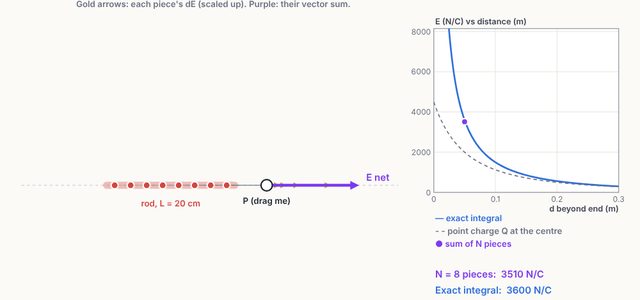 Simulation for this sectionContinuous Charge DistributionsOpen it →
Fields of continuous charge distributions
Chop the object into pieces dq, write the field dE of each piece as if it were a point charge, use symmetry to drop cancelling components, then integrate. Use dq = λ dx for a line, σ dA for a surface and ρ dV for a volume.
E = ∫ k dqr² r̂Standard results worth knowing: on the axis of a ring, E = kQx/(x² + R²)3/2. On the axis of a rod, a distance d beyond its end, E = kQ/(d(d + L)). Near a large sheet, E = σ/(2ε₀).
Potential from integration, and back again
Potential is a scalar, so there are no components to worry about: V = ∫k dq/r. Going the other way:
VB − VA = −∫AB E·dr Ex = −dVdxThe field points "downhill" in potential, and it is strongest where the equipotentials are closest together.
Potential energy of a system of charges
The work needed to assemble a group of point charges from infinity is the sum over every pair: U = Σ kqiqj/rij. Count each pair once. A negative total means the system is bound.
More worked examples
Example 1. A ring of radius 0.10 m carries 20 nC spread uniformly. Find E and V on its axis, 0.10 m from the centre.
- Each dq is the same distance √(x² + R²) from the point, and only axial components survive.
- E = kQx/(x² + R²)3/2 = (8.99 × 10⁹)(20 × 10⁻⁹)(0.10)/(0.02)3/2 = 6.4 × 10³ N/C, along the axis.
- V = kQ/√(x² + R²) = 179.8/0.1414 = 1.27 × 10³ V.
Example 2. A thin rod of length 0.20 m carries 5.0 nC uniformly. Find E at a point on its axis 0.050 m beyond one end.
- λ = Q/L. A piece dx at distance s from the point gives dE = kλ ds/s².
- E = kλ∫dd+L ds/s² = kλ(1/d − 1/(d + L)) = kQ/(d(d + L)).
- E = (8.99 × 10⁹)(5.0 × 10⁻⁹)/((0.050)(0.25)) = 3.6 × 10³ N/C, pointing away from the rod.
Example 3. Three charges form a triangle: 2.0 µC and 3.0 µC are 0.30 m apart, 2.0 µC and −1.0 µC are 0.40 m apart, and 3.0 µC and −1.0 µC are 0.50 m apart. How much work was needed to assemble them?
- U = k(q₁q₂/r₁₂ + q₁q₃/r₁₃ + q₂q₃/r₂₃).
- U = (8.99 × 10⁹)(10⁻¹²)(6/0.30 − 2/0.40 − 3/0.50) = 8.99 × 10⁻³ (20 − 5 − 6).
- U = +0.081 J, so positive work was needed to bring them together.
Exam-style practice
1. In a region, V(x) = 4x² − 2x (volts, metres). Find E at x = 1 m.
Show the solution
Ex = −dV/dx = −(8x − 2) = −6 V/m, pointing in the −x direction.
2. How much work does it take to bring a 2.0 µC charge from infinity to a point where V = 500 V?
Show the solution
W = qV = 1.0 mJ.
3. Far from a ring (x ≫ R), what does E = kQx/(x² + R²)3/2 reduce to?
Show the solution
E → kQ/x², a point charge, as it should.
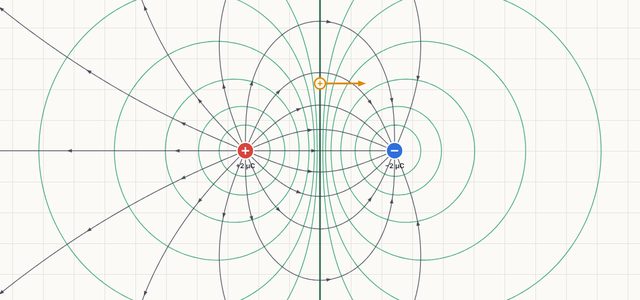
Open the Electric Field Explorer simulation and test every idea on this page yourself.
Open the simulation →