The big idea
A force can make something turn as well as move. How much it turns depends on the size of the force and where it is applied. Torque, τ = r⊥F, captures both. An object in static equilibrium needs no net force and no net torque.
Key ideas
- Torque = force × lever arm, where the lever arm is the perpendicular distance from the pivot to the line of the force.
- Choose a sign convention, for example counter-clockwise = +.
- For equilibrium: ΣF = 0 and Στ = 0, about any point. Choose the pivot where an unknown force acts, and it drops out.
- Rotational version of Newton's 2nd law: α = Στ / I.
- Rotational inertia I = Σmr² depends on how the mass is spread out: mass far from the axis is harder to spin up.
Equations
| τ = rF sin θ = r⊥F | torque |
| Στ = 0, ΣF = 0 | static equilibrium |
| α = Στ / I | rotational 2nd law |
| I = Σmiri² | rotational inertia |
Worked example
A 30 kg child sits 1.5 m to the left of a seesaw's pivot. Where should a 45 kg child sit to balance it?
- For balance, the clockwise and counter-clockwise torques must be equal.
- Left child: τ = (30)(9.8)(1.5). Right child: τ = (45)(9.8)(x).
- Set them equal: 30 × 1.5 = 45x, so x = 1.0 m to the right of the pivot.
- The heavier child sits closer in, so that m₁r₁ = m₂r₂.
Common mistakes
- Using the distance along the beam when the force is at an angle. Use r sin θ.
- Forgetting the beam's own weight, which acts at its centre of mass.
- Choosing a pivot that leaves two unknowns in the torque equation, when a better choice would remove one.
Try it yourself
You pull on a 0.25 m wrench with 80 N at 60° to the handle. What torque do you apply?
Show the answer
τ = rF sin θ = (0.25)(80)(sin 60°) ≈ 17 N·m.
Going deeper: AP Physics 1
Exam-level reasoning in algebra: answers in symbols, "what happens if it doubles?" questions, multi-step problems and the conceptual traps the AP Physics 1 exam likes to set.
Lever arm and angle
τ = rF sin θ = r⊥F. Only the part of the force perpendicular to the lever arm turns the object. A force aimed at the pivot gives zero torque however large it is. That's why door handles sit far from the hinges, and why pushing at an angle is less effective.
Equilibrium strategy
Static equilibrium needs both ΣF = 0 and Στ = 0. You may put the pivot anywhere, so put it where an unknown force acts: that force then drops out of the torque equation. The weight of a uniform beam acts at its centre.
Centre of mass and tipping
An object is stable when its centre of mass lies above its base of support. It tips once the centre of mass moves past the edge, because gravity then produces a torque that turns it further. For point masses, xcm = Σmx/Σm.
More worked examples
Example 1. A uniform 4.0 m, 20 kg plank rests on supports at both ends. A 60 kg person stands 1.0 m from the left end. Find the force from each support.
- Pivot at the left support so that its force has no torque.
- Στ = 0: R(4.0) = (20)(9.8)(2.0) + (60)(9.8)(1.0) → R = 245 N.
- ΣF = 0: L = (80)(9.8) − 245 = 539 N.
- The support nearer the person carries more, as expected.
Example 2. A 30 kg child sits 1.5 m from a seesaw's pivot. Where must a 45 kg child sit to balance?
- Equal torques: (30)(1.5) = (45)d.
- d = 1.0 m from the pivot, on the other side. The heavier child sits closer.
Exam-style practice
1. An 80 N force is applied to the end of a 0.25 m wrench, first at 90° and then at 30° to the handle. Compare the torques.
Show the solution
20 N·m vs 20 sin 30° = 10 N·m.
2. A 2.0 kg mass sits at x = 0 and a 3.0 kg mass at x = 1.0 m. Where is the centre of mass?
Show the solution
xcm = (3.0 × 1.0)/5.0 = 0.60 m.
3. Why is a racing car built low and wide?
Show the solution
A low centre of mass over a wide base means it must tilt a long way before the centre of mass passes the wheels, so it is hard to tip.
Going deeper: AP Physics C
This part goes beyond the algebra course: calculus derivations, harder multi-step problems and exam-style practice, written at the level of the AP Physics C exam.
Rotational kinematics
Rotation has its own "big five", with θ, ω and α in place of x, v and a: ω = ω₀ + αt, θ = ω₀t + ½αt², ω² = ω₀² + 2αθ. Linear and angular quantities are linked by s = rθ, v = rω and at = rα, with θ in radians.
Rotational inertia by integration
For a continuous body, I = ∫r² dm. For a uniform rod about one end, dm = (M/L)dx, so I = ∫₀ᴸ (M/L)x² dx = ML²/3. The parallel-axis theorem shifts I from an axis through the centre of mass to any parallel axis a distance d away:
I = Icm + Md²Useful results: hoop MR², disk ½MR², solid sphere ⅖MR², rod about its centre ML²/12, rod about one end ML²/3.
Static equilibrium problems
Write ΣFx = 0, ΣFy = 0 and Στ = 0. Choose the pivot point to eliminate the unknown you care least about, such as a hinge force you aren't asked for.
More worked examples
Example 1. A 5.0 kg block hangs from a rope wrapped around a solid-disk pulley (M = 4.0 kg, R = 0.20 m). Find the block's acceleration and the rope tension.
- Block: mg − T = ma. Pulley: TR = Iα = (½MR²)(a/R), which gives T = ½Ma.
- Combine: mg = (m + ½M)a → a = (5.0 × 9.8)/(5.0 + 2.0) = 7.0 m/s².
- T = ½(4.0)(7.0) = 14 N. Without the pulley's inertia, a would be g and T would be 0.
Example 2. A uniform 20 kg ladder rests against a frictionless wall at 60° to the floor. Find the minimum coefficient of static friction at the floor.
- Forces: weight at the midpoint, the wall's normal force Nw (horizontal), and from the floor Nf (up) and friction f (toward the wall).
- Torques about the base: NwL sin 60° = mg(L/2)cos 60° → Nw = (196)(0.5)/(2 × 0.866) = 56.6 N.
- Horizontal: f = Nw = 56.6 N. Vertical: Nf = mg = 196 N.
- μs ≥ f/Nf = 56.6/196 = 0.29. The length cancels.
Example 3. Use integration to find I for a uniform rod of mass M and length L about an axis through one end. Then confirm it with the parallel-axis theorem.
- dm = (M/L)dx, so I = ∫₀ᴸ x²(M/L)dx = (M/L)(L³/3) = ML²/3.
- Parallel axis: I = ML²/12 + M(L/2)² = ML²/12 + 3ML²/12 = ML²/3 ✓
Exam-style practice
1. A wheel speeds up from rest to 30 rad/s in 6.0 s at constant α. How many revolutions does it make?
Show the solution
α = 5 rad/s²; θ = ½(5)(36) = 90 rad = 14.3 rev.
2. Find I for a 2 kg, 1 m rod about an axis 0.25 m from its centre.
Show the solution
I = (2)(1)²/12 + 2(0.25)² = 0.167 + 0.125 = 0.29 kg·m².
3. A 4 m, 10 kg beam is held horizontally by a hinge at the wall and a vertical cable at its far end. Find the cable tension.
Show the solution
Torques about the hinge: T(4) = 98(2), so T = 49 N.
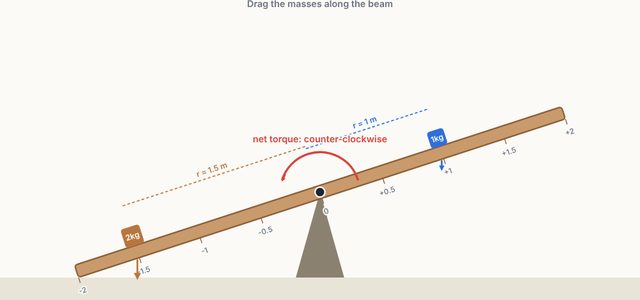
Open the Torque & Balance simulation and test every idea on this page yourself.
Open the simulation →