The big idea
Momentum p = mv measures how hard something is to stop. When objects interact only with each other, the forces between them are equal and opposite (Newton's 3rd law), so the total momentum of the system stays constant. This holds for every collision: bouncy, sticky or explosive.
Key ideas
- Impulse J = FΔt = Δp. A longer impact time means a smaller force, which is why airbags and bending your knees help.
- With no external net force, Σpbefore = Σpafter. Momentum is a vector, so watch the signs.
- Elastic collisions also conserve kinetic energy. Inelastic ones don't. Perfectly inelastic objects stick together and lose the most KE.
- The centre of mass of an isolated system moves at constant velocity, whatever happens inside it.
- The area under a force–time graph equals the impulse.
Equations
| p = mv | momentum |
| J = FavgΔt = Δp | impulse–momentum theorem |
| m₁v₁ + m₂v₂ = m₁v₁′ + m₂v₂′ | conservation of momentum |
| v′ = (m₁v₁ + m₂v₂)/(m₁ + m₂) | perfectly inelastic |
| vcm = Σmivi / Σmi | centre-of-mass velocity |
Worked example
A 2.0 kg cart moving at 3.0 m/s hits a 1.0 kg cart at rest, and they stick together. Find their final speed and the kinetic energy lost.
- Momentum before: (2.0)(3.0) + (1.0)(0) = 6.0 kg·m/s.
- After (stuck together): (3.0)v′ = 6.0 → v′ = 2.0 m/s.
- KE before = ½(2.0)(3.0)² = 9.0 J. KE after = ½(3.0)(2.0)² = 6.0 J.
- Lost: 3.0 J (a third), which became heat, sound and deformation.
Common mistakes
- Assuming kinetic energy is conserved in every collision.
- Forgetting the minus sign for an object moving the opposite way.
- Using conservation of momentum when there is a large external force, like friction during a long skid.
Try it yourself
A 0.15 kg ball arrives at 40 m/s and leaves the bat at 50 m/s in the opposite direction. The contact lasts 1.2 ms. Find the impulse and the average force.
Show the answer
J = mΔv = 0.15(50 − (−40)) = 13.5 N·s; F = J/Δt = 13.5/0.0012 ≈ 1.1 × 10⁴ N.
Going deeper: AP Physics 1
Exam-level reasoning in algebra: answers in symbols, "what happens if it doubles?" questions, multi-step problems and the conceptual traps the AP Physics 1 exam likes to set.
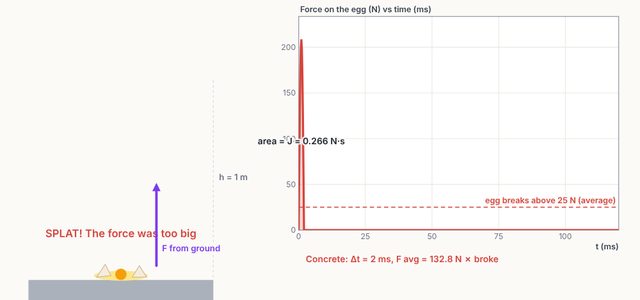 Simulation for this sectionImpulse & the Egg DropOpen it →
Same impulse, different force
Stopping an object always takes the same impulse, J = Δp. What you control is the time. Stretch the time and the force drops (F = Δp/Δt). That's the physics of airbags, crumple zones, bending your knees on landing, and catching an egg gently.
When is momentum conserved?
Momentum is conserved for a system when the net external force on it is zero, or negligible during a brief collision. The momentum of one ball alone is not conserved, but the two-ball system's momentum is. Kinetic energy is conserved only in elastic collisions. In a "sticky" (perfectly inelastic) collision, the largest possible share of KE is lost.
Bouncing gives a bigger impulse
An object that bounces back reverses its momentum, so Δp is larger than for one that just stops. A rubber bullet that bounces off a target delivers more impulse than a sticky one of the same mass and speed.
More worked examples
Example 1. A 0.15 kg ball arrives at 30 m/s. Compare the average force needed to stop it in 0.050 s (a soft catch) with the force to stop it in 0.0050 s (a rigid catch).
- J = Δp = 0.15 × 30 = 4.5 N·s in both cases.
- Soft: F = 4.5/0.050 = 90 N. Rigid: F = 4.5/0.0050 = 900 N.
- Ten times the stopping time means one-tenth of the force.
Example 2. A 1200 kg car moving at 20 m/s rear-ends an 1800 kg car moving at 10 m/s in the same direction, and they lock together. Find their common speed and the kinetic energy lost.
- p before = 1200(20) + 1800(10) = 42 000 kg·m/s.
- v = 42 000/3000 = 14 m/s.
- KE before = 240 000 + 90 000 = 330 000 J. KE after = ½(3000)(14)² = 294 000 J.
- Lost: 36 000 J (11%), which goes into crumpling metal, sound and heat.
Example 3. A 0.50 kg ball hits a wall at 6.0 m/s and rebounds at 4.0 m/s. Contact lasts 0.020 s. Find the average force from the wall.
- Take toward the wall as positive: Δp = 0.50(−4.0) − 0.50(6.0) = −5.0 N·s.
- F = Δp/Δt = 250 N, directed away from the wall.
- Had it stuck, Δp would only be 3.0 N·s.
Exam-style practice
1. A 60 kg skater at rest throws a 2.0 kg ball forward at 15 m/s. What is her recoil speed?
Show the solution
0 = 2.0(15) + 60v → v = −0.50 m/s (backward).
2. A moving ball hits an identical ball at rest head-on in an elastic collision. What happens?
Show the solution
They swap velocities: the first stops and the second moves off at the original speed.
3. Why don't we conserve momentum for a ball falling toward Earth alone?
Show the solution
Gravity is an external force on the ball, so its momentum grows. Include Earth in the system and the total is conserved.
Going deeper: AP Physics C
This part goes beyond the algebra course: calculus derivations, harder multi-step problems and exam-style practice, written at the level of the AP Physics C exam.
Impulse from a varying force
Real collision forces rise and fall. The impulse is the integral J = ∫F dt, which is the area under the F–t graph. Dividing by the contact time gives the average force.
Centre of mass
For point masses xcm = Σmixi/Σmi. For a continuous object with linear density λ(x), integrate:
M = ∫λ dx xcm = ∫x λ dxMNewton's 2nd law for a system is ΣFext = M acm. Internal forces, like a person walking on a boat or an explosion, cannot move the centre of mass.
Collisions in two dimensions
Momentum is a vector, so conserve the x and y components separately. In an elastic collision between equal masses where one starts at rest, the two objects always leave at 90° to each other.
More worked examples
Example 1. Ballistic pendulum: a 10 g bullet at 400 m/s embeds in a 2.0 kg block hanging on a string. How high does the block swing?
- Collision (momentum conserved, KE is not): (0.010)(400) = (2.01)V → V = 1.99 m/s.
- Swing (energy conserved): ½V² = gh → h = 1.99²/(2 × 9.8) = 0.20 m.
- You cannot use energy conservation through the collision itself, because over 99% of the bullet's KE becomes heat.
Example 2. A 2.0 m rod has linear density λ = (2 + 3x) kg/m, with x measured from one end. Find its mass and centre of mass.
- M = ∫₀²(2 + 3x)dx = [2x + 1.5x²]₀² = 4 + 6 = 10 kg.
- ∫xλ dx = ∫₀²(2x + 3x²)dx = [x² + x³]₀² = 4 + 8 = 12 kg·m.
- xcm = 12/10 = 1.2 m from the light end, past the midpoint because the rod is heavier toward x = 2.
Example 3. A 60 kg person walks 4.0 m from one end of a 140 kg boat to the other (no water friction). How far does the boat move?
- No external horizontal force, so the centre of mass stays put.
- The person moves 4.0 − d relative to the water, and the boat moves d the opposite way: 60(4.0 − d) = 140d.
- d = 240/200 = 1.2 m, opposite to the walk.
Exam-style practice
1. A force on a 0.15 kg ball rises linearly from 0 to 600 N and back to 0 over 0.020 s. Find the ball's speed if it started at rest.
Show the solution
J = ½(600)(0.020) = 6.0 N·s; v = 6.0/0.15 = 40 m/s.
2. A 3 kg object at 4 m/s (east) collides elastically with a 1 kg object at rest. Find both final velocities.
Show the solution
v₁′ = (3 − 1)/(4)·4 = 2 m/s; v₂′ = 2(3)/4·4 = 6 m/s, both east.
3. A stationary 5 kg shell explodes into 2 kg (moving at 9 m/s east) and 3 kg pieces. Find the velocity of the 3 kg piece.
Show the solution
0 = 2(9) + 3v → v = −6 m/s (6 m/s west).
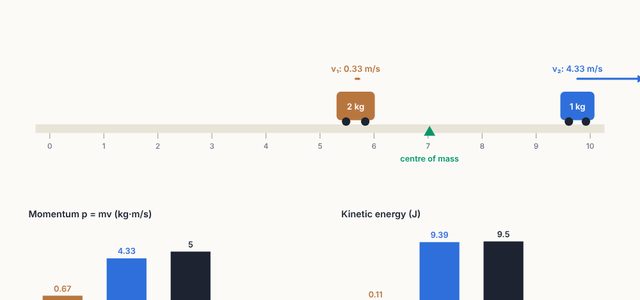
Open the Collisions & Momentum simulation and test every idea on this page yourself.
Open the simulation →