The big idea
Energy methods often solve in one line what forces would take a page to do. Instead of tracking forces moment by moment, compare a system's energy before and after. If no outside work is done and there is no friction, the mechanical energy K + U stays constant.
Key ideas
- Work W = Fd cos θ transfers energy. Only the force component along the motion does work.
- Work–energy theorem: the net work on an object equals its change in kinetic energy.
- With only conservative forces (gravity, springs), K + U = constant.
- Friction converts mechanical energy into thermal energy. The total energy is still conserved.
- Power is the rate of energy transfer: P = ΔE/Δt = Fv.
Equations
| K = ½mv² | kinetic energy |
| Ug = mgh | gravitational PE near Earth |
| Us = ½kx² | spring PE |
| W = Fd cos θ | work by a constant force |
| Ki + Ui + Wother = Kf + Uf | energy conservation |
| P = ΔE/Δt = Fv | power |
Worked example
A 60 kg skier starts from rest at the top of a 20 m high slope. (a) How fast is she going at the bottom if the slope is frictionless? (b) What if friction does −3000 J of work?
- Initial energy: U = mgh = (60)(9.8)(20) = 11 760 J, and K = 0.
- (a) All of it becomes kinetic energy: ½mv² = 11 760 → v = √(2gh) = 19.8 m/s. The mass cancels.
- (b) K = 11 760 − 3000 = 8760 J → v = √(2 × 8760 / 60) = 17.1 m/s.
- The missing 3000 J became thermal energy in the snow and skis.
Common mistakes
- Counting work done by gravity and including Ug in the same equation. That counts gravity twice.
- Thinking the normal force does work on an object sliding along a surface. It's perpendicular to the motion.
- Assuming the shape of the path matters. Without friction, only the height change matters.
Try it yourself
A spring (k = 400 N/m) compressed by 0.10 m launches a 0.20 kg block along a frictionless floor. How fast does the block go?
Show the answer
½kx² = ½(400)(0.10)² = 2.0 J = ½mv², so v = √(2 × 2.0 / 0.20) ≈ 4.5 m/s.
Going deeper: AP Physics 1
Exam-level reasoning in algebra: answers in symbols, "what happens if it doubles?" questions, multi-step problems and the conceptual traps the AP Physics 1 exam likes to set.
Choose your system
The AP 1 exam cares about which objects you include. If the system is the object plus Earth, gravity is internal and its effect shows up as potential energy. If the system is the object alone, gravity is an external force that does work, and there is no U. Both give the same answer, but don't count gravity twice.
Energy bar charts
Draw bars for K, Ug, Us and thermal energy at the start and end. Draw Wext in the middle for energy entering or leaving the system. The bars must balance: K₁ + U₁ + Wext = K₂ + U₂ + ΔEth, with ΔEth = fkd for sliding friction.
Proportional reasoning with energy
KE ∝ v², so doubling a car's speed quadruples its stopping distance (the same friction force must remove 4× the energy). For a spring, U ∝ x², so doubling the compression stores 4× the energy and launches a ball 4× as high.
More worked examples
Example 1. A box slides from rest down a frictionless ramp of height h, then across a rough floor with coefficient μk until it stops. Find (a) its speed at the bottom of the ramp and (b) the distance d it slides on the floor, both in terms of the given quantities. Then evaluate for h = 2.0 m and μk = 0.25.
- (a) Box–Earth system, no friction on the ramp: mgh = ½mv² → v = √(2gh) = √(39.2) = 6.3 m/s.
- (b) On the floor, all the kinetic energy becomes thermal: mgh = μkmg·d.
- d = h/μk = 2.0/0.25 = 8.0 m. Mass and g cancel, so this is a good result to check with units.
Example 2. A toy launcher has a spring with k = 400 N/m. It is compressed 0.10 m and fires a 50 g ball straight up. How high does the ball rise? What if the compression is doubled?
- ½kx² = mgh → h = kx²/(2mg) = (400)(0.010)/(2 × 0.050 × 9.8) = 4.1 m.
- h ∝ x², so doubling the compression gives 4 × the height, about 16 m.
Example 3. A 70 kg student runs up a 4.0 m flight of stairs in 5.0 s. What is her average power output?
- Work against gravity: mgh = 70 × 9.8 × 4.0 = 2744 J.
- P = W/t = 2744/5.0 ≈ 550 W, about ¾ of a horsepower.
Exam-style practice
1. A car's speed doubles. With the same braking force, how does its stopping distance change?
Show the solution
KE ∝ v², so it becomes 4 times longer.
2. A pendulum bob is released 0.45 m above its lowest point. How fast does it go at the bottom?
Show the solution
v = √(2gh) = √(8.82) ≈ 3.0 m/s. Its mass doesn't matter.
3. A 2.0 kg block slides 3.0 m across a floor against a 6.0 N friction force. How much thermal energy is produced?
Show the solution
ΔEth = fkd = 18 J.
Going deeper: AP Physics C
This part goes beyond the algebra course: calculus derivations, harder multi-step problems and exam-style practice, written at the level of the AP Physics C exam.
Work done by a variable force
When the force changes along the path, add up small pieces of work: W = ∫F·dr. In one dimension this is the area under the F–x graph. For a spring, F = −kx, so the work done by the spring from x₁ to x₂ is ½kx₁² − ½kx₂².
W = ∫x₁x₂ F(x) dxConservative forces and potential energy
A force is conservative if the work it does depends only on the start and end points, not on the path. For such forces we define ΔU = −W, or U(x) = −∫F dx, and F = −dU/dx. Gravity and springs are conservative. Friction is not, so its work must appear separately in the energy equation.
Power
Power is the rate of doing work: P = dW/dt = F·v. A car climbing a hill at constant speed needs a power equal to the rate at which it gains potential energy, plus whatever is lost to friction and drag.
More worked examples
Example 1. A force F(x) = (6 − 2x) N acts on a 0.50 kg object as it moves from x = 0 to 3 m, starting from rest. How much work does the force do, and what is the final speed?
- W = ∫₀³(6 − 2x)dx = [6x − x²]₀³ = 18 − 9 = 9 J.
- Work–energy: ½mv² = 9 J → v = √(2 × 9/0.5) = 6.0 m/s.
- This is the triangle under the F–x graph: ½(3)(6) = 9 ✓
Example 2. A 1200 kg car climbs a 5° slope at a steady 20 m/s. Ignoring friction and drag, what power does the engine deliver?
- Constant speed, so the engine force equals the component of gravity along the slope: F = mg sin 5°.
- P = Fv = (1200)(9.8)(sin 5°)(20).
- P ≈ 2.0 × 10⁴ W (20 kW, about 27 hp).
Example 3. A 2.0 kg block is pushed 0.15 m into a spring (k = 800 N/m) and released on a rough floor (μk = 0.30). How far does it slide after leaving the spring?
- Spring energy: ½(800)(0.15)² = 9.0 J.
- Friction acts over the whole path, including the 0.15 m while the spring pushes: f = 0.30 × 2.0 × 9.8 = 5.88 N.
- Total distance before stopping: d = 9.0/5.88 = 1.53 m.
- After leaving the spring: 1.53 − 0.15 = 1.38 m.
Exam-style practice
1. How much work is needed to stretch a spring (k = 200 N/m) from 0.10 m to 0.20 m beyond its natural length?
Show the solution
W = ½k(0.2² − 0.1²) = 100(0.03) = 3.0 J.
2. A force F = 3x² N acts from x = 0 to 2 m. Find the work done.
Show the solution
W = [x³]₀² = 8 J.
3. An elevator motor lifts 800 kg at 2.0 m/s. What is the minimum power?
Show the solution
P = mgv = 800 × 9.8 × 2 ≈ 15.7 kW.
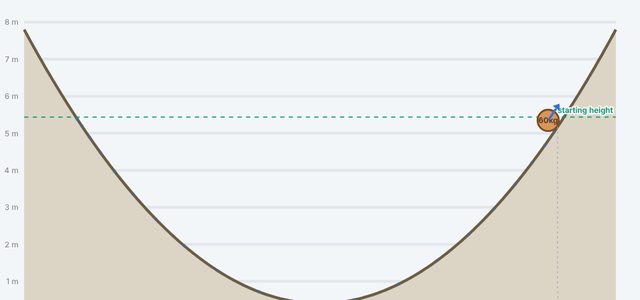
Open the Energy Skate Track simulation and test every idea on this page yourself.
Open the simulation →