The big idea
Even at constant speed, an object moving in a circle is accelerating, because its direction keeps changing. That centripetal acceleration points toward the centre, so the net force must point there too. "Centripetal force" is not a new force: it is whichever real forces add up to point inward.
Key ideas
- Centripetal acceleration: ac = v²/r, always directed toward the centre.
- Find which real force (tension, friction, gravity or normal) supplies the inward net force, then set ΣFin = mv²/r.
- Doubling the speed needs four times the force, because F ∝ v².
- If the force disappears, the object moves off in a straight line along the tangent, not outward.
- At the top of a vertical loop, gravity and the normal force both point down, toward the centre. The minimum speed there is v = √(gr).
Equations
| ac = v² / r | centripetal acceleration |
| ΣFin = mv² / r | Newton's 2nd law, radially |
| T = 2πr / v | period |
| v = rω | speed and angular speed |
Worked example
A 1200 kg car rounds a flat curve of radius 50 m at 15 m/s. (a) What net force is needed? (b) What is the minimum coefficient of static friction?
- ac = v²/r = 15²/50 = 4.5 m/s².
- Fnet = mac = (1200)(4.5) = 5400 N, toward the centre. Static friction between the tyres and the road supplies it.
- The maximum friction is μsmg, so μsmg ≥ mv²/r → μs ≥ v²/(rg) = 225/(50 × 9.8) = 0.46.
Common mistakes
- Drawing an outward "centrifugal force" on the free-body diagram.
- Thinking constant speed means no acceleration. The direction is changing.
- Forgetting that F ∝ v²: double the speed and you need four times the force.
Try it yourself
What is the minimum speed at the top of a vertical loop of radius 4.0 m?
Show the answer
At the minimum, N = 0 and gravity alone provides the centripetal force: mg = mv²/r, so v = √(gr) = √(9.8 × 4.0) ≈ 6.3 m/s.
Going deeper: AP Physics 1
Exam-level reasoning in algebra: answers in symbols, "what happens if it doubles?" questions, multi-step problems and the conceptual traps the AP Physics 1 exam likes to set.
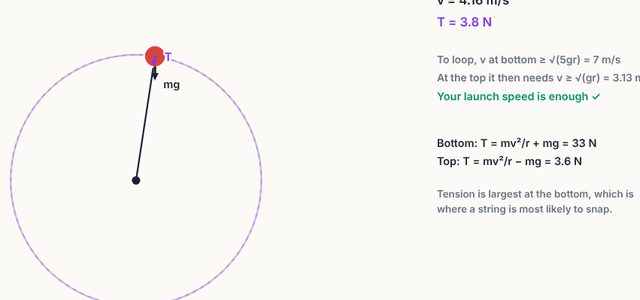 Simulation for this sectionVertical Circles & CurvesOpen it →
Centripetal force is a job, not a force
"Centripetal force" never appears on a free-body diagram. Instead, ask which real force (tension, gravity, normal force, friction) points toward the centre. Its net inward part must equal mv²/r. For a car on a flat curve that force is static friction. For the Moon it is gravity.
Vertical circles and apparent weight
At the bottom of a dip, the normal force must exceed the weight (N = mg + mv²/r), so riders feel heavier. At the top of a hill, N = mg − mv²/r, so they feel lighter. At v = √(gr) the normal force is zero and the car is about to leave the track.
More worked examples
Example 1. A 500 kg roller-coaster car moves at 15 m/s through the bottom of a dip with radius 20 m. Find the normal force and how many "g's" the riders feel. What is the fastest it can crest a hill of the same radius without leaving the track?
- Bottom: N − mg = mv²/r → N = 500(9.8 + 225/20) = 1.05 × 10⁴ N.
- Riders feel N/mg = 21.05/9.8 ≈ 2.1 g.
- Top of the hill: N = 0 at the limit, so mg = mv²/r → v = √(gr) = √(196) = 14 m/s.
Example 2. What is the top speed of a car on a flat curve of radius 50 m if μs = 0.80? Does a heavier car have a higher limit?
- Friction provides the centripetal force: μsmg = mv²/r.
- The mass cancels: v = √(μsgr) = √(0.80 × 9.8 × 50) = 19.8 m/s (about 71 km/h).
- No: a heavier car needs more friction but gets proportionally more, so the limit is the same.
Exam-style practice
1. A car rounds a curve at twice its previous speed. By what factor must the friction force increase?
Show the solution
F ∝ v², so by a factor of 4.
2. What is the minimum speed at the top of a vertical circle of radius 1.0 m to keep the water in a swung bucket?
Show the solution
v = √(gr) = √9.8 ≈ 3.1 m/s.
3. A ball on a string moves in a horizontal circle. The string breaks. Which way does the ball go?
Show the solution
Along the tangent, in the direction of its velocity at that moment, not outward.
Going deeper: AP Physics C
This part goes beyond the algebra course: calculus derivations, harder multi-step problems and exam-style practice, written at the level of the AP Physics C exam.
Non-uniform circular motion
If the speed changes as well, the acceleration has two perpendicular parts: the radial (centripetal) part v²/r, which changes the direction, and the tangential part dv/dt, which changes the speed. The total is a = √(ac² + at²).
Vertical circles
On a string or in a loop, the forces that point toward the centre change around the circle. At the top, T + mg = mv²/r. At the bottom, T − mg = mv²/r. Combine this with energy conservation (vbottom² = vtop² + 4gr) to connect the two points. The minimum speed to complete the loop is vtop = √(gr).
More worked examples
Example 1. A 0.50 kg ball swings in a vertical circle of radius 0.80 m on a string. At the top its speed is 4.0 m/s. Find the tension at the top, its speed at the bottom, and the tension at the bottom.
- Top: T + mg = mv²/r → T = 0.5(16/0.8) − 0.5(9.8) = 10 − 4.9 = 5.1 N.
- Energy: vb² = 16 + 4(9.8)(0.8) = 47.4 → vb = 6.9 m/s.
- Bottom: T − mg = mv²/r → T = 0.5(47.4/0.8) + 4.9 = 34.5 N.
Example 2. A car speeds up uniformly from 10 m/s to 20 m/s in 5.0 s around a curve of radius 100 m. Find the magnitude of its acceleration when v = 15 m/s.
- at = Δv/Δt = 10/5 = 2.0 m/s².
- ac = v²/r = 225/100 = 2.25 m/s².
- a = √(2.0² + 2.25²) = 3.0 m/s².
Exam-style practice
1. A conical pendulum: a 1.0 m string makes 30° with the vertical. Find the speed of the bob.
Show the solution
r = L sin θ = 0.5 m; tan θ = v²/(rg), so v = √(0.5 × 9.8 × tan 30°) ≈ 1.7 m/s.
2. What is the minimum speed at the top of a 10 m radius loop?
Show the solution
v = √(gr) = √98 ≈ 9.9 m/s.
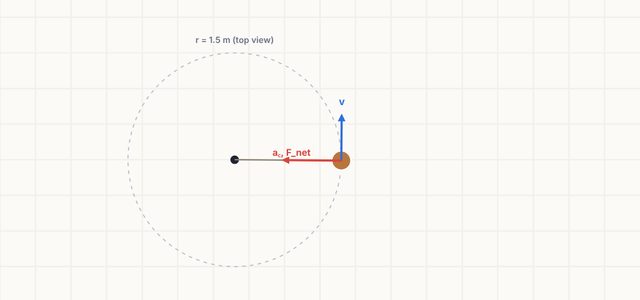
Open the Circular Motion simulation and test every idea on this page yourself.
Open the simulation →