The big idea
Newton's second law, ΣF = ma, is the engine of mechanics. Almost every dynamics problem follows the same recipe: draw a free-body diagram, choose axes (tilted along the slope for inclines), write ΣF = ma for each axis, and solve.
Key ideas
- Draw only forces that act on the object, each one with a cause: gravity, normal, tension, friction or an applied push.
- On an incline, split the weight into mg sin θ (along the slope) and mg cos θ (into the slope).
- With no acceleration perpendicular to the surface, N = mg cos θ (plus or minus any other perpendicular forces).
- Static friction adjusts itself up to a maximum of μsN. Kinetic friction is exactly μkN and opposes the sliding.
- Newton's third law: forces come in equal and opposite pairs acting on different objects. They never cancel on a single FBD.
Equations
| ΣF = ma | Newton's second law (per axis) |
| Fg = mg | weight |
| fs ≤ μsN | static friction (up to a max) |
| fk = μkN | kinetic friction |
| a = g(sin θ − μkcos θ) | block sliding down an incline |
Worked example
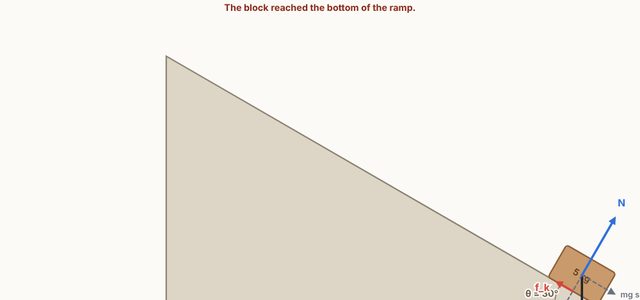
A 5.0 kg block slides down a 30° incline with μk = 0.20. Find the normal force, the friction force and the acceleration.
- Perpendicular to the slope: N = mg cos 30° = (5.0)(9.8)(0.866) = 42.4 N.
- Kinetic friction: f = μkN = (0.20)(42.4) = 8.5 N, pointing up the slope.
- Along the slope: mg sin 30° = (5.0)(9.8)(0.5) = 24.5 N, pointing down.
- ΣF = ma → 24.5 − 8.5 = 5.0a → a = 3.2 m/s² down the slope.
Common mistakes
- Writing N = mg on an incline. It's mg cos θ.
- Using μsN as the friction force when the object isn't about to slip. Static friction is only as big as it needs to be.
- Adding "the force of motion" or "ma" to the free-body diagram. ma is the result, not a force.
Try it yourself
A block rests on a ramp with μs = 0.60. At what angle does it just start to slide?
Show the answer
It slips when mg sin θ = μsmg cos θ, so tan θ = 0.60 and θ ≈ 31°. The mass doesn't matter.
Going deeper: AP Physics 1
Exam-level reasoning in algebra: answers in symbols, "what happens if it doubles?" questions, multi-step problems and the conceptual traps the AP Physics 1 exam likes to set.
 Simulation for this sectionPulleys, Connected Objects & ElevatorsOpen it →
Third-law pairs vs. balanced forces
A Newton's-3rd-law pair acts on two different objects and is always the same type of force (the floor pushes you, you push the floor). Your weight and the normal force on you are both on you, so they are not a 3rd-law pair. They are only equal when your acceleration is zero.
Static friction is "as much as needed"
fs ≤ μsN is a limit, not a formula for the friction force. A box at rest on a slope feels exactly f = mg sin θ, until that would exceed μsmg cos θ. So a box stays put whenever tan θ ≤ μs.
Systems: outside first, then inside
For objects that move together, first treat them as one system: the forces between them are internal and cancel, giving a = Fext/mtotal. Then isolate one object to find the force between them.
More worked examples
Example 1. A 20 N horizontal push acts on a 3.0 kg block, which pushes a 2.0 kg block ahead of it across a frictionless floor. Find the acceleration and the force between the blocks. What changes if you push the 2.0 kg block instead?
- System: a = 20/(3.0 + 2.0) = 4.0 m/s².
- The front (2.0 kg) block is pushed only by the contact force: F = 2.0 × 4.0 = 8.0 N.
- Push from the other side and the contact force must accelerate the 3.0 kg block: 3.0 × 4.0 = 12 N. The acceleration is the same.
Example 2. A block on a 30° incline has μk = 0.30. (a) Find its acceleration sliding down. (b) If instead it is launched up the slope at 6.0 m/s, how far does it go?
- Down: friction acts up the slope. a = g(sin 30° − 0.30 cos 30°) = 9.8(0.500 − 0.260) = 2.4 m/s².
- Up: gravity and friction both act down the slope. a = g(0.500 + 0.260) = 7.4 m/s².
- d = v₀²/(2a) = 36/14.9 = 2.4 m.
- The two accelerations differ because friction always opposes the motion.
Exam-style practice
1. An 800 N person stands on a scale in an elevator accelerating upward at 2.5 m/s². What does the scale read?
Show the solution
N = m(g + a) = (800/9.8)(12.3) ≈ 1000 N.
2. A box rests on a 25° ramp with μs = 0.60. Does it slide? If not, how big is the friction force compared with its weight?
Show the solution
tan 25° = 0.47 < 0.60, so it stays put. f = mg sin 25° ≈ 0.42 mg, not μsN.
3. A horse pulls a cart. By the 3rd law the cart pulls back on the horse equally. So how does anything move?
Show the solution
The two forces act on different objects. The horse accelerates because the ground pushes it forward harder than the cart pulls back.
Going deeper: AP Physics C
This part goes beyond the algebra course: calculus derivations, harder multi-step problems and exam-style practice, written at the level of the AP Physics C exam.
Systems of connected objects
For blocks joined by strings over pulleys, draw a free-body diagram for each object, choose a positive direction that follows the motion around the pulley, and write ΣF = ma for each one. An ideal string (massless) over an ideal pulley (massless, frictionless) has the same tension throughout, and the connected objects share the same magnitude of acceleration. Adding the equations makes the tension cancel.
Atwood machine
Two masses hang over a pulley. Treating the pair as one system, the net driving force is (m₂ − m₁)g, which accelerates the total mass:
a = (m₂ − m₁)gm₁ + m₂ T = 2m₁m₂gm₁ + m₂Banked curves and apparent weight
On a frictionless banked curve, the horizontal component of the normal force supplies the centripetal force: N sin θ = mv²/r and N cos θ = mg, so tan θ = v²/(rg). In an accelerating elevator, the scale reading (the normal force) is N = m(g + a), with a positive upward.
More worked examples
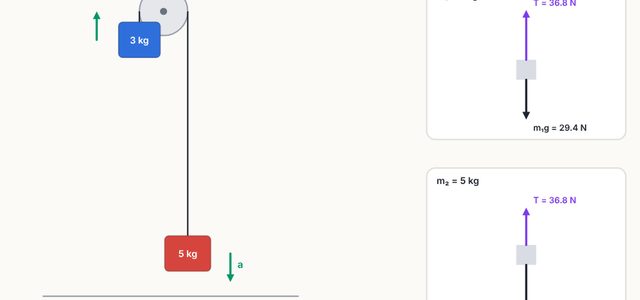
Example 1. An Atwood machine has m₁ = 3.0 kg and m₂ = 5.0 kg. Find the acceleration and the string tension.
- a = (m₂ − m₁)g/(m₁ + m₂) = (2.0)(9.8)/8.0 = 2.45 m/s².
- For m₁ (accelerating up): T − m₁g = m₁a → T = 3.0(9.8 + 2.45) = 36.8 N.
- Check with m₂: m₂g − T = 49 − 36.8 = 12.2 = 5.0 × 2.45 ✓
Example 2. A 4.0 kg block on a table (μk = 0.25) is tied by a string over a pulley at the edge to a hanging 2.0 kg block. Find the acceleration and tension.
- Driving force: the weight of the hanging block, 2.0 × 9.8 = 19.6 N.
- Friction on the table block: 0.25 × 4.0 × 9.8 = 9.8 N.
- System: a = (19.6 − 9.8)/(4.0 + 2.0) = 1.63 m/s².
- Hanging block: mg − T = ma → T = 2.0(9.8 − 1.63) = 16.3 N.
Example 3. At what angle should a curve of radius 80 m be banked so that cars at 20 m/s need no friction?
- N cos θ = mg and N sin θ = mv²/r.
- Divide them: tan θ = v²/(rg) = 400/(80 × 9.8) = 0.510.
- θ = 27°. The mass cancels, so every car needs the same angle.
Exam-style practice
1. A 60 kg person stands on a scale in an elevator accelerating downward at 2.0 m/s². What does the scale read?
Show the solution
N = m(g − a) = 60(7.8) = 468 N.
2. A 10 kg crate is pulled with 50 N at 30° above horizontal across a floor with μk = 0.20. Find a.
Show the solution
N = 98 − 50 sin 30° = 73 N; friction = 14.6 N; a = (43.3 − 14.6)/10 ≈ 2.9 m/s².
3. In an Atwood machine, what happens to a and T as m₂ ≫ m₁?
Show the solution
a → g, and T → 2m₁g.
Open the Forces on an Incline simulation and test every idea on this page yourself.
Open the simulation →