The big idea
A projectile is anything moving under gravity alone: a thrown ball, a jumping athlete, water from a hose. The trick is to split the motion into horizontal and vertical parts, which don't affect each other. The only thing they share is time.
Key ideas
- Horizontally there is no force, so vₓ is constant: x = vₓt.
- Vertically there is free fall: ay = −g, so vy changes by 9.8 m/s every second.
- Break the launch velocity into components: vₓ = v₀cos θ and vy0 = v₀sin θ.
- At the top, vy = 0 but vₓ is not zero, so the speed is at its minimum, not zero.
- On level ground, complementary angles (30° and 60°) give the same range, and 45° gives the maximum range.
Equations
| x = v₀cos θ · t | horizontal position |
| y = h + v₀sin θ · t − ½gt² | vertical position |
| vy = v₀sin θ − gt | vertical velocity |
| H = (v₀sin θ)² / 2g | height gained (level launch) |
| R = v₀² sin 2θ / g | range on level ground only |
Worked example
A ball rolls off a 20 m high cliff with a horizontal speed of 8.0 m/s. Find (a) the time in the air, (b) how far from the base of the cliff it lands, and (c) its speed just before landing.
- Vertical motion starts with vy0 = 0: 20 = ½(9.8)t² → t = √(40/9.8) = 2.02 s.
- Horizontal: x = vₓt = (8.0)(2.02) = 16.2 m.
- Just before landing: vy = gt = (9.8)(2.02) = 19.8 m/s (downward), and vₓ = 8.0 m/s.
- Speed = √(8.0² + 19.8²) = 21.4 m/s.
Common mistakes
- Using the speed v₀ in both directions. Always split it into vₓ and vy first.
- Using the range formula R = v₀²sin 2θ/g when the launch and landing heights are different.
- Thinking a heavier projectile falls faster. Without air resistance, mass doesn't appear anywhere.
Try it yourself
A ball is launched at 20 m/s and 30° above level ground. Find the time of flight, the range and the maximum height.
Show the answer
vy0 = 10 m/s, so T = 2(10)/9.8 = 2.04 s; R = (17.3)(2.04) = 35.3 m; H = 10²/19.6 = 5.1 m.
Going deeper: AP Physics 1
Exam-level reasoning in algebra: answers in symbols, "what happens if it doubles?" questions, multi-step problems and the conceptual traps the AP Physics 1 exam likes to set.
Two motions, one clock
Horizontal and vertical motions are independent, and the only thing they share is time. That's why a ball rolled off a table and a ball dropped from the same height land together. Strategy: use the vertical motion to find t, then use t in the horizontal motion.
What changes when you change one thing?
For a launch from level ground, R = v₀² sin 2θ/g, H = v₀² sin²θ/(2g) and T = 2v₀ sin θ/g. So doubling v₀ makes the range and height 4× and the time 2×. Complementary angles (30° and 60°) share a range, but the steeper shot flies higher and longer.
More worked examples
Example 1. A ball rolls off a 1.25 m high table and lands 2.0 m from its base. How fast was it rolling?
- Vertical (vy0 = 0): 1.25 = ½(9.8)t² → t = 0.51 s.
- Horizontal: v₀ = 2.0/0.51 = 4.0 m/s.
Example 2. Two balls are launched from level ground at the same speed v₀, one at 30° and one at 60°. Compare their ranges, maximum heights and flight times.
- Range ∝ sin 2θ: sin 60° = sin 120°, so the ranges are equal.
- Height ∝ sin²θ: (sin 60°/sin 30°)² = 3, so the 60° ball goes 3 times as high.
- Time ∝ sin θ: the 60° ball stays up √3 ≈ 1.7 times as long.
Exam-style practice
1. If a projectile's launch speed doubles (same angle, level ground), what happens to its range?
Show the solution
R ∝ v₀², so it becomes 4 times as large.
2. A ball is thrown horizontally off a cliff. If its throwing speed doubles, what happens to its time of flight and horizontal distance?
Show the solution
The time is unchanged, because it is set by the height alone. The distance doubles.
3. What is the acceleration of a projectile at the top of its path?
Show the solution
g, straight down. Only the vertical velocity is zero there.
Going deeper: AP Physics C
This part goes beyond the algebra course: calculus derivations, harder multi-step problems and exam-style practice, written at the level of the AP Physics C exam.
The trajectory equation
Eliminate t between x = (v₀cos θ)t and y = (v₀sin θ)t − ½gt² to get the shape of the path, which is a parabola:
y = x tan θ − g x²2v₀² cos²θLaunching from a height
When the landing height differs from the launch height, the range formula no longer applies. Solve the vertical equation, which is a quadratic in t, for the time of flight, and take the positive root. Then use x = vₓt. The speed on impact comes from the components, or from energy: ½v² = ½v₀² + gh.
Why 45° maximises range
On level ground R = v₀² sin 2θ/g, and sin 2θ peaks at θ = 45°. Launched from a height, the best angle is slightly less than 45°, because the extra fall time favours more horizontal speed.
More worked examples
Example 1. A ball is thrown at 25 m/s, 37° above the horizontal, from the top of a 20 m cliff. Find the time of flight, the horizontal range and the impact speed.
- vₓ = 25 cos 37° = 20.0 m/s, and vy0 = 25 sin 37° = 15.0 m/s.
- Taking the landing point as y = 0: 0 = 20 + 15.0t − 4.9t² → t = [15.0 + √(15.0² + 4·4.9·20)]/9.8 = 4.07 s.
- Range: x = (20.0)(4.07) = 81 m.
- vy = 15.0 − 9.8(4.07) = −24.9 m/s, so speed = √(20.0² + 24.9²) = 31.9 m/s. Check with energy: √(25² + 2·9.8·20) = 31.9 ✓
Example 2. Show that the maximum height of a projectile is H = v₀²sin²θ/(2g), and find the launch angle at which the range equals the maximum height.
- At the top vy = 0: 0 = (v₀sin θ)² − 2gH → H = v₀²sin²θ/(2g).
- Set R = H: 2v₀²sin θ cos θ/g = v₀²sin²θ/(2g).
- Divide through: 4 cos θ = sin θ → tan θ = 4 → θ ≈ 76°.
Exam-style practice
1. Two balls are launched at the same speed, at 25° and 65°. Which lands farther away (level ground)?
Show the solution
They land at the same place, because sin 50° = sin 130°. The 65° ball stays in the air longer.
2. A package is dropped from a plane flying horizontally at 60 m/s, 180 m up. How far ahead of the drop point does it land?
Show the solution
t = √(2·180/9.8) = 6.06 s, so x = 60 × 6.06 ≈ 364 m.
3. At what point in a projectile's flight is its speed smallest?
Show the solution
At the top, where vy = 0. The speed there equals vₓ, which is not zero.
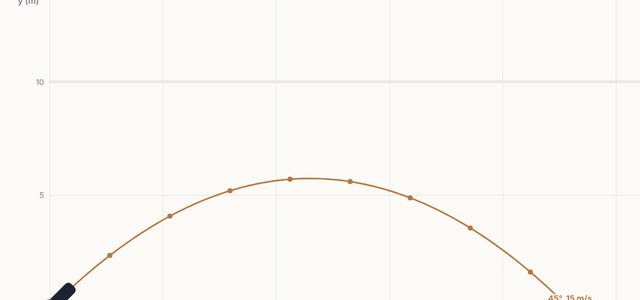
Open the Projectile Motion Lab simulation and test every idea on this page yourself.
Open the simulation →